Agile Planning for Software Products (Coursera)

Offered by University of Alberta,
Agile Planning for Software Products (Coursera)

This course covers the techniques required to break down and map requirements into plans that will ultimately drive software production. Upon successful completion of this course, you will be able to: create effective plans for software development; map user requirements to developer tasks; assess and plan for project risks; apply velocity-driven planning techniques; generate work estimates for software products.

Class Deals by MOOC List - Click here and see Coursera's Active Discounts, Deals, and Promo Codes.

What You Will Learn

  • Create effective plans for software development
  • Map user requirements to developer tasks
  • Assess and plan for project risks
  • Apply velocity-driven planning techniques

Course 4 of 6 in the Software Product Management Specialization.

Syllabus

WEEK 1
Introduction to Planning
Welcome to the first module! In this module, you will be learning some basic principles that you will need for effective planning. You will start this module off with an introduction to planning. You will then learn about how planning, and the approach you take to planning, can reduce uncertainty in your project. We will then move onto learning how to breakdown a project into small, manageable pieces, and how to organize those pieces. Finally, we will go over the differences between estimates, targets, and commitments. Together, these lessons will build a good base for learning planning techniques at both the release and iteration level.

WEEK 2
Project Planning
Welcome to module 2! Now that you’ve gotten your feet wet with general principles in project planning, let’s talk about some specific ways that you can use to implement those techniques. We’ll first discuss the concepts of story points and velocity, then move into how time boxing can be used to improve your project efficiency. We’ll then introduce the Gantt chart, a basic tried and true method of visualizing project tasks. We’ll finish off with techniques for planning your project at a release level, which will set the stage for iteration planning in the next module.

WEEK 3
Iteration Planning
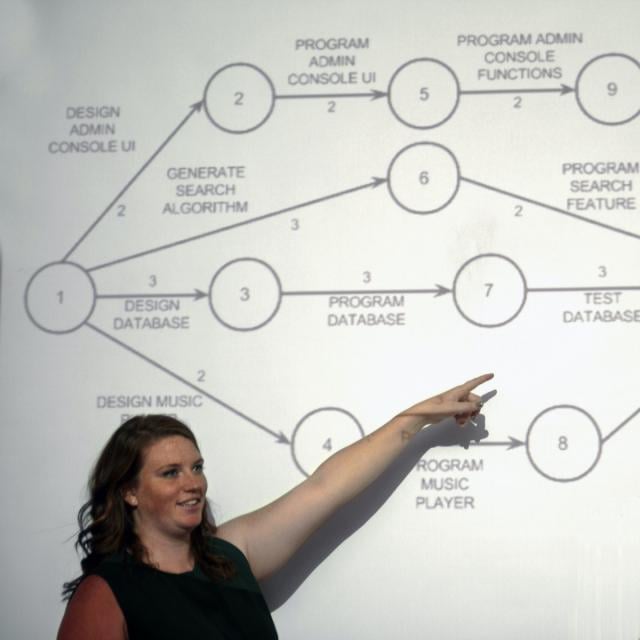
This module will be focusing on planning techniques at the iteration or sprint level. You will start by looking at various techniques for estimating task time. You will then look at task dependencies in more detail. This will come in handy when you learn two visual planning charts--the Critical Path Method chart, and the PERT chart. Finally, you will learn the process for creating an iteration plan. By the end of this module, you will have the tools you need to plan sprints or iterations for development.

WEEK 4
Risk Planning
You’ve made it to the last module, congratulations! Here, we’re going to talk about what can cause projects to fail. We’ll start off by discussing common causes of failures, including anti-patterns. Then, you’ll learn how to assess risks, looking at their likelihood and potential impact on the project. We’ll end on an optimistic note by leaving you with strategies for intervening when risks present themselves and avoiding those risks to begin with.
Go to Class
MOOC List is learner-supported. When you buy through links on our site, we may earn an affiliate commission.

Related Courses

Build a Modern Computer from First Principles: Nand to Tetris Part II (project-centered course) (Coursera) Coursera
Hebrew University of Jerusalem

Build a Modern Computer from First Principles: Nand to Tetris Part II (project-centered course) (Coursera)

In this project-centered course you will build a modern software hierarchy, designed to enable the translation and execution of object-based, high-level languages on a bare-bone computer hardware platform. In particular, you will implement a virtual machine and a compiler for a simple, Java-like programming language, and you will develop a basic operating system that closes gaps between the high-level language and the underlying hardware platform.

Jun 22nd 2026
5-12 Weeks
TDD - Desenvolvimento de Software Guiado por Testes (Coursera) Coursera
Instituto Tecnológico de Aeronáutica

TDD - Desenvolvimento de Software Guiado por Testes (Coursera)

Neste curso, assumimos que você já sabe projetar e desenvolver programas mais complexos em Java, com método e organização graças às boas práticas e princípios exercitados no curso anterior; mas você talvez não se sinta ainda confortável em projetar programas usando técnicas ágeis, como o desenvolvimento guiado por testes (TDD).

Jun 22nd 2026
4 Weeks
Corporate Finance II: Financing Investments and Managing Risk (Coursera) Coursera
University of Illinois at Urbana-Champaign

Corporate Finance II: Financing Investments and Managing Risk (Coursera)

In this course you will learn how companies decide on how much debt to take, and whether to raise capital from markets or from banks. You will also learn how to measure and manage credit risk and how to deal with financial distress. You will discuss the mechanics of dividends and share repurchases, and how to choose the best way to return cash to investors. You will also learn how to use derivatives and liquidity management to offset specific sources of financial risk, including currency risks. Finally, You will learn how companies finance merger and acquisition decisions, including leveraged buyouts, and how to incorporate large changes in leverage in standard valuation models.

Jun 22nd 2026
4 Weeks
Creative Programming for Digital Media & Mobile Apps (Coursera) Coursera
University of London,Goldsmiths, University of London

Creative Programming for Digital Media & Mobile Apps (Coursera)

This course is for anyone who would like to apply their technical skills to creative work ranging from video games to art installations to interactive music, and also for artists who would like to use programming in their artistic practice. This course will teach you how to develop and apply programming skills to creative work. This is an important skill within the development of creative mobile applications, digital music and video games. It will teach the technical skills needed to write software that make use of images, audio and graphics, and will concentrate on the application of these skills to creative projects. Additional resources will be provided for students with no programming background.

Jun 22nd 2026
5-12 Weeks
The Arduino Platform and C Programming (Coursera) Coursera
University of California, Irvine

The Arduino Platform and C Programming (Coursera)

The Arduino is an open-source computer hardware/software platform for building digital devices and interactive objects that can sense and control the physical world around them. In this class you will learn how the Arduino platform works in terms of the physical board and libraries and the IDE (integrated development environment). You will also learn about shields, which are smaller boards that plug into the main Arduino board to perform other functions such as sensing light, heat, GPS tracking, or providing a user interface display. The course will also cover programming the Arduino using C code and accessing the pins on the board via the software to control external devices.

Jun 22nd 2026
4 Weeks
Princípios de Desenvolvimento Ágil de Software (Coursera) Coursera
Instituto Tecnológico de Aeronáutica

Princípios de Desenvolvimento Ágil de Software (Coursera)

Neste curso, assumimos que você já sabe projetar e desenvolver programas mais complexos em Java, graças às boas práticas e princípios orientados a objetos, TDD e conceitos avançados de Java aplicados à Web e banco de dados exercitados nos cursos anteriores; mas você talvez não se sinta ainda confortável em planejar e gerenciar o desenvolvimento das aplicações com base em modernas práticas de modelagem ágil.

Jun 22nd 2026
4 Weeks
Project Planning: Putting It All Together (Coursera) Coursera
Google

Project Planning: Putting It All Together (Coursera)

This is the third course in the Google Project Management Certificate program. This course will explore how to map out a project in the second phase of the project life cycle: the project planning phase. You will examine the key components of a project plan, how to make accurate time estimates, and how to set milestones. Next, you will learn how to build and manage a budget and how the procurement processes work. Then, you will discover tools that can help you identify and manage different types of risk and how to use a risk management plan to communicate and resolve risks.

Jun 23rd 2026
5-12 Weeks
The Raspberry Pi Platform and Python Programming for the Raspberry Pi (Coursera) Coursera
University of California, Irvine

The Raspberry Pi Platform and Python Programming for the Raspberry Pi (Coursera)

The Raspberry Pi is a small, affordable single-board computer that you will use to design and develop fun and practical IoT devices while learning programming and computer hardware. In addition, you will learn how to set up up the Raspberry Pi environment, get a Linux operating system running, and write and execute some basic Python code on the Raspberry Pi. You will also learn how to use Python-based IDE (integrated development environments) for the Raspberry Pi and how to trace and debug Python code on the device.

Jun 22nd 2026
4 Weeks
Mastering the Software Engineering Interview (Coursera) Coursera
University of California, San Diego

Mastering the Software Engineering Interview (Coursera)

You’ve hit a major milestone as a computer scientist and are becoming a capable programmer. You now know how to solve problems, write algorithms, and analyze solutions; and you have a wealth of tools (like data structures) at your disposal. You may now be ready for an internship or (possibly) an entry-level software engineering job. But can you land the internship/job? It depends in part on how well you can solve new technical problems and communicate during interviews. How can you get better at this? Practice!

Jun 22nd 2026
4 Weeks
Object Oriented Programming in Java (Coursera) Coursera
University of California, San Diego

Object Oriented Programming in Java (Coursera)

Welcome to our course on Object Oriented Programming in Java using data visualization. People come to this course with many different goals -- and we are really excited to work with all of you! Some of you want to be professional software developers, others want to improve your programming skills to implement that cool personal project that you’ve been thinking about, while others of you might not yet know why you’re here and are trying to figure out what this course is all about.

Jun 22nd 2026
5-12 Weeks