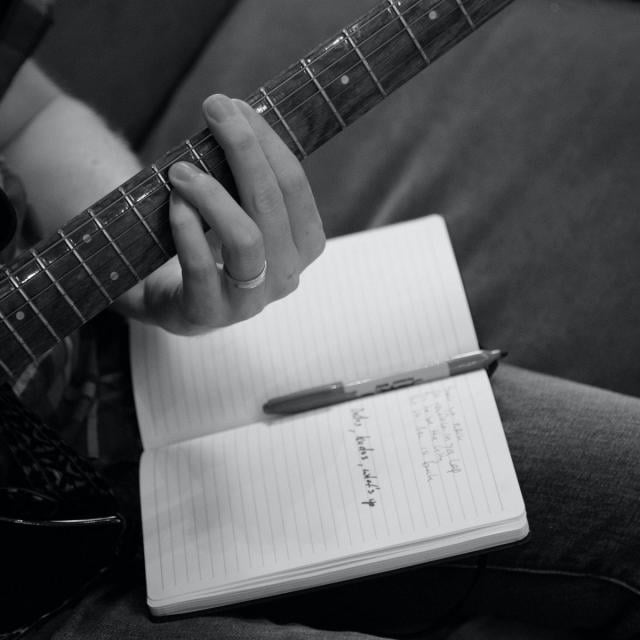
Songwriting: Writing the Music (Coursera)

Songwriting: Writing the Music (Coursera)

If your notebook is full of unused lyrics and you’re struggling to find inspiration for the music, this course is for you. Whether you are an experienced songwriter looking for new ideas or a beginning songwriter learning to read music, this course will lead you to a rich source of songwriting possibilities. Led by award winning songwriter and Berklee College of Music professor Scarlet Keys, you’ll learn to construct strong, expressive melodies that your audience will remember as well as experiment with new chords to break out of any harmonic rut.

Class Deals by MOOC List - Click here and see Coursera's Active Discounts, Deals, and Promo Codes.

Whether you are new to writing music or are looking for new ideas to change up your songs, this class will teach you how to make deliberate choices with your harmonies and melodies to best emulate the emotions you want your audience to feel. You will start by discovering common chord progression and tying specific emotions to each chords in a scale. Then you will practice changing the harmonic and melodic rhythm of a song to better highlight important lyrics. Finally, you will learn to create melodic hooks and simple techniques to help you generate new melodic ideas.
Course 2 of 4 in the Songwriting: Writing, Arranging, and Producing Music Specialization.

Syllabus

WEEK 1
Welcome to Songwriting: Writing the Music
Welcome to the course! Here we will cover all the details about the course and what you'll need to know to get the most out of your experience.
Choosing Emotive Chords
In this first lesson, we will begin working with diatonic chords in a chosen key and learning how to borrow non-diatonic chords to create evocative harmonies for your songs. We will look at several popular chord progressions and begin experimenting with choosing the perfect chords to help you tell your lyrical story.

WEEK 2
Creating Contrast with Harmonic Rhythm
In this lesson we will expand our knowledge of harmony to include 7th chords and added tensions. We will use these new chords to create more interesting harmonies for our lyrics and melodies. We will also practice changing the harmonic rhythm in our songs to better support our melodies and lyrics. Finally, we will use harmonic rhythm to show contrast between our song sections.

WEEK 3
Developing Interesting Melodies
In this lesson we will begin to create better melodies for our lyrics. We will start by learning about different types and shapes of melodic lines. We will then practice creating melodic hooks and using stable and unstable tones in our melodies. We will also learn the importance of using melodic contrast between song sections.

WEEK 4
Telling a Story with the Music
In this final lesson, we will begin to put everything together to help our lyrics tell their story. We will discover how to highlight our melodies by using chord tones and non-chord tones from our harmonies. We will also focus on setting our lyrics to the melody and harmony in a way that highlights the meaning we want to convey to the audience. Finally, we will practice creating melodies in minor keys.
Go to Class
MOOC List is learner-supported. When you buy through links on our site, we may earn an affiliate commission.

Related Courses

Music and Social Action (Coursera) Coursera
Yale University

Music and Social Action (Coursera)

What is a musician’s response to the condition of the world? Do musicians have an obligation and an opportunity to serve the needs of the world with their musicianship? At a time of crisis for the classical music profession, with a changing commercial landscape, a shrinking audience base, and a contraction in the number of professional orchestras, how does a young musician construct a career today? Are we looking at a dying art form or a moment of reinvigoration?

Oct 5th 2026
5-12 Weeks
Music as Biology: What We Like to Hear and Why (Coursera) Coursera
Duke University

Music as Biology: What We Like to Hear and Why (Coursera)

The course will explore the tone combinations that humans consider consonant or dissonant, the scales we use, and the emotions music elicits, all of which provide a rich set of data for exploring music and auditory aesthetics in a biological framework. Analyses of speech and musical databases are consistent with the idea that the chromatic scale (the set of tones used by humans to create music), consonance and dissonance, worldwide preferences for a few dozen scales from the billions that are possible, and the emotions elicited by music in different cultures all stem from the relative similarity of musical tonalities and the characteristics of voiced (tonal) speech.

Sep 21st 2026
5-12 Weeks
Developing Your Musicianship (Coursera) Coursera
Berklee College of Music

Developing Your Musicianship (Coursera)

Learn the basic concepts and approaches needed to understand, create, and perform contemporary music. If you have a passion for music and are curious about how it works, or if you are a musician who learned to play by ear without formal study, this course will provide you with an engaging introduction to key concepts and approaches needed to understand, create, and perform contemporary music. Taught by Berklee College of Music professor George W. Russell, Jr., the course includes six lessons that delve into harmony and ear training—two areas of intensive focus for every entering Berklee student.

Oct 5th 2026
5-12 Weeks
Electronic Music Performance Techniques (Coursera) Coursera
Berklee College of Music

Electronic Music Performance Techniques (Coursera)

From the Moog analog synthesizers in the 1960s to the contemporary usage of computers, performance controllers, and mobile devices, Electronic Digital Instruments (EDIs) have long been capable of offering artists a new range of musical expression. In this one-of-a-kind course, you'll learn the essential skills you need to perform on an EDI.

Sep 28th 2026
4 Weeks
The Music of the Beatles (Coursera) Coursera
University of Rochester

The Music of the Beatles (Coursera)

The Music of the Beatles will track the musical development of the band, starting from the earliest days in Liverpool and Hamburg, moving through the excitement of Beatlemania, the rush of psychedelia, and the maturity of Abbey Road. While the focus will be on the music, we will also consider how recording techniques, the music business, the music of other artists, and the culture of the 1960s affected John, Paul, George, and Ringo as they created the Beatles repertory.

Sep 28th 2026
5-12 Weeks
Guitar for Beginners (Coursera) Coursera
Berklee College of Music

Guitar for Beginners (Coursera)

Grasp the essentials needed to begin playing acoustic or electric guitar. You'll learn an easy approach to get you playing quickly, through a combination of exploring the instrument, performance technique, and basic music theory. For students who have long thought about picking up the acoustic or electric guitar, this course will provide an easy-access foundation that will get you playing.

Sep 28th 2026
5-12 Weeks
The Blues: Understanding and Performing an American Art Form (Coursera) Coursera
University of Rochester

The Blues: Understanding and Performing an American Art Form (Coursera)

The blues is an American art form and the most important musical form in jazz. Although there are other formal paradigms of the blues, such as 8-bar or 16-bar, this course focuses on different incarnations of the 12-bar blues. There are considerable differences between Early Jazz blues, Swing blues, Bebop blues, Modal blues, and Post Bop blues.

Oct 5th 2026
5-12 Weeks
Princípios Gerais da Técnica do Violino e da Viola de Arco (Coursera) Coursera
Universidade Estadual de Campinas - UNICAMP

Princípios Gerais da Técnica do Violino e da Viola de Arco (Coursera)

Esse curso visa fornecer informações sobre aspectos básicos da técnica do violino e da viola de arco. Ao longo de 18 aulas, com duração média de 7 minutos cada, serão abordados temas como posicionamento do instrumento, maneiras de posicionar a mão esquerda, como segurar o arco, como executar os principais golpes de arco, como estudar mudanças de posição, etapas para desenvolvimento do vibrato e sugestões para a organização do estudo diário do instrumento.

Oct 5th 2026
4 Weeks
Richard Schechner's Introduction to Performance Studies (Coursera) Coursera
New York University

Richard Schechner's Introduction to Performance Studies (Coursera)

Performance Studies: An Introduction explores the wide world of performance--from theatre, dance, and music to ritual, play, political campaigns, social media, and the performances of everyday life. Performance studies also ranges across cultures--Asia, Africa, the Caribbean, Europe, the Americas. And it spans historical periods from the art of the paleolithic caves to YouTube and the avantgarde. This course is devised by Richard Schechner, one of the pioneers of performance studies, in dialogue with more than a dozen expert scholars and artists.

Sep 28th 2026
13-24 Weeks
Teaching the Violin and Viola: Creating a Healthy Foundation (Coursera) Coursera
Northwestern University

Teaching the Violin and Viola: Creating a Healthy Foundation (Coursera)

Join us as we explore the fundamental principles and early stages of teaching violin and viola through a series of engaging video lectures and lesson demonstrations, including: 1) Master classes with some of the world’s top string pedagogues, 2) Individual lesson demos of teaching violin/viola set up, left and right hand technique and pieces from the early violin/viola repertoire, 3) Group lesson demos of teaching music theory, ear training and fun activities that encourage good playing habits, and 4) A “field trip” to the violin shop, where we will outfit a new beginning student with a proper instrument and bow.

Sep 28th 2026
5-12 Weeks