Simulation Analysis for Mechanical Engineers with Autodesk Fusion 360 (Coursera)

Offered by Autodesk,
Simulation Analysis for Mechanical Engineers with Autodesk Fusion 360 (Coursera)

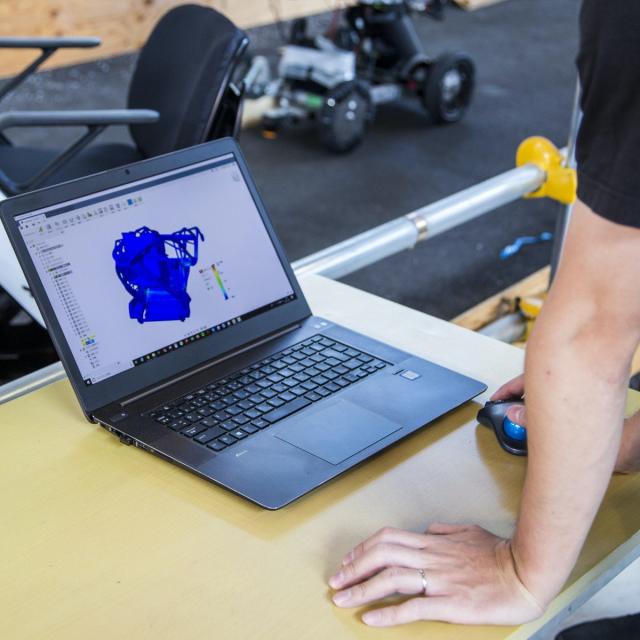
The foundation of engineering design is often coupled with validation. Simulation is a great tool that allows engineers to test, validate, and modify designs before they become a physical prototype. When used early in the process for simulation driven design and throughout the development process, simulation can help drive the design, make informed design decisions, speed up time to production, and most importantly, identify and eliminate costly design mistakes.

Class Deals by MOOC List - Click here and see Coursera's Active Discounts, Deals, and Promo Codes.

Like any other tool though, it must be used properly to yield the best results. In this course, we’ll explore the usage static stress simulation, shape optimization, thermal and other mechanical simulation types to better understand how we can apply these tools to everyday design problems.
After taking this course, you'll be able to:

  • Describe the simulation workflow in Fusion 360.
  • Summarize the use cases for various types of simulation studies.
  • Demonstrate knowledge and skills in more advanced Fusion 360 CAD and CAE skills.
  • Explain and identify simulation results

What You Will Learn

  • Describe the simulation workflow in Fusion 360.
  • Summarize the use cases for various types of simulation studies.
  • Demonstrate knowledge and skills in more advanced Fusion 360 CAD and CAE skills.
  • Explain and identify simulation results

Course 3 of 4 in the Autodesk CAD/CAM/CAE for Mechanical Engineering Specialization.

Syllabus

WEEK 1
Static Stress Simulation
In Week 1, we’ll explore the setup, solve, and understanding surrounding static stress simulations. Starting with the basics and moving to more advanced tools such as bolted connections we’ll walk through how to prepare and process a static simulation.

WEEK 2
Using Shape Optimization to Drive a Design
In Week 2, we’ll cover shape optimization simulation study type to explore load paths in designs. This simulation study will help engineers identify critical load paths in a design to make more informed decisions on material removal.

WEEK 3
Nonlinear Response, Buckling and Modal Frequencies
In Week 3, we’ll focus on some additional simulation study types in Fusion 360, namely nonlinear response, structural buckling and modal frequencies. These study types allow for greater insight into structural and mechanical problems associated with a wide variety of designs. We will focus on various aspects of our gear reduction assembly as well as explore other examples suited for these types of simulations.

WEEK 4
Thermal and Thermal Stress
In Week 4, we’ll explore and compare the effects of thermal and thermal stresses on designs. Temperature and heat can be a major factor in the failure of a design so exploring a design’s performance can lead to better informed design decisions. As a bonus, we’ll also look at event simulation and how a design performs when subject to motion and how it responds to an impact.


Go to Class
MOOC List is learner-supported. When you buy through links on our site, we may earn an affiliate commission.

Related Courses

The Finite Element Method for Problems in Physics (Coursera) Coursera
University of Michigan

The Finite Element Method for Problems in Physics (Coursera)

This course is an introduction to the finite element method as applicable to a range of problems in physics and engineering sciences. The treatment is mathematical, but only for the purpose of clarifying the formulation. The emphasis is on coding up the formulations in a modern, open-source environment that can be expanded to other applications, subsequently.

Jun 15th 2026
13-24 Weeks
Systems Engineering (Coursera) Coursera
MathWorks

Systems Engineering (Coursera)

Systems Engineering provides a broad overview of how systems engineering helps you develop complex projects that meet program objectives in an efficient way. You will learn how system architectures are developed and described, how to communicate the needs, requirements, and constraints throughout the project, how to optimize the design through trade studies, and how to know the system does what it’s supposed to in the end.

Jun 19th 2026
1 Week
Fundamentals of Fluid-Solid Interactions (Coursera) Coursera
École Polytechnique

Fundamentals of Fluid-Solid Interactions (Coursera)

What is fluid-solid interactions ? It is what happens when the motions of a fluid and of a solid are somehow coupled. This happens all the time, around you when leaves flutter in the wind, inside you when your heart beats, above you when wings of a plane vibrate, under the sea... The idea behind this MOOC is to give you the basic tools to be able to predict and eventually mitigate things called flutter, galloping, sloshing, vortex-induced vibrations, added mass, to cite a few. We are going to consider any possible domains of applications such as civil engineering, aerospace engineering, nuclear engineering , ocean engineering, biomechanics and even food processing !

Jun 15th 2026
5-12 Weeks
3D Printing Software (Coursera) Coursera
University of Illinois at Urbana-Champaign

3D Printing Software (Coursera)

This course will demonstrate how to use 3D printing software to create digital designs that can be turned into physical objects. It will also demonstrate how 3D scanners work to turn physical objects into digital designs. This course is hands-on in nature and will provide step-by-step instructions to guide you through two popular 3D modeling programs, Tinkercad and Fusion 360.

Jun 15th 2026
5-12 Weeks
Introduction to Basic Vibrations (Coursera) Coursera
Korea Advanced Institute of Science and Technology - KAIST

Introduction to Basic Vibrations (Coursera)

Introduction to Basic Vibrations starts with the fundamental principle of vibrations with a single and double degree of freedom systems. These fundamental vibration systems provide a solid platform not only to understand general vibrations but also to apply or use them into simple mechanical problems.

Jun 15th 2026
5-12 Weeks
Non-Equilibrium Applications of Statistical Thermodynamics (Coursera) Coursera
University of Colorado Boulder

Non-Equilibrium Applications of Statistical Thermodynamics (Coursera)

Course 5 of Statistical Thermodynamics explores three different applications of non-equilibrium statistical thermodynamics. The first is the transport behavior of ideal gases, with some discussion of transport in dense gases and liquids. It starts with simple estimates of the transport properties of an ideas gas. It then introduces the Boltzmann Equation and describes the Chapman-Enskog solution of that equation in order to obtain the transport properties. It closes with a discussion of practical sources of transport properties.

Jun 22nd 2026
3 Weeks
Machine Design Part I (Coursera) Coursera
Georgia Institute of Technology

Machine Design Part I (Coursera)

“Machine Design Part I” is the first course in an in-depth three course series of “Machine Design.” The “Machine Design” Coursera series covers fundamental mechanical design topics, such as static and fatigue failure theories, the analysis of shafts, fasteners, and gears, and the design of mechanical systems such as gearboxes. Throughout this series of courses we will examine a number of exciting design case studies, including the material selection of a total hip implant, the design and testing of the wing on the 777 aircraft, and the impact of dynamic loads on the design of an bolted pressure vessel. In this first course, you will learn robust analysis techniques to predict and validate design performance and life.

Jun 22nd 2026
5-12 Weeks
Modern Robotics, Course 1: Foundations of Robot Motion (Coursera) Coursera
Northwestern University

Modern Robotics, Course 1: Foundations of Robot Motion (Coursera)

Do you want to know how robots work? Are you interested in robotics as a career? Are you willing to invest the effort to learn fundamental mathematical modeling techniques that are used in all subfields of robotics? If so, then the "Modern Robotics: Mechanics, Planning, and Control" specialization may be for you. This specialization, consisting of six short courses, is serious preparation for serious students who hope to work in the field of robotics or to undertake advanced study. It is not a sampler.

Jun 15th 2026
4 Weeks
Intelligent Machining (Coursera) Coursera
University at Buffalo,The State University of New York

Intelligent Machining (Coursera)

Manufacturers are increasingly utilizing machine tools that are self-aware – they perceive their own states and the state of the surrounding environment – and are able to make decisions related to machine activity processes. This is called intelligent machining, and through this course students will receive a primer on its background, tools and related terminology.

Jun 15th 2026
4 Weeks
Advanced Engineering Systems in Motion: Dynamics of Three Dimensional (3D) Motion (Coursera) Coursera
Georgia Institute of Technology

Advanced Engineering Systems in Motion: Dynamics of Three Dimensional (3D) Motion (Coursera)

This course is an advanced study of bodies in motion as applied to engineering systems and structures. We will study the dynamics of rigid bodies in 3D motion. This will consist of both the kinematics and kinetics of motion. Kinematics deals with the geometrical aspects of motion describing position, velocity, and acceleration, all as a function of time. Kinetics is the study of forces acting on these bodies and how it affects their motion.

Jun 15th 2026
5-12 Weeks