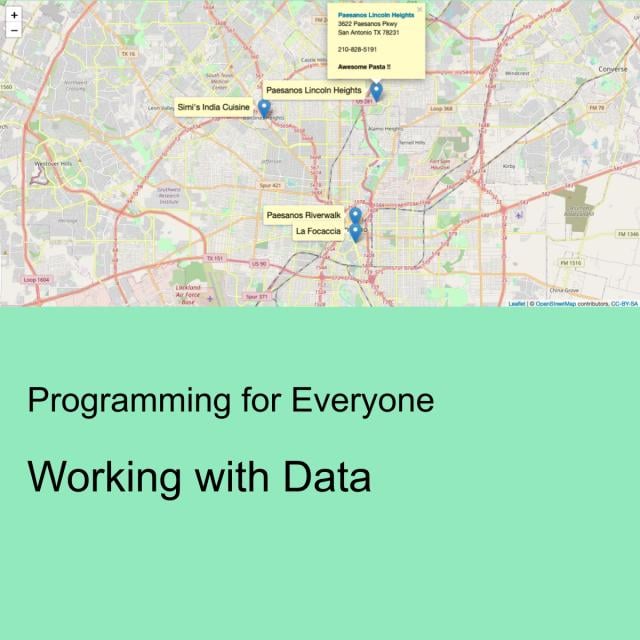
Programming for Everyone : Working with Data (Coursera)

Programming for Everyone : Working with Data (Coursera)

In this 3rd Guided Project in the "Programming for Everyone" series, we will learn how to work with data. We will learn about the dplyr package and how to use it to process data. We will subsequently update the app that we created in the 2nd Guided Project in this "Programming for Everyone" series to add support for multiple cities. Finally, we will see how to create tabular graphics with data using the "gt" package.

Class Deals by MOOC List - Click here and see Coursera's Active Discounts, Deals, and Promo Codes.

In this Guided Project, you will:

  • Learn how to organize data using dataframes and process data in a dataframe.
  • Use dplyr package to process data in dataframes
  • Learn about Shiny App Layout and Shiny Widgets

Learn step-by-step

  1. Guided Project Introduction
  2. Introduction to Dataframes in R
  3. Working with Dataframes
  4. Using dplyr Package for processing data
  5. Web App Layouts in Shiny
  6. Adding a drop down
  7. Update Server Function
  8. Deploying our App
  9. Additional Material and Wrapu
Go to Class
MOOC List is learner-supported. When you buy through links on our site, we may earn an affiliate commission.
Related Courses

Programming Mobile Applications for Android Handheld Systems: Part 2 (Coursera) Coursera
University of Maryland, College Park

Programming Mobile Applications for Android Handheld Systems: Part 2 (Coursera)

This course introduces you to the design and implementation of Android applications for mobile devices. You will build upon concepts from the prior course, including handling notifications, using multimedia and graphics and incorporating touch and gestures into your apps.

Aug 3rd 2026
5-12 Weeks
Data Processing Using Python (Coursera) Coursera
Nanjing University

Data Processing Using Python (Coursera)

This course is mainly for non-computer majors. It starts with the basic syntax of Python, to how to acquire data in Python locally and from network, to how to present data, then to how to conduct basic and advanced statistic analysis and visualization of data, and finally to how to design a simple GUI to present and process data, advancing level by level.

Aug 10th 2026
5-12 Weeks
Code Yourself! An Introduction to Programming (Coursera) Coursera
University of Edinburgh,Universidad ORT Uruguay

Code Yourself! An Introduction to Programming (Coursera)

Have you ever wished you knew how to program, but had no idea where to start from? This course will teach you how to program in Scratch, an easy to use visual programming language. More importantly, it will introduce you to the fundamental principles of computing and it will help you think like a software engineer.

Aug 3rd 2026
5-12 Weeks
Ajax Basics (Coursera) Coursera
Board Infinity

Ajax Basics (Coursera)

This Ajax Basics course is designed for beginners who want to learn how to build web applications that dynamically update content without reloading the entire page. In this course, you will learn the fundamentals of Ajax, including its features, advantages, and common usage scenarios.

Aug 10th 2026
3 Weeks
Foundations of Data Science: K-Means Clustering in Python (Coursera) Coursera
University of London,Goldsmiths, University of London

Foundations of Data Science: K-Means Clustering in Python (Coursera)

This MOOC, designed by an academic team from Goldsmiths, University of London, will quickly introduce you to the core concepts of Data Science to prepare you for intermediate and advanced Data Science courses. It focuses on the basic mathematics, statistics and programming skills that are necessary for typical data analysis tasks.

Aug 10th 2026
5-12 Weeks
Data and Health Indicators in Public Health Practice (Coursera) Coursera
Johns Hopkins University

Data and Health Indicators in Public Health Practice (Coursera)

Epidemiology is often described as the cornerstone science in public health. Epidemiology in public health practice uses study design and analyses to identify causes in an outbreak situation, guides interventions to improve population health, and evaluates programs and policies. In this course, we'll define the role of the professional epidemiologist as it relates to public health services, functions, and competencies. With that foundation in mind, we'll introduce you to the problem solving methodology and demonstrate how it can be used in a wide variety of settings to identify problems, propose solutions, and evaluate interventions.

Aug 10th 2026
4 Weeks
Parallel programming (Scala 2 version) (Coursera) Coursera
École Polytechnique Fédérale de Lausanne

Parallel programming (Scala 2 version) (Coursera)

With every smartphone and computer now boasting multiple processors, the use of functional ideas to facilitate parallel programming is becoming increasingly widespread. In this course, you'll learn the fundamentals of parallel programming, from task parallelism to data parallelism. In particular, you'll see how many familiar ideas from functional programming map perfectly to to the data parallel paradigm. We'll start the nuts and bolts how to effectively parallelize familiar collections operations, and we'll build up to parallel collections, a production-ready data parallel collections library available in the Scala standard library.

Aug 10th 2026
4 Weeks
Estruturas de dados Python (Coursera) Coursera
University of Michigan

Estruturas de dados Python (Coursera)

Este curso apresentará as estruturas de dados centrais da linguagem de programação Python. Vamos superar os fundamentos da programação de procedimentos e explorar como podemos usar as estruturas de dados integradas do Python, como listas, dicionários e tuplas, para realizar análises de dados cada vez mais complexas. Este curso cobrirá os capítulos 6 a 10 do livro “Python para Todos”. Este curso aborda o Python 3.

Aug 10th 2026
5-12 Weeks
Computer Science: Algorithms, Theory, and Machines (Coursera) Coursera
Princeton University

Computer Science: Algorithms, Theory, and Machines (Coursera)

This course introduces the broader discipline of computer science to people having basic familiarity with Java programming. It covers the second half of our book Computer Science: An Interdisciplinary Approach (the first half is covered in our Coursera course Computer Science: Programming with a Purpose, to be released in the fall of 2018). Our intent is to demystify computation and to build awareness about the substantial intellectual underpinnings and rich history of the field of computer science.

Aug 10th 2026
5-12 Weeks
Introducción a Java (Coursera) Coursera
Universidad Nacional Autónoma de México

Introducción a Java (Coursera)

Me llamo Elisa Viso y una de mis pasiones es la de programar y enseñar a programar. El lenguaje Java es uno de los que más me ha gustado en mis 45 años que llevo programando. Si bien te podrá parecer un poco complicado empezar a programar en Java, una vez que cubras los conceptos básicos verás qué rápido se avanza. Java, como todos los lenguajes de programación bien hechos, te dejan hacer cualquier cosa (algunas de ellas con más trabajo que en otros lenguajes y otras casi directamente de cómo piensas la solución al problema).

Aug 10th 2026
5-12 Weeks
Introduction and Programming with IoT Boards (Coursera) Coursera
Pohang University of Science and Technology - POSTECH

Introduction and Programming with IoT Boards (Coursera)

Internet of Things (IoT) is an emerging area of information and communications technology (ICT) involving many disciplines of computer science and engineering including sensors/actuators, communications networking, server platforms, data analytics and smart applications. IoT is considered to be an essential part of the 4th Industrial Revolution along with AI and Big Data. This course will be very useful to senior undergraduate and graduate students as well as engineers who are working in the industry.

Aug 3rd 2026
5-12 Weeks