Programming Languages, Part A (Coursera)

Programming Languages, Part A (Coursera)

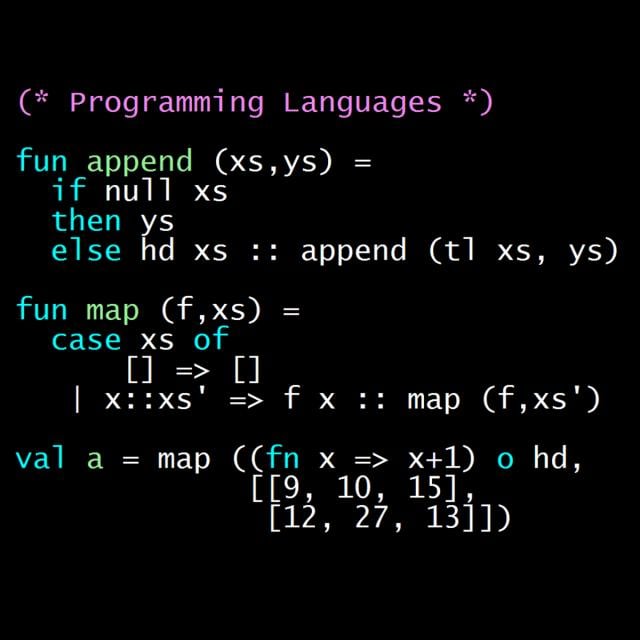
This course is an introduction to the basic concepts of programming languages, with a strong emphasis on functional programming. The course uses the languages ML, Racket, and Ruby as vehicles for teaching the concepts, but the real intent is to teach enough about how any language “fits together” to make you more effective programming in any language -- and in learning new ones.

Class Deals by MOOC List - Click here and see Coursera's Active Discounts, Deals, and Promo Codes.

This course is neither particularly theoretical nor just about programming specifics -- it will give you a framework for understanding how to use language constructs effectively and how to design correct and elegant programs. By using different languages, you will learn to think more deeply than in terms of the particular syntax of one language. The emphasis on functional programming is essential for learning how to write robust, reusable, composable, and elegant programs. Indeed, many of the most important ideas in modern languages have their roots in functional programming. Get ready to learn a fresh and beautiful way to look at software and how to have fun building it. The course assumes some prior experience with programming, as described in more detail in the first module. The course is divided into three Coursera courses: Part A, Part B, and Part C. As explained in more detail in the first module of Part A, the overall course is a substantial amount of challenging material, so the three-part format provides two intermediate milestones and opportunities for a pause before continuing. The three parts are designed to be completed in order and set up to motivate you to continue through to the end of Part C. The three parts are not quite equal in length: Part A is almost as substantial as Part B and Part C combined.
Week 1 of Part A has a more detailed list of topics for all three parts of the course, but it is expected that most course participants will not (yet!) know what all these topics mean.

Syllabus

WEEK 1
Introduction and Course-Wide Information (Start Here)
Welcome! Start here! Learn about this course and how it's organized.
Software Installation and Homework 0
This module contains two things: (1) The information for the [unusual] software you need to install for Programming Languages Part A. (2) An optional "fake" homework that you can turn in for auto-grading and peer assessment to get used to the mechanics of assignment turn-in that we will use throughout the course. You can do this module either before or after watching the first few "actual course content" videos in the next module, but you will want to get the software installed soon so you can learn by actively trying out variations on the code in the videos. You will need to install the software to do the homework.

WEEK 2
Section 1 and Homework 1
It's time to dive in! Start with a careful reading of the "Section 1 Welcome Message" and go from there.

WEEK 3
Section 2 and Homework 2
This section is a particularly rewarding one where a lot of ideas come together to reveal a surprisingly elegant underlying structure in ML. As usual, start with the welcome reading, dive into the material, and leave plenty of time to approach the programming assignment methodically.

WEEK 4
Section 3 and Homework 3 -- and Course Motivation
This section is all about higher-order functions -- the feature that gives functional programming much of its expressiveness and elegance -- and its name! As usual, the first reading below introduces you to the section, but it will make more sense once you dive in to the lectures.
Also be sure not to miss the material on course motivation that we have put in a "lesson" between the other videos for this week and the homework assignment. The material is "optional" in the sense that it is not needed for the homeworks or next week's exam, but it is still very highly encouraged to better understand why the course (including Parts B and C) covers what it does and, hopefully, will change the way you look at software forever.

WEEK 5
Section 4 and Part-A Exam
We finish Part A of the course with this module. As explained in more detail in the welcome message, we discuss type inference, ML's module system, and the fundamental idea in computing of two computations being equivalent. There is no programming assignment -- instead there is an exam covering all of Part A. Finally, there is a brief wrap-up video for the end of Part A that also looks ahead to Part B and Part C -- we have put it after the exam, so don't overlook it.

Go to Class
MOOC List is learner-supported. When you buy through links on our site, we may earn an affiliate commission.

Related Courses

The Arduino Platform and C Programming (Coursera) Coursera
University of California, Irvine

The Arduino Platform and C Programming (Coursera)

The Arduino is an open-source computer hardware/software platform for building digital devices and interactive objects that can sense and control the physical world around them. In this class you will learn how the Arduino platform works in terms of the physical board and libraries and the IDE (integrated development environment). You will also learn about shields, which are smaller boards that plug into the main Arduino board to perform other functions such as sensing light, heat, GPS tracking, or providing a user interface display. The course will also cover programming the Arduino using C code and accessing the pins on the board via the software to control external devices.

Jun 22nd 2026
4 Weeks
Introduction to Web Development (Coursera) Coursera
University of California, Davis

Introduction to Web Development (Coursera)

This course is designed to start you on a path toward future studies in web development and design, no matter how little experience or technical knowledge you currently have. The web is a very big place, and if you are the typical internet user, you probably visit several websites every day, whether for business, entertainment or education. But have you ever wondered how these websites actually work? How are they built? How do browsers, computers, and mobile devices interact with the web? What skills are necessary to build a website? With almost 1 billion websites now on the internet, the answers to these questions could be your first step toward a better understanding of the internet and developing a new set of internet skills.

Jun 22nd 2026
5-12 Weeks
Building Scalable Java Microservices with Spring Boot and Spring Cloud (Coursera) Coursera
Google Cloud

Building Scalable Java Microservices with Spring Boot and Spring Cloud (Coursera)

"Microservices" describes a software design pattern in which an application is a collection of loosely coupled services. These services are fine-grained, and can be individually maintained and scaled. The microservices architecture is ideal for the public cloud, with its focus on elastic scaling with on-demand resources. In this course, you will learn how to build Java applications using Spring Boot and Spring Cloud on Google Cloud Platform.

Jun 23rd 2026
2 Weeks
Interfacing with the Raspberry Pi (Coursera) Coursera
University of California, Irvine

Interfacing with the Raspberry Pi (Coursera)

The Raspberry Pi uses a variety of input/output devices based on protocols such as HDMI, USB, and Ethernet to communicate with the outside world. In this class you will learn how to use these protocols with other external devices (sensors, motors, GPS, orientation, LCD screens etc.) to get your IoT device to interact with the real world.

Jun 22nd 2026
4 Weeks
Interactivity with JavaScript (Coursera) Coursera
University of Michigan

Interactivity with JavaScript (Coursera)

If you want to take your website to the next level, the ability to incorporate interactivity is a must. But adding some of these types of capabilities requires a stronger programming language than HTML5 or CSS3, and JavaScript can provide just what you need. With just a basic understanding of the language, you can create a page that will react to common events such as page loads, mouse clicks & movements, and even keyboard input.

Jun 22nd 2026
4 Weeks
Build a Modern Computer from First Principles: Nand to Tetris Part II (project-centered course) (Coursera) Coursera
Hebrew University of Jerusalem

Build a Modern Computer from First Principles: Nand to Tetris Part II (project-centered course) (Coursera)

In this project-centered course you will build a modern software hierarchy, designed to enable the translation and execution of object-based, high-level languages on a bare-bone computer hardware platform. In particular, you will implement a virtual machine and a compiler for a simple, Java-like programming language, and you will develop a basic operating system that closes gaps between the high-level language and the underlying hardware platform.

Jun 22nd 2026
5-12 Weeks
Algorithms, Part II (Coursera) Coursera
Princeton University

Algorithms, Part II (Coursera)

This course covers the essential information that every serious programmer needs to know about algorithms and data structures, with emphasis on applications and scientific performance analysis of Java implementations. Part I covers elementary data structures, sorting, and searching algorithms. Part II focuses on graph- and string-processing algorithms.

Jun 22nd 2026
5-12 Weeks
Cloud Computing Concepts, Part 1 (Coursera) Coursera
University of Illinois at Urbana-Champaign

Cloud Computing Concepts, Part 1 (Coursera)

Cloud computing systems today, whether open-source or used inside companies, are built using a common set of core techniques, algorithms, and design philosophies—all centered around distributed systems. Learn about such fundamental distributed computing "concepts" for cloud computing. Some of these concepts include: clouds, MapReduce, key-value/NoSQL stores, classical distributed algorithms, widely-used distributed algorithms, scalability, trending areas, and much, much more!

Jun 22nd 2026
5-12 Weeks
Learn to code with AI (Coursera) Coursera
Scrimba

Learn to code with AI (Coursera)

Imagine waking up tomorrow as a web developer. What would you want to build? With AI tools like ChatGPT, you're already a developer, regardless of your experience, if you know how to work with them. So in this course, you'll build functional, interactive front-end projects while learning how to write effective prompts and debug and refine your code with the help of AI.

Jun 24th 2026
2 Weeks
Java Programming: Principles of Software Design (Coursera) Coursera
Duke University

Java Programming: Principles of Software Design (Coursera)

Solve real world problems with Java using multiple classes. Learn how to create programming solutions that scale using Java interfaces. Recognize that software engineering is more than writing code - it also involves logical thinking and design. By the end of this course you will have written a program that analyzes and sorts earthquake data, and developed a predictive text generator.

Jun 22nd 2026
4 Weeks