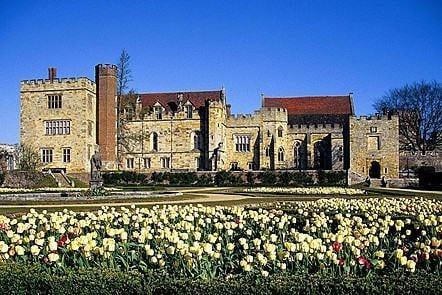
Penshurst Place and the Sidney Family of Writers (FutureLearn)

Offered by Lancaster University,
Penshurst Place and the Sidney Family of Writers (FutureLearn)

Uncover the literary history of Penshurst Place, the 16th-century home of the Sidney family of writers and poets. Learn how Lady Mary Wroth and the Sidney family shaped the English Renaissance. In the 16th century, Penshurst Place was the home to the Sidney family, renowned for their literary works in the age of Shakespeare. The family, including Lady Mary Wroth and her uncle Sir Philip Sidney, wrote poetry and prose that still appeal to audiences today.

Class Deals by MOOC List - Click here and see FutureLearn's Active Discounts, Deals, and Promo Codes.

On this course, you will be introduced to Penshurst Place, the Sidney family, and their famous works. You will learn how Lady Mary Wroth and Mary Sidney paved the way for female authors in Elizabethan England. You will also review Wroth’s drama ‘Love’s Victory’, which was reenacted and filmed at Penshurst Place in September 2018.

Syllabus
Week 1: The Sidney Family and Penshurst Place
Week 2: The Sidneys and Love
Week 3: The Sidneys and Women’s Household Theatre
Week 4: The Sidneys and Religion

What will you achieve?
By the end of the course, you‘ll be able to...

  • Explore how aristocratic family networks fostered writing by both men and women in the age of Shakespeare
  • Evaluate examples of writings by the Sidney family and their importance as an influence on English literary history
  • Investigate a different type of theatre from Shakespeare's age
  • Explore how individual writers responded to questions of faith and belief in a time of turbulent religious change
  • Investigate how writing shapes the natural environment and the emotions of others both within a family network and beyond.
Go to Class
MOOC List is learner-supported. When you buy through links on our site, we may earn an affiliate commission.

Related Courses

Gabriel García Márquez: entre el poder, la historia y el amor (FutureLearn) FutureLearn
Universidad de los Andes

Gabriel García Márquez: entre el poder, la historia y el amor (FutureLearn)

Identifique las contribuciones del autor a la literatura universal mediante el estudio de tres de sus grandes obsesiones. En este curso usted podrá identificar los aportes narrativos del escritor colombiano Gabriel García Márquez a la literatura universal a través del estudio de tres de las grandes obsesiones del autor: el poder, la historia y el amor.

No sessions available
5-12 Weeks
Teaching Reluctant Writers (Coursera) Coursera
Johns Hopkins University

Teaching Reluctant Writers (Coursera)

All educators will encounter students who struggle with writing. This course first focuses on the reasons student writers may be reluctant and then provides learners with a variety of strategies and practices to help reluctant writers develop a greater comfort and confidence with writing. Learners will examine classroom relationships, mentoring, scaffolding, conferencing, low-risk writing and mini-lessons, all tools and techniques that can be brought right into the classroom to help struggling writers increase student participation and success in writing.

Aug 31st 2026
13-24 Weeks
Words Spun Out of Images: Visual and Literary Culture in Nineteenth Century Japan (Coursera) Coursera
The University of Tokyo

Words Spun Out of Images: Visual and Literary Culture in Nineteenth Century Japan (Coursera)

In their ambition to capture “real life,” Japanese painters, poets, novelists and photographers of the nineteenth century collaborated in ways seldom explored by their European contemporaries. This course offers learners the chance to encounter and appreciate behavior, moral standards and some of the material conditions surrounding Japanese artists in the nineteenth century, in order to renew our assumptions about what artistic “realism” is and what it meant.

Sep 7th 2026
4 Weeks
Humphry Davy: Laughing Gas, Literature, and the Lamp (FutureLearn) FutureLearn
Lancaster University,Royal Institution - RI

Humphry Davy: Laughing Gas, Literature, and the Lamp (FutureLearn)

Discover Humphry Davy and his contribution to science and the arts. Before culture was divided into the sciences and the arts there was a chemist who was also a poet. Sir Humphry Davy (1778-1829) is one of the best known men of science of the nineteenth century: he was the first person to inhale nitrous oxide; he isolated nine chemical elements; and he invented the miners’ safety lamp known as the Davy lamp. This course will consider Davy’s life and career using manuscript sources held at the Royal Institution of Great Britain.

Oct 9th 2023
4 Weeks
Poetry: How to Read a Poem (FutureLearn) FutureLearn
University of York

Poetry: How to Read a Poem (FutureLearn)

Discover what poetry can tell us about human emotion and learn key ideas and techniques for understanding and interpreting verse. Dive into the wonderful world of poetry and learn how to analyse a poem. Humans have communicated their thoughts, ideas, and feelings through poetry throughout history. At its best, it tells us new truths about the human experience. However, it’s often presented as hard to understand without expert knowledge. On this course, you’ll build your confidence in reading and enjoying poetry.

Self Paced
4 Weeks
Shakespeare: Print and Performance (FutureLearn) FutureLearn
King's College London

Shakespeare: Print and Performance (FutureLearn)

As part of Shakespeare400, learn about Shakespeare in print and performance around the world, from early modern times to today. Why do we continue to read and perform Shakespeare’s works around the world today? How were his plays performed and printed 400 years ago, and how has our conception of Shakespeare changed over the centuries?

Self Paced
4 Weeks
Shakespeare: Context and Stagecraft (FutureLearn) FutureLearn
King's College London

Shakespeare: Context and Stagecraft (FutureLearn)

Explore Shakespeare’s stagecraft through three of his most well-known plays: Romeo and Juliet, The Merchant of Venice and Macbeth. Study fascinating theatrical and social contexts that shaped Shakespeare’s plays. On this course, you’ll explore the language, themes, and contexts of three of Shakespeare’s most widely studied and frequently performed plays.

Self Paced
2 Weeks
Teaching Writing Process (Coursera) Coursera
Johns Hopkins University

Teaching Writing Process (Coursera)

Half a century ago, a revolution took place in the teaching of writing. Educators asked, “What if we were to study how professional writers wrote, as a way to learn how we might teach writing more effectively?” The result was the writing process movement, with its emphasis on not just writing as product but as process. Good writing doesn’t magically appear, nor does it spring from the brain fully formed and perfect the first time.

Aug 31st 2026
4 Weeks
Reasoning Across the Disciplines (Coursera) Coursera
University of North Carolina

Reasoning Across the Disciplines (Coursera)

Critical reasoning skills are a key success factor for students entering their first year of college. They must be able to think logically and form arguments. This course, designed with incoming college freshmen in mind but open to anyone, provides an essential grounding in critical reasoning skills. Faculty from multiple disciplines at the University of North Carolina at Chapel Hill offer guidance on applying critical thinking skills in the context of specific disciplines. By developing these skills, students will learn more, enjoy their courses more, and experience greater academic success.

Sep 7th 2026
5-12 Weeks
Creative Writing: The Craft of Plot (Coursera) Coursera
Wesleyan University

Creative Writing: The Craft of Plot (Coursera)

In this course aspiring writers will be introduced to perhaps the most elemental and often the most challenging element of story: plot. We will learn what keeps it moving, how it manipulates our feelings, expectations, and desires. We will examine the choices storytellers make to snag our imaginations, drag them into a fictional world, and keep them there. We will learn how to outline and structure a plot, discuss narrative arc, pacing and reversals and reveal the inevitable surprise: connecting the beginning, middle and end.

Aug 31st 2026
4 Weeks