Moons (FutureLearn)

Offered by The Open University,
Moons (FutureLearn)

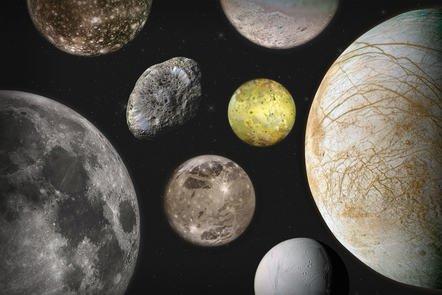
Explore the many moons of our Solar System. Find out what makes them special and ask whether we send humans to our Moon again. Discover the amazing diversity of moons in our Solar System. There are lots of moons in our Solar System. The Earth is the only planet with just a single moon. Some are bigger than ours. Many are much smaller. Some moons have ongoing volcanic eruptions. Others have rivers of liquid methane. A small handful may even be home to primitive life. This online course will allow you to explore the rich diversity of moons in our Solar System.

Class Deals by MOOC List - Click here and see FutureLearn's Active Discounts, Deals, and Promo Codes.

With experts from The Open University, you’ll explore the fundamental processes that have shaped them, and the relationship between our Moon and the Earth.
The course was produced with the kind support of Dangoor Education.

Syllabus
Week 1: What are moons?
Week 2: Moons and what they are made of; craters and cratering
Week 3: Volcanism on moons, Europa, small moons
Week 4: Our Moon and how it has been explored
Week 5: What we have learned from the Moon
Week 6: Water on the Moon, and the future of lunar exploration
Week 7: Exploring other moons:
Week 8: Moons and the future; how many of them host life?

What will you achieve?
By the end of the course, you'll be able to...

  • Develop an awareness of the nature and diversity of moons in our Solar System, and their significance.
  • Explain and understand the general nature of moons’ orbits and the effects of tides.
  • Describe some of the possible origins of moons.
  • Describe the compositions and nature of the surfaces and interiors of moons.
  • Calculate and understand how impact craters are formed and recognise their significance for dating surfaces.
  • Describe the nature and history of volcanic activity on several moons.
  • Assess and be aware of which moons may have subsurface oceans, and the implications for hosting native life.
  • Classify and become aware of the history of manned and unmanned lunar exploration, and of some of the major discoveries.
  • Identify and recognise aspects of lunar samples seen under the microscope.
  • Describe the different settings in which ‘water’ has been found on the Moon.
  • Describe and be aware of the history of discovery and exploration of moons, and of future prospects.
  • Reflect and suggest ways in which resources from the Moon may help future space exploration.
Go to Class
MOOC List is learner-supported. When you buy through links on our site, we may earn an affiliate commission.

Related Courses

Journey of the Universe: The Unfolding of Life (Coursera) Coursera
Yale University

Journey of the Universe: The Unfolding of Life (Coursera)

Journey of the Universe weaves together the discoveries of the evolutionary sciences together with humanities such as history, philosophy, art, and religion. The course draws on the Emmy-award winning film, Journey of the Universe, and the book from Yale University Press. Journey explores cosmic evolution as a creative process based on connection, interdependence, and emergence. It examines a range of dynamic interactions in the unfolding of galaxies, Earth, life, and human communities. It investigates ways in which we understand evolutionary processes and the implications for humans and our ecological future.

Jun 22nd 2026
5-12 Weeks
Understanding Quantum Computers (FutureLearn) FutureLearn
Keio University

Understanding Quantum Computers (FutureLearn)

Explore the key concepts of quantum computing and find out how it’s changing computer science with this introductory course. In this course, we will discuss the motivation for building quantum computers, cover the important principles in quantum computing, and take a look at some of the important quantum computing algorithms.

Available now
3 Weeks
Invisible Worlds: Understanding the Natural Environment (FutureLearn) FutureLearn
University of Exeter,Eden Project

Invisible Worlds: Understanding the Natural Environment (FutureLearn)

Explore the connection between life and the Earth's invisible systems and gain new insights into the natural environment. Discover Earth's invisible systems and transform your understanding of the world. Given the current climate emergency, it’s increasingly important that we have a good understanding of Earth’s life support systems. We rely on these systems for fresh air, clean water, fertile soil, rich biodiversity and a stable climate. On this course, you’ll explore the natural systems we can’t see or feel, from microscopic creatures to gases.

Available Now
4 Weeks
Mechanics: Motion, Forces, Energy and Gravity, from Particles to Planets (Coursera) Coursera
UNSW Sydney - University of New South Wales

Mechanics: Motion, Forces, Energy and Gravity, from Particles to Planets (Coursera)

Most of the phenomena in the world around you are, at the fundamental level, based on physics, and much of physics is based on mechanics. Mechanics begins by quantifying motion, and then explaining it in terms of forces, energy and momentum. This allows us to analyse the operation of many familiar phenomena around us, but also the mechanics of planets, stars and galaxies.

Jun 22nd 2026
5-12 Weeks
Planet Earth: Understanding and Protecting our Environment (FutureLearn) FutureLearn
University of Leeds

Planet Earth: Understanding and Protecting our Environment (FutureLearn)

Learn about the physical geography of Earth and discover how to use this knowledge to protect our natural environment. Discover the Earth’s natural systems and how human activity affects them. On this two-week course from the University of Leeds, you will discover the processes of the hydrosphere, the geosphere, and the biosphere and explore the impact of human activity and climate change on our planet.

Feb 16th 2026
2 Weeks
Climate Change: Challenges and Solutions (FutureLearn) FutureLearn
University of Exeter

Climate Change: Challenges and Solutions (FutureLearn)

This course aims to explain the science of climate change, the risks it poses, and the solutions available to reduce those risks. The course is aimed at the level of students entering university, and seeks to provide an inter-disciplinary introduction to what is a broad field. It engages a number of experts from the University of Exeter and a number of partner organisations.

No sessions available
5-12 Weeks
Cracking Mechanics: Further Maths for Engineers (FutureLearn) FutureLearn
University of Bristol

Cracking Mechanics: Further Maths for Engineers (FutureLearn)

Practise the maths, learn the physics, and find out how engineers use both to solve real world problems. The aim of this free online course is to introduce you to some of the physics and maths that engineers find useful. The content comprises: parts of A-level maths and further maths (mechanics); the physical laws which this maths is used to model; and examples of how these skills are employed in mechanical, aerospace, civil, environmental, materials and electrical engineering.

No sessions available
5-12 Weeks
Kinetics: Studying Spacecraft Motion (Coursera) Coursera
University of Colorado Boulder

Kinetics: Studying Spacecraft Motion (Coursera)

As they tumble through space, objects like spacecraft move in dynamical ways. Understanding and predicting the equations that represent that motion is critical to the safety and efficacy of spacecraft mission development. Kinetics: Modeling the Motions of Spacecraft trains your skills in topics like rigid body angular momentum and kinetic energy expression shown in a coordinate frame agnostic manner, single and dual rigid body systems tumbling without the forces of external torque, how differential gravity across a rigid body is approximated to the first order to study disturbances in both the attitude and orbital motion, and how these systems change when general momentum exchange devices are introduced.

Jun 22nd 2026
4 Weeks
Journey Conversations: Weaving Knowledge and Action (Coursera) Coursera
Yale University

Journey Conversations: Weaving Knowledge and Action (Coursera)

Journey of the Universe weaves together the discoveries of the evolutionary sciences together with humanities such as history, philosophy, art, and religion. This course draws on the Journey of the Universe Conversations, a series of 20 interviews with scientists and environmentalists. The first 10 interviews are with scientists and historians who deepen our understanding of the evolutionary process of universe, Earth, and humans.

Jun 22nd 2026
5-12 Weeks
The Earth in My Pocket: an Introduction to Geology (FutureLearn) FutureLearn
The Open University

The Earth in My Pocket: an Introduction to Geology (FutureLearn)

Get an introduction to geology. Discover where materials that make up everyday objects come from and how to use them sustainably. Everything we use that has not been grown either contains or relies on materials that have been sourced by a geoscientist. Whether we are standing out in the wilderness, in the middle of a city or in our home, geology and the Earth’s natural resources are all around us, forming an integral part of our everyday lives.

No sessions available
4 Weeks