EdX

Microstructural Evolution of Materials Part 1: Statistical Mechanics (edX)

Offered by MIT, MITx,
Microstructural Evolution of Materials Part 1: Statistical Mechanics (edX)

Discover the principles of statistical mechanics that explain materials science phenomena. This module is Part 1 of a four-part series on the Microstructural Evolution in Materials. Taken together, these four modules provide similar content to the MIT Course 3.022: Microstructural Evolution of Materials. This series introduces various kinetic phenomena in various classes of materials. The course explains how materials develop different microstructure based on different processing techniques, and it relates these microstructures to the properties of the material.

Class Deals by MOOC List - Click here and see EdX's Active Discounts, Deals, and Promo Codes.

Microstructural Evolution of Materials is intended for engineering and science students and professionals with an interest in materials statistics, kinetics, and microstructural transformations.
Part 1 of the course will introduce important concepts in statistical mechanics that are especially relevant to materials scientists. Topics include solid solutions, the canonical ensemble and heat capacity.
Part 2 of the course focuses on point defect evolution, including diffusion, substitutional diffusion, ionic defects, and ionic conductivity.
Part 3 of the course discusses surfaces and surface-driven reactions. Topics include surface energy, faceted and non-faceted growth, and growth and ripening.
Part 4 of the course focuses on phase transformations, including nucleation and growth, precipitate growth, interface stability, and glass transition.

What you'll learn:
At the end of this course, you will be able to:

  • Explain the entropy of a solid solution from a quantum mechanical perspective
  • Understand the trends in heat capacity of a monatomic gas and an atomic solid
  • Use the canonical distribution to explain both the effect of gravitational force on the density of a gas and the origin of Curie’s law of paramagnetism

Syllabus

Introduction

  • What is an ensemble?
  • The Microcanonical Ensemble
  • Fluctuations in a System
  • Statistical Interpretations of Entropy

Solid Solutions

  • Particle Distinguishability
  • Gibbs Theorem
  • Ideal Solid Solutions and Ideal Gasses
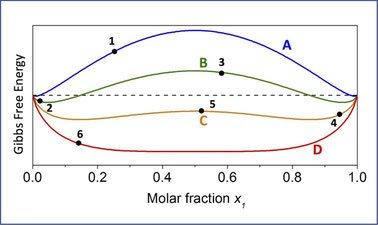
  • Regular Binary Solution Theory
  • Determining Phase Composition in Binary Solution

Canonical Ensemble

  • Deriving the Canonical Distribution for N=5
  • Deriving the Canonical Distribution
  • The Partition Function

Canonical Ensemble: Application

  • Example: Effect of Gravitational Force on Gas Density
  • Example: Paramagnetism Materials

Heat Capacity

  • Heat Capacity of an Ideal Gas
  • Heat Capacity of Atomic Solids
  • The Debye Model
Go to Class
MOOC List is learner-supported. When you buy through links on our site, we may earn an affiliate commission.

Related Courses

Light and Materials (Coursera) Coursera
Rice University

Light and Materials (Coursera)

This second course serves as an introduction to the physics of waves and light. Upon completion, learners will understand how mathematical laws and conservation principles describe wave propagation and light in the context of both geometrical and physical optics. Learners will gain experience in solving physics problems with tools such as graphical analysis, algebra, vector analysis, and calculus.

Jun 22nd 2026
3 Weeks
Microstructural Evolution of Materials Part 2: Defects and Diffusion (edX) EdX
MIT,MITx

Microstructural Evolution of Materials Part 2: Defects and Diffusion (edX)

Discover the principles of point defect evolution that explain materials science phenomena. This series introduces various kinetic phenomena in various classes of materials. The course explains how materials develop different microstructure based on different processing techniques, and it relates these microstructures to the properties of the material.

Self Paced
Self-Paced
Introduction to Thermodynamics (FutureLearn) FutureLearn
University of Hull

Introduction to Thermodynamics (FutureLearn)

Discover the laws of thermodynamics as you learn how to calculate chemical properties and predict chemical reactions. Get an introduction to thermodynamic properties and systems. Curious about thermodynamics or thinking about studying it at university? This short course from the University of Hull offers a short introduction to the fundamentals of thermodynamics – the branch of physics that deals with heat and its relation to energy.

Available now
3 Weeks
Advanced Functional Ceramics (Coursera) Coursera
Yonsei University

Advanced Functional Ceramics (Coursera)

To realize next-generation devices, novel ceramic materials with ultimate physical and chemical properties are required. For this purpose, a few intrinsic and extrinsic approaches for the development of new functional ceramics are proceeding. This course provides the fundamentals of functional ceramics and the materials design rules for developing advanced ceramics with ultimate physical and chemical properties.

Jun 22nd 2026
5-12 Weeks
Thermodynamics (saylor.org) Saylor Academy
Saylor.org

Thermodynamics (saylor.org)

There are many different ways that you can go about solving engineering problems. One of the most important methods is energy analysis. Energy is a physical property that allows work of any kind to be done; without it, there would be no motion, no heat, and no life. You wouldn’t be able to get out of bed in the morning, but it wouldn’t matter, because there would be no sun. Without energy, our world would not exist as it does.

Legacy Course
Self-Paced
Thermodynamics in Energy Engineering (FutureLearn) FutureLearn
Hanyang University

Thermodynamics in Energy Engineering (FutureLearn)

Understand the basic thermodynamic principles widely used in many engineering fields: temperature, free energy and entropy. This free online course introduces the basic thermodynamic principles that are widely used in many engineering fields. It will prepare you for degree-level study, by helping you understand and apply thermodynamic fundamentals through real-world, problem-solving exercises.

No sessions available
5-12 Weeks
Supply Chain Fundamentals (edX) EdX
MIT,MITx

Supply Chain Fundamentals (edX)

Learn fundamental concepts for logistics and supply chain management from both analytical and practical perspectives – part of the MITx MicroMasters Credential in Supply Chain Management. The CTL.SC1x Supply Chain Fundamentals course provides the foundational skills for supply chain management and logistics. You will learn how to develop and apply analytic tools, approaches, and techniques used in the design and operation of logistics systems and integrated supply chains.

Apr 3rd 2024
13-24 Weeks
Entropy and Equilibria (edX) EdX
HarvardX,Harvard University

Entropy and Equilibria (edX)

Expand your learning of chemistry and thermodynamics by exploring entropy, free energy, and equilibrium. Nature is driven by spontaneity — processes that move forward without external intervention. In this course, Entropy and Equilibria , you will explore the Second Law of Thermodynamics and get an introduction to the concepts of entropy and equilibrium states.

Self Paced
Self-Paced
Phases of Matter: Solid, Liquid, Gas and Beyond (Coursera) Coursera
University of Colorado Boulder

Phases of Matter: Solid, Liquid, Gas and Beyond (Coursera)

Complex systems can exhibit emergent phenomena, wherein the interplay of simple underlying rules governing the constituent parts leads to rich and unexpected behavior of the whole. Condensed matter physics is the branch of physics devoted to understanding such emergence in physical systems. It is the largest subfield of physics, and has developed a wealth of ideas and techniques for taming complexity. The course provides an introduction to this physics of emergence.

Jun 15th 2026
4 Weeks