EdX

Macroeconomics Performance Indicators (edX)

Macroeconomics Performance Indicators (edX)

The macroeconomy affects business conditions and broader social outcomes. Learn about key performance indicators of macroeconomics such as GDP, unemployment and inflation. This course consists of two types of materials. The first type of materials concerns with how to measure the performance of the economy as a whole. The second type of materials concerns how to explain why a country underperforms in one or more of these aspects, and what can be done about it. The behaviour of an economy as a whole is often broadly predictable, but sometimes it can suddenly change. You will learn how to understand macroeconomic data and know how it can be interpreted for analysis.

Class Deals by MOOC List - Click here and see EdX's Active Discounts, Deals, and Promo Codes.

This MOOC is part of the Professional Certificate in Macroeconomics. We recommend that you explore the other two courses of the program, Macroeconomics Policy and International Macroeconomics. The program is based on an introductory macroeconomics course taught on campus at The University of Queensland. Recent global economic and non-economic events have highlighted the importance of understanding the interconnection between the domestic and the international economy, don't wait to enroll and begin your learning with industry experts now.
If you are interested in pursuing economics further, UQx provides an accompanying Professional Certificate in Microeconomics running in parallel to this course. Building on your knowledge of macroeconomics with this additional program will provide you with a strong foundation of economics.
Overall, this course is for everyone, whether you are studying at university, a career professional interested in expanding your economic knowledge, or simply curious about global economic behaviour and what influences it.

What you'll learn
This course focuses on:

  • an overview of Gross Domestic Product (GDP) and the difference between nominal and real GDP
  • an insight into the different models of economic growth
  • lessons on how to measure and identify the various types of unemployment
  • an exploration into labour markets, including labour supply and demand.

Go to Class
MOOC List is learner-supported. When you buy through links on our site, we may earn an affiliate commission.

Related Courses

Macroeconomics for a Sustainable Planet (edX) EdX
SDGAcademyX,SDG Academy

Macroeconomics for a Sustainable Planet (edX)

Is it possible to develop a thriving global economy in an equitable and environmentally-resilient way? Unemployment. Inflation. Protectionism. Trade barriers. Fiscal deficit. These are not just terms in an economics textbook or in newspaper headlines. These real-life challenges carry societal and environmental implications for billions of people around the world.

Self Paced
Self-Paced
Macroeconomics: Theory and Policy (edX) EdX
Indian Institute of Management, Bangalore,IIMBx

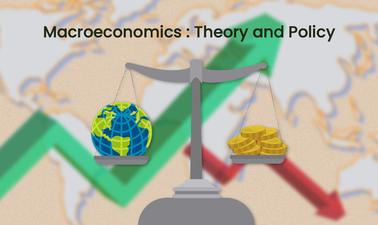
Macroeconomics: Theory and Policy (edX)

This course provides a basic understanding of the overall components of economies which tend to be the key factor for taking decisions in a large scale. The course deals with theoretical models of Consumption, Savings, Investment alongwith key economic concepts like Inflation and Unemployment. This course will discuss the unique economic terms which dictate the working of economies all over the world.

Self Paced
Self-Paced
Consumer Price Index (edX) EdX
International Monetary Fund - IMF,IMFx

Consumer Price Index (edX)

Consumer price index (CPI) data are essential inputs for sound policies. Policymakers require reliable measures of price change to make sound policy decisions. In addition, wages, salaries, government payments, pensions, rent, and other payments are indexed to the CPI and require accurate estimates of inflation. Learn the key concepts and compilation methods required to compile sound data using the best available methods.

Self Paced
Self-Paced
Quarterly National Accounts and High-Frequency Indicators of Economic Activity (edX) EdX
International Monetary Fund - IMF,IMFx

Quarterly National Accounts and High-Frequency Indicators of Economic Activity (edX)

Learn how to compile timely and high-quality Quarterly National Accounts (QNA) and High-Frequency Indicators of Economic Activity (HFIEAs). This course, presented by the Statistics Department, teaches you how to compile timely and high-quality Quarterly National Accounts (QNA) and High-Frequency Indicators of Economic Activity (HFIEAs).

Self Paced
Self-Paced
SDG: Moving Towards Sustainable Work (edX) EdX
Universidad Carlos III de Madrid - UC3M,UC3Mx

SDG: Moving Towards Sustainable Work (edX)

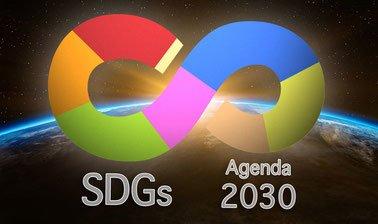
Decent work is thecritical engine of sustainable development. This course explores the United Nations' Sustainable Development Goals and mechanisms for developing decent and sustainable work. The United Nations' Sustainable Development 2030 Agenda gives us the opportunity to change and improve the lives of millions of people. These widespread efforts won't juststem from organizations in the formal public or private sectors (governments, corporations, trade unions, etc.) but will also require participation from ordinary people and civil society as a whole.

Self Paced
Self-Paced
China’s First Empires and the Rise of Buddhism (edX) EdX
HarvardX,Harvard University

China’s First Empires and the Rise of Buddhism (edX)

Learn about the Qin and Han dynasties, and how Buddhism and ideas of self-realization influenced the medieval period. This course, the second in a collection on Chinese history and culture, addresses how the Qin dynasty conquered China and established a new system of government and how the Han dynasty built a stable, centralized empire that lasted for hundreds of years. We cover the early history of Buddhism in China and how the rising feudal aristocracy responded to the loss of empire by looking inward.

Self Paced
Self-Paced
National Accounts Statistics (edX) EdX
International Monetary Fund - IMF,IMFx

National Accounts Statistics (edX)

Learn how to compile and disseminate national accounts statistics. This course, presented by the IMF's Statistics Department, teaches you how to compile timely, high quality national accounts statistics based on the system of national accounts (SNA) framework. The course introduces the sequence of national accounts, the accounting rules, and the key macroeconomic indicators in the SNA framework.

Self Paced
Self-Paced
Introduction to Economics: Microeconomics (edX) EdX
Seoul National University,SNUx

Introduction to Economics: Microeconomics (edX)

Learn the basics of microeconomics, including supply and demand of commodities and how equilibrium in the market affects price. A country’s economy consists of three major economic agents; consumers, firms and government. Analyzing the choices made by these economic agents is one of the main subjects of microeconomics. In this economics and finance course, you will learn how the decisions made by economic agents are represented in the market as demand and supply of commodities.

Self Paced
Self-Paced
Economics: Consumer Demand (edX) EdX
Babson College

Economics: Consumer Demand (edX)

Learn the fundamental economic principles of consumer demand and how the relationship between price, quantity and demand affect the market. Demand is a simple yet challenging concept that is essential to understanding how markets function. In this economics course, you will gain a solid understanding of demand, its underlying principles, major determinants and how they are beneficial for individuals, decision makers inside the firm, and policy makers.

Self Paced
Self-Paced
Macroeconometric Forecasting (edX) EdX
International Monetary Fund - IMF,IMFx

Macroeconometric Forecasting (edX)

Learn how to create and assess forecasting models to predict macroeconomic variables such as inflation and economic growth. In this macroeconomics course, you will learn to predict macroeconomic variables such as inflation, growth or consumption, and to create statistical models in economics and use them to predict responses to economic policy.

Self Paced
Self-Paced