EdX

Macroeconomics: Theory and Policy (edX)

Macroeconomics: Theory and Policy (edX)

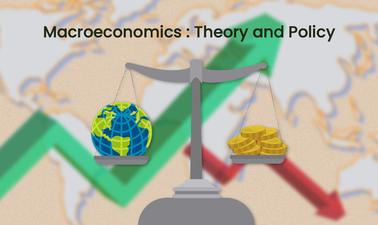
This course provides a basic understanding of the overall components of economies which tend to be the key factor for taking decisions in a large scale. The course deals with theoretical models of Consumption, Savings, Investment alongwith key economic concepts like Inflation and Unemployment. This course will discuss the unique economic terms which dictate the working of economies all over the world.

Class Deals by MOOC List - Click here and see EdX's Active Discounts, Deals, and Promo Codes.

The course starts with the understanding of the basic accounts and indicators of the economy. Then the course proceeds with the theories of consumption, savings and investment. Then we understand how shifts in aggregate demand and aggregate supply affect the overall economic outcomes such as growth and inflation. Then the focus shifts on the government and its fiscal policies, taxation and the sort of impact it has on economy. We touch upon indicators like fiscal deficit, revenue deficit, primary deficit and look at issues like fiscal sustainability and public debt and how they impact the economy. We also touch upon the role of Central banks and how it affects the monetary policy of the economy. We discuss the various monetary tools and policies and contextualise the interest rates and liquidity available in the economy. The last module deals with a country’s engagement with the world through trade and capital flows where we discuss external sector accounts, imbalances that a country may have, exchange rates and capital flows. This will help to look at an economy and its integration with the rest of the world.

What you'll learn
At the end of this course, you will:

  • Understand the various theories of economics with regards to Keynesian and Classical.
  • Interpret how the various components of economics like Inflation play a major role in the growth of an economy.

-Understand the circular flow of income and and the determinants of its various components like savings, consumption and investment.

  • Deduce the importance of monetary and fiscal policies and how it affects the developed and developing countries.

Syllabus

Week 1: Basic accounts and indicators of our economy.

  • National Income Accounting
  • Circular Flow of Income
  • Measuring GDP
  • Twin Deficit Identity
  • Price Indices
  • Employment Indicators
  • Poverty and Inequality

Week 2: Consumption and Savings

  • Introduction to Keynes
  • Keynesian Equilibrium
  • The Multiplier
  • Alternative Theories of Consumption
  • Determinants of Investment

Week 3: Aggregate Demand and Supply

  • Aggregate demand
  • Aggregate supply
  • Equilibrium
  • Managing the economy
  • Cae studies
  • Inflation and Defaltion
  • Growth

Week 4: Fiscal Policy

  • Terms and definitions
  • Financing the deficit
  • Public debt
  • Developed and developing country issues
  • Pandemic fiscal policy
  • Fiscal reforms in India

Week 5: Monetary Policy

  • Definision and transmission
  • Money supply process
  • Instrument of monetary policy
  • Instruments in India
  • Foreign transactions
  • Monetary policy targets and effectiveness
  • Demonetization in India

Week 6: Open Economy

  • Balance of payments
  • Exchange rates
  • Exchange rate regimes
  • Indicators of exchange rates
  • Covertibility
  • Open economy and India
Go to Class
MOOC List is learner-supported. When you buy through links on our site, we may earn an affiliate commission.

Related Courses

Macroeconomic Management in Resource-Rich Countries (edX) EdX
International Monetary Fund - IMF,IMFx

Macroeconomic Management in Resource-Rich Countries (edX)

What macroeconomic policy issues and challenges confront resource-rich countries?This course explores how policy-makers cope with the finite nature of the resources and the volatility of prices. In this online course on Macroeconomic Management in Resource-Rich Countries (MRCx), you will learn about macroeconomic policy issues and challenges that confront resource-rich countries (RRCs).

Self Paced
Self-Paced
Economics: Consumer Demand (edX) EdX
Babson College

Economics: Consumer Demand (edX)

Learn the fundamental economic principles of consumer demand and how the relationship between price, quantity and demand affect the market. Demand is a simple yet challenging concept that is essential to understanding how markets function. In this economics course, you will gain a solid understanding of demand, its underlying principles, major determinants and how they are beneficial for individuals, decision makers inside the firm, and policy makers.

Self Paced
Self-Paced
China’s First Empires and the Rise of Buddhism (edX) EdX
HarvardX,Harvard University

China’s First Empires and the Rise of Buddhism (edX)

Learn about the Qin and Han dynasties, and how Buddhism and ideas of self-realization influenced the medieval period. This course, the second in a collection on Chinese history and culture, addresses how the Qin dynasty conquered China and established a new system of government and how the Han dynasty built a stable, centralized empire that lasted for hundreds of years. We cover the early history of Buddhism in China and how the rising feudal aristocracy responded to the loss of empire by looking inward.

Self Paced
Self-Paced
Modelo de estimación de la brecha tributaria de IVA del RA-GAP (edX) EdX
International Monetary Fund - IMF,IMFx

Modelo de estimación de la brecha tributaria de IVA del RA-GAP (edX)

Aprenda a usar el modelo de estimación de la brecha tributaria de IVA que utiliza el Fondo Monetario Internacional. En este curso en línea aprenderá la teoría del modelo de estimación de la brecha tributaria del impuesto al valor agregado (IVA) del Programa de Análisis de Brechas en la Administración de Ingresos Públicos (PAB-AIP, o RA-GAP por sus siglas en inglés) del FMI, y también aprenderá a usar el modelo para elaborar sus propias estimaciones de la brecha tributaria de IVA.

Self Paced
Self-Paced
Public Debt, Investment, and Growth: The DIG and DIGNAR Models (edX) EdX
International Monetary Fund - IMF,IMFx

Public Debt, Investment, and Growth: The DIG and DIGNAR Models (edX)

This online course, presented by the Institute for Capacity Development and the Research Department, explains how to analyze the relation between public investment, growth, and public debt dynamics, using two dynamic structural models: the Debt, Investment, and Growth (DIG) model and the Debt, Investment, Growth and Natural Resources (DIGNAR) model.

Self Paced
Self-Paced
Financial Development and Financial Inclusion (edX) EdX
International Monetary Fund - IMF,IMFx

Financial Development and Financial Inclusion (edX)

Learn how to develop an efficient, inclusive and stable financial sector that is essential for a thriving economy. This course was developed by the IMF in collaboration with the European Investment Bank. Higher rates of financial inclusion and financial market development mean more prosperous societies. But how to make it all happen? This course outlines common ways countries develop robust financial sectors – from banks to equity markets.

Self Paced
Self-Paced
Foundations of Central Bank Law (edX) EdX
International Monetary Fund - IMF,IMFx

Foundations of Central Bank Law (edX)

This online course, presented by the IMF Institute and the IMF Legal Department, introduces participants to the foundations of central bank law. The course covers the legal issues that are necessary to support sound and effective central banks. It addresses the legal underpinnings of the mandate, decision-making structures, autonomy, accountability, transparency, and operations of central banks. This course combines theoretical components with practical exercises on how to analyze and design central bank legal frameworks.

Self Paced
Self-Paced
Introduction to Economics: Microeconomics (edX) EdX
Seoul National University,SNUx

Introduction to Economics: Microeconomics (edX)

Learn the basics of microeconomics, including supply and demand of commodities and how equilibrium in the market affects price. A country’s economy consists of three major economic agents; consumers, firms and government. Analyzing the choices made by these economic agents is one of the main subjects of microeconomics. In this economics and finance course, you will learn how the decisions made by economic agents are represented in the market as demand and supply of commodities.

Self Paced
Self-Paced
Fixed Income Portfolio Management (edX) EdX
New York Institute of Finance,NYIF

Fixed Income Portfolio Management (edX)

Learn how to construct and manage fixed income portfolios using the latest tools and techniques. Fixed Income Portfolio Management is a comprehensive survey of the key drivers and features of managing a portfolio of fixed income assets. This thorough and interactive course offers students like you, a detailed grounding in the full range of fixed income product categories and portfolio management techniques. Fixed Income Portfolio Management is a comprehensive survey of the key drivers and features of managing a portfolio of fixed income assets.

Self Paced
Self-Paced