Introduction to XR: VR, AR, and MR Foundations (Coursera)

Offered by Unity,
Introduction to XR: VR, AR, and MR Foundations (Coursera)

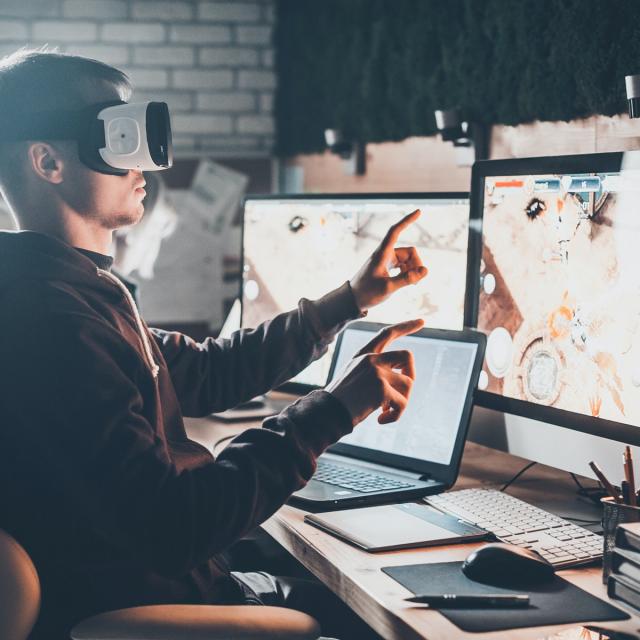
What is XR? It’s shorthand for a related set of new technologies that are changing the way we interact with the world and with each other: Virtual Reality, Augmented Reality, and Mixed Reality. To understand XR, you need to understand the technologies that enable it. If you understand the available technologies, how they are used, and what their future holds, you’ll be well equipped to deal with XR as it rapidly evolves and converges.

Class Deals by MOOC List - Click here and see Coursera's Active Discounts, Deals, and Promo Codes.

In this course, we will present an introduction to XR using a broadly chronological approach, focusing on how all of the underlying technologies came together at key moments in the history of XR to launch the concepts of Virtual Reality and Augmented Reality into the mainstream consciousness. Throughout the course, we’ll give a brief description of each of the supporting technologies, some history about when it first came into use, limitations and future potential for improvement, and how it’s used for AR, VR, and MR.
As you learn about the technology, you’ll also develop hands on experience in the field along two tracks. First, you will use Unity to build and run two simple XR applications on your own smartphone: a “VR Museum” app and a handheld Augmented Reality app. Second, you will brainstorm, define, visualize, and iterate your own original concept for an XR application, ending the course with a thorough and peer-reviewed XR Product Brief that you could use as the basis for future development.
This is the first of three planned courses in Unity's XR Specialization, which include the Mobile VR App Development with Unity course as well as a future course focused on developing Augmented Reality (AR) applications with Unity.
Course 1 of 3 in the Unity XR: How to Build AR and VR Apps Specialization.

Syllabus

WEEK 1
All Aboard - How Google Cardboard Brought VR to the Masses
The first module looks at the technologies that allowed Google to launch the now famous New York Times Google Cardboard experience and help make Virtual Reality a household name. We will also highlight how it also democratized VR development with the release of the SDK for Unity.

WEEK 2
From Google Cardboard to Google Earth VR
In this module we will look at the explosion of VR related developments that have taken place since that time, with a focus on how Unity native support for VR features has rapidly evolved along with them.

WEEK 3
Get Ready, Get Set, Pokemon GO!
In this module, we'll examine the technologies that led to another key moment in the history of XR—Pokemon GO—which brought Augmented Reality to the masses and made it a mainstream concept. We will highlight the technologies that AR and MR share in common with VR, and also cover additional technologies that only AR and MR use, and discuss the various AR and MR frameworks available for working with AR in Unity.

WEEK 4
My Implants Don’t Distinguish Between Realities
This final module will look at the future of XR with a focus on technologies now in development that will be available in the near term, such as foveated rendering and ultra high resolution headset displays. We’ll also look at the future of Unity support for XR, and we’ll talk about the convergence of different branches of XR as technology allows products to be made that blur the distinctions.

Go to Class
MOOC List is learner-supported. When you buy through links on our site, we may earn an affiliate commission.

Related Courses

Desarrollo de Videojuegos 3D en Unity: Una Introducción (Coursera) Coursera
Universidad de los Andes

Desarrollo de Videojuegos 3D en Unity: Una Introducción (Coursera)

Este curso te permite crear un prototipo de juego 3D, explorando los conceptos necesarios y las herramientas para desarrollo de videojuegos en 3D disponibles en Unity y en la Web. Explorarás y harás uso de herramientas para crear una escena 3D en Unity, podrás agregar personajes y animaciones 3D e integrarlas en los escenarios que crees, podrás definir comportamiento e interacción entre elementos del videojuego, y publicar en la Web los resultados de lo que diseñes. Vas a utilizar como base los conceptos aprendidos en el curso introductorio de desarrollo, ahora aplicados a juegos 3D.

Jun 1st 2026
5-12 Weeks
VR and 360 Video Production (Coursera) Coursera
Google AR & VR

VR and 360 Video Production (Coursera)

Welcome to Daydream Impact Virtual Reality (VR) and 360 video production course! Our mission is to give you the skills needed to use VR to advocate for a cause and communicate your mission. This course will introduce you to Virtual Reality (VR) and 360 video production, guiding you through a step-by-step process to create VR content. To begin, we recommend taking a few minutes to explore the course site and review the material.

Jun 22nd 2026
4 Weeks
Intermediate Object-Oriented Programming for Unity Games (Coursera) Coursera
University of Colorado System

Intermediate Object-Oriented Programming for Unity Games (Coursera)

This course is the third course in the specialization about learning how to develop video games using the C# programming language and the Unity game engine on Windows or Mac. Why use C# and Unity instead of some other language and game engine? Well, C# is a really good language for learning how to program and then programming professionally. Also, the Unity game engine is very popular with indie game developers; Unity games were downloaded 16,000,000,000 times in 2016! Finally, C# is one of the programming languages you can use in the Unity environment.

Jun 22nd 2026
4 Weeks
Advanced App Development in Android Capstone (Coursera) Coursera
Imperial College London

Advanced App Development in Android Capstone (Coursera)

This capstone project has been designed as an opportunity to practice what you have learned in the first 3 courses of this specialisation. This capstone project consists of 4 assignments. You will have to develop an immersive Android app with the use 3D graphics, sensor control and VR. For the first assignment, you will have to develop a virtual art gallery using the Android Canvas drawing functions introduced in Course 1 "Introduction to Android graphics". The second assignment entails the design and development of a virtual 3D art gallery based on OpenGL ES applying the knowledge and skills acquired in Course 2 "Android Graphics with OpenGL ES". For the third assignment you will create a virtual reality app with your 3D art gallery, using advanced techniques like introducing sensor control, animations, binocular view for VR, lighting effects and texture mapping, based on the knowledge and skills you learned in Course 3 "3D Graphics in Android: Sensors and VR".

Jun 22nd 2026
4 Weeks
Game Design and Development 3: 3D Shooter (Coursera) Coursera
Michigan State University

Game Design and Development 3: 3D Shooter (Coursera)

If you love games and want to learn how to make them, then this course is your third step down that path. In this course you will learn the fundamentals of game design, including an understanding of level design, game balancing, prototyping, and playtesting, as well as game asset creation techniques. You will continue developing video games using industry standard game development tools, including the Unity 2020 game engine. At the end of the course you will have completed a 3D First-Person Shooter game, and will be able to leverage an array of game development techniques to create your own basic games.

Jun 22nd 2026
4 Weeks
Game Design and Development 4: 3D Platformer (Coursera) Coursera
Michigan State University

Game Design and Development 4: 3D Platformer (Coursera)

If you love games and want to learn how to make them, then this course is your fourth step down that path. In this course you will learn the fundamentals of game design, including an understanding of game idea generation, design documentation, the business side of games, and social issues in games. You will continue developing video games using industry standard game development tools, including the Unity 2020 game engine. At the end of the course you will have completed a 3D Platformer game, and will be able to leverage an array of game development techniques to create your own basic games.

Jun 22nd 2026
4 Weeks
3D Models for Virtual Reality (Coursera) Coursera
University of London,Goldsmiths, University of London

3D Models for Virtual Reality (Coursera)

This course will begin your journey to creating Virtual Reality experiences. A Virtual Reality experience is a new world that you step into and are entirely immersed in. Creating a VR experience means creating that world and all the objects in it. In this course you will learn the basics of 3D graphics: how we create objects and how to lay them out to create an environment. You will learn techniques like materials and texturing that make your objects appear realistic. You will also learn about audio techniques to ensure that your experiences sound great as well as looking great.

Jun 22nd 2026
4 Weeks
Introduction to Virtual Reality (Coursera) Coursera
University of London,Goldsmiths, University of London

Introduction to Virtual Reality (Coursera)

This course will introduce you to Virtual Reality (VR). The course will teach you everything from the basics of VR- the hardware and the history of VR- to different applications of VR, the psychology of Virtual Reality, and the challenges of the medium. The course is designed for people who are new to VR as a medium. You may have experienced some virtual reality before, and may have some hardware- but this course is suitable to individuals who have never experienced VR and those who do not have much hardware- we will explain Mobile VR as well as devices such as the Oculus Rift and HTC Vive.

Jun 22nd 2026
4 Weeks