Intro to Physics (Udacity)

Offered by Udacity,
Intro to Physics (Udacity)

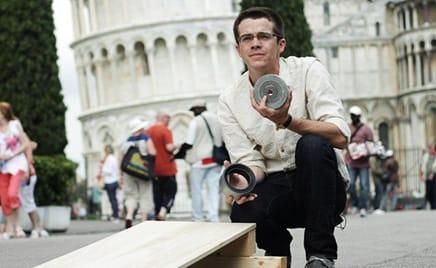
Landmarks in Physics. Study physics abroad in Europe -- virtually! Learn the basics of physics on location in Italy, the Netherlands and the UK, by answering some of the discipline's major questions from over the last 2000 years.

Class Deals by MOOC List - Click here and see Udacity's Active Discounts, Deals, and Promo Codes.

This unique class gives you the chance to see the sites where physics history was made and learn some of the subject's most captivating concepts.

What You Will Learn

Lesson 1
How can we measure the circumference of the Earth?

  • Basics of geometry and trigonometry.

Lesson 2
How do objects move?

  • Data analysis and kinematics.

Lesson 3
What causes motion?

  • Forces
  • acceleration
  • and Newton’s Laws.

Lesson 4
How can we use motion?

  • Work
  • energy
  • and simple machines.

Lesson 5
How can we determine our longitude at sea?

  • Simple harmonic motion.

Lesson 6
What is electricity?

  • Charge and electric fields.

Lesson 7
What is left to discover?

  • Modern physics and open questions.
Go to Class
MOOC List is learner-supported. When you buy through links on our site, we may earn an affiliate commission.
Related Courses

Energy Justice: Fostering More Equitable Energy Futures (Coursera) Coursera
Dartmouth College

Energy Justice: Fostering More Equitable Energy Futures (Coursera)

Are you motivated by the idea that social justice can be served by the energy transition, but are not sure how to make this happen? Do you want to grow your ability to recognize - and do something about - injustice in the energy space? Are you a sustainability or environmental professional eager to help design just energy systems? Do you wonder how to help advance equity in your community’s energy decisions? This course is for you!

Jun 22nd 2026
3 Weeks
Rigid Body Dynamics (Coursera) Coursera
Korea Advanced Institute of Science and Technology - KAIST

Rigid Body Dynamics (Coursera)

This course teaches dynamics, one of the basic mechanics subjects of Mechanical Engineering. Students would be able to organize their knowledge about force and motion, work-energy, impulse-momentum in view of Newton's 2nd law and its integration over time and displacement. The Engineering Dynamics consists of two parts: particle dynamics and rigid body dynamics. This is the second part of the dynamics: rigid body dynamics.

Jun 22nd 2026
13-24 Weeks
Physics 102 - Magnetic Fields and Faraday's Law (Coursera) Coursera
Rice University

Physics 102 - Magnetic Fields and Faraday's Law (Coursera)

This course serves as an introduction to the physics of electricity and magnetism. Upon completion, learners will have an understanding of how the forces between electric charges are described by fields, and how these fields are related to electrical circuits. They will gain experience in solving physics problems with tools such as graphical analysis, algebra, vector analysis, and calculus. The course follows the typical progression of topics of a first-semester university physics course: charges, electric forces, electric fields potential, magnetic fields, currents, magnetic moments, electromagnetic induction, and circuits.

Jun 22nd 2026
4 Weeks
Archaeoastronomy (Coursera) Coursera
Politecnico di Milano

Archaeoastronomy (Coursera)

Archaeoastronomy is the “science of stars and stones”: it studies the relationships between the ancient monuments and the sky, in order to gain a better understanding of the ideas of the architects of the past and of their religious and symbolic world. The course provides the first complete, easy introduction to this fascinating discipline.

Jun 22nd 2026
5-12 Weeks
Physics 102 - Electric Charges and Fields (Coursera) Coursera
Rice University

Physics 102 - Electric Charges and Fields (Coursera)

This course serves as an introduction to the physics of electricity and magnetism. Upon completion, learners will have an understanding of how the forces between electric charges are described by fields, and how these fields are related to electrical circuits. They will gain experience in solving physics problems with tools such as graphical analysis, algebra, vector analysis, and calculus. The course follows the typical progression of topics of a first-semester university physics course: charges, electric forces, electric fields potential, magnetic fields, currents, magnetic moments, electromagnetic induction, and circuits.

Jun 22nd 2026
4 Weeks
Electrodynamics: In-depth Solutions for Maxwell’s Equations (Coursera) Coursera
Korea Advanced Institute of Science and Technology - KAIST

Electrodynamics: In-depth Solutions for Maxwell’s Equations (Coursera)

This course is the fourth course in the Electrodynamics series, and is directly proceeded by Electrodynamics: Electric and Magnetic Fields. Previously, we have learned about visualization of fields and solutions which were not time dependent. Here, we will return to Maxwell's Equations and use them to produce wave equations which can be used to analyze complex systems, such as oscillating dipoles. We will also introduce AC circuits, and how they can be simplified, solved, and applied.

Jun 22nd 2026
5-12 Weeks
Renewable Power and Electricity Systems (Coursera) Coursera
University of Colorado Boulder

Renewable Power and Electricity Systems (Coursera)

The energy revolution in underway. Renewable energy is growing at an astounding pace - notably in electricity. Wind turbines and solar photovoltaic (PV) systems account for most new power plants built worldwide, and are essential to building a low-carbon and sustainable energy future. As a result, there are countless new opportunities in renewable electricity.

Jun 22nd 2026
5-12 Weeks
Astro 101: Black Holes (Coursera) Coursera
University of Alberta

Astro 101: Black Holes (Coursera)

What is a black hole? Do they really exist? How do they form? How are they related to stars? What would happen if you fell into one? How do you see a black hole if they emit no light? What’s the difference between a black hole and a really dark star? Could a particle accelerator create a black hole? Can a black hole also be a worm hole or a time machine? In Astro 101: Black Holes, you will explore the concepts behind black holes. Using the theme of black holes, you will learn the basic ideas of astronomy, relativity, and quantum physics.

Jun 22nd 2026
5-12 Weeks