The Importance and Power of Music in our Society (Coursera)

The Importance and Power of Music in our Society (Coursera)

Music plays an important role in our daily lives and is woven into the fabric of society. We listen to music while alone or in company, in a dance club or at home, through simple headphones or via high-end speakers, as background or as foreground, after we get up or before we go to bed. Music accompanies us when we are traveling, doing sports, shopping, working or relaxing. This omnipresence of music raises several questions: how does music affect our lives? What is the relation between the society we live in and the role, function, and position of music within that society? How is music influenced by and does music influence social, political, economic, technological, and multiple other developments?

Class Deals by MOOC List - Click here and see Coursera's Active Discounts, Deals, and Promo Codes.

Do these questions trigger you? Music and Society provides a thorough introduction to the various ways in which music and society are connected through engaging lectures, insightful interviews, challenging assignments, interesting readings, and of course a lot of musical examples. The course aims at increasing your insights on where, how and why we listen to music, how music contributes to shaping our identity, how music forms, expresses, and subverts political ideas, and how music affects our norms and values.

Syllabus

WEEK 1
Welcome to the Course
Great that you are joining us! In this course you will learn about the various roles, functions, and positions music can have in our contemporary society. Before you start this course we invite you to first go through the introduction and introduce yourself in the forum to meet your fellow learners. If you encounter any difficulties while studying, please let us know in the forum. For technical difficulties or questions regarding the course certificate, you can always contact the Coursera Learner Helpdesk. Good luck and we hope you will enjoy studying in this course!
Music and Atmosphere
What do you think about background music? Does it disturb you or does it create a nice atmosphere? Do you think there is too much music played all day long? And why do people play music? In this first module we will basically discuss and reflect on three interrelated items: (1) How and why music is omnipresent in our contemporary society; (2) Music's influence on the specific atmosphere of a space; (3) How music affects and is affected by other societal developments.

WEEK 2
Music and Identity
How does music affect identity and how does identity influence music? Is music only an expression of personal taste or is there more to say about this relation? In this module we will discuss and explore the relation between music and identity. We'll do this by discussing (1) how music influences personal identity and (2) how music influences collective identity and (3) how the 'structure of society' influences music as well as identity.

WEEK 3
Music and Politics
In this module we will investigate and discuss the relation between music and politics: how music affects politics and how it is affected by politics. Music may support political organizations and governmental institutions, it has the power to discipline the behavior of groups and individuals, but it can also act as a form of protest against a political status quo or dominant (political) discourses.

WEEK 4
Music and Ethics
In this module we will explore the relation between music and ethics. Music influences behavior and certain judgments of behavior are ethical judgments. We will explore the relation between aesthetic good and ethical good music. We will discuss how hospitality can evoke a fruitful attitude towards music. We will discuss the role of music in human flourishing.
Go to Class
MOOC List is learner-supported. When you buy through links on our site, we may earn an affiliate commission.

Related Courses

Teaching the Violin and Viola: Creating a Healthy Foundation (Coursera) Coursera
Northwestern University

Teaching the Violin and Viola: Creating a Healthy Foundation (Coursera)

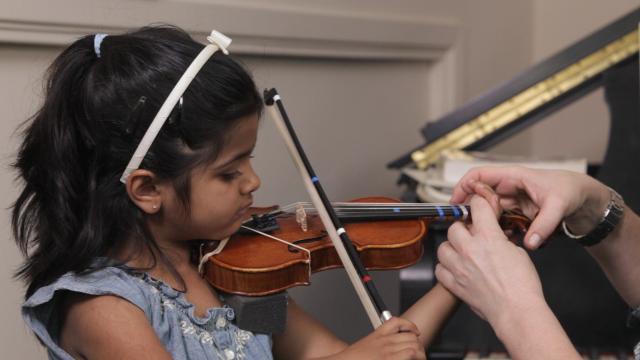
Join us as we explore the fundamental principles and early stages of teaching violin and viola through a series of engaging video lectures and lesson demonstrations, including: 1) Master classes with some of the world’s top string pedagogues, 2) Individual lesson demos of teaching violin/viola set up, left and right hand technique and pieces from the early violin/viola repertoire, 3) Group lesson demos of teaching music theory, ear training and fun activities that encourage good playing habits, and 4) A “field trip” to the violin shop, where we will outfit a new beginning student with a proper instrument and bow.

Oct 26th 2026
5-12 Weeks
Exploring Beethoven's Piano Sonatas (Coursera) Coursera
Curtis Institute of Music

Exploring Beethoven's Piano Sonatas (Coursera)

Our relationship to Beethoven is a deep and paradoxical one. For many musicians, he represents a kind of holy grail: His music has an intensity, rigor, and profundity which keep us in its thrall, and it is perhaps unequalled in the interpretive, technical, and even spiritual challenges it poses to performers. At the same time, Beethoven’s music is casually familiar to millions of people who do not attend concerts or consider themselves musically inclined. Two hundred years after his death, he is everywhere in the culture, yet still represents its summit. This course takes an inside-out look at the 32 piano sonatas from the point of view of a performer.

Oct 26th 2026
5-12 Weeks
Fundamentals of Audio and Music Engineering: Part 1 Musical Sound & Electronics (Coursera) Coursera
University of Rochester

Fundamentals of Audio and Music Engineering: Part 1 Musical Sound & Electronics (Coursera)

In this course students learn the basic concepts of acoustics and electronics and how they can applied to understand musical sound and make music with electronic instruments. Topics include: sound waves, musical sound, basic electronics, and applications of these basic principles in amplifiers and speaker design.

Oct 26th 2026
5-12 Weeks
Risk in Modern Society (Coursera) Coursera
Leiden University,LDE Centre for Safety and Security

Risk in Modern Society (Coursera)

Risk has become one of the defining features of modern society. Almost daily, we are preoccupied with assessing, discussing, or preventing a wide variety of risks. It is a cornerstone notion for businesses and organizations, but also for nation states and their many levels of government. And even for individuals, risk and the avoidance or embracing thereof, is a key theme. The course Risk in Modern Society sheds light on the broad concept of risk.

Oct 26th 2026
5-12 Weeks
Global Diplomacy: the United Nations in the World (Coursera) Coursera
University of London,SOAS University of London

Global Diplomacy: the United Nations in the World (Coursera)

The course offers a well-researched and broad-ranging primer to the United Nations system. Consisting of an introduction to the complex UN family and its history, and a series of ‘snapshots’ of key UN functions, which are used to explore important UN themes and help learners develop important analysis, communication, and policy-based skills.

Oct 26th 2026
5-12 Weeks
So You Think You Know Tango? (Coursera) Coursera
Emory University

So You Think You Know Tango? (Coursera)

How well do you think you know tango? This two-week mini-course is designed for music lovers, musicians, and dancers who are interested in learning more about the Argentine Tango. It will explore the many dimensions of the Argentine Tango music, including its origins, popularization during the Golden Age, dissemination abroad, evolution into an artistic music-dance form, and adoption by Argentine and international art-music composers to date.

Oct 26th 2026
2 Weeks
The Politics of Skepticism (Coursera) Coursera
Erasmus University Rotterdam

The Politics of Skepticism (Coursera)

This is a course about the history of Skepticism from the ancient Greeks to today, with special attention to the political ramifications of questioning man's ability to know the world and himself with any certainty. We will discuss the debates raging between Plato and the Sophists, the rise of Christianity in the Roman world, and the so-called 'Skeptical Crisis' of the Renaissance as well as Pierre Bayle's Skepticism and David Hume's.

Oct 26th 2026
5-12 Weeks
Corruption (Coursera) Coursera
University of Pennsylvania

Corruption (Coursera)

You can't understand the world today if you don't understand corruption. Every day, we see high-level government officials resigning, governments changing, hundreds of thousands of people standing in squares, holding up signs, and often risking their lives to protest the corruption in the world. It's critically important to the health of our societies to understand what people are protesting against. We want to understand corruption. This course is designed to teach you about what corruption is, what causes corruption, the effects of corruption, and how to control corruption.

Oct 26th 2026
4 Weeks
Today’s Music Industry (Coursera) Coursera
West Virginia University

Today’s Music Industry (Coursera)

This course provides an engaging and methodical insight into the past and present cultural and commercial music industry developments, directions, and trends. It will equip the students with the knowledge and skills necessary to appreciate, understand and more productively participate in today’s music industry field.

Oct 26th 2026
5-12 Weeks