Hacking COVID-19 — Course 2: Decoding SARS-CoV-2's Secrets (Coursera)

Hacking COVID-19 — Course 2: Decoding SARS-CoV-2's Secrets (Coursera)

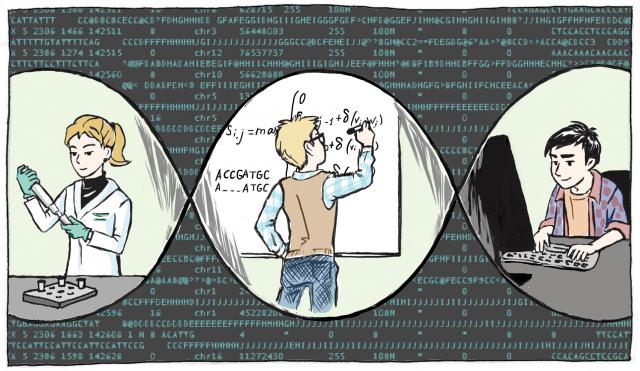
In this course, you will follow in the footsteps of the bioinformaticians investigating the COVID-19 outbreak by annotating the SARS-CoV-2 genome and using the annotation to design a COVID-19 diagnostic test. Whether you’re new to the world of computational biology, or you’re a bioinformatics expert seeking to learn about its applications in the COVID-19 pandemic, or somewhere in between, this course is for you!

Class Deals by MOOC List - Click here and see Coursera's Active Discounts, Deals, and Promo Codes.

As you go through this journey, we will introduce and explain genomic concepts and give you many opportunities to practice your skills, and we will provide a series of problems with gradually increasing complexity. This second course will only discuss the annotation of the SARS-CoV-2 genome, but future courses in this series will explore follow-up bioinformatics analyses used in the COVID-19 pandemic.

Syllabus

WEEK 1
In Chapter 3, we will explore how to use bioinformatics to aid in rapidly diagnosing patients who may be infected with COVID-19. Much like how laboratories around the world have been hard at work developing methods to test for COVID-19, we will now try to design our own diagnostic test.

WEEK 2
In Chapter 4, we will use the SARS-CoV-2 genome annotation to design our own COVID-19 diagnostic test and will learn how to measure its accuracy.

Go to Class
MOOC List is learner-supported. When you buy through links on our site, we may earn an affiliate commission.

Related Courses

Computing for Cancer Informatics (Coursera) Coursera
Johns Hopkins University

Computing for Cancer Informatics (Coursera)

One of the key cancer informatics challenges is dealing with and managing the explosion of large data from multiple sources that are often too large to work with on typical personal computers. This course is designed to help researchers and investigators to understand the basics of computing and to familiarize them with various computing options to ultimately help guide their decisions on the topic.

Jun 15th 2026
4 Weeks
Strategies for Assisted Living Communities during COVID-19 (Coursera) Coursera
Johns Hopkins University

Strategies for Assisted Living Communities during COVID-19 (Coursera)

SARS-CoV-2, the virus that causes COVID-19, poses a high risk for assisted living communities due to residents’ age, health status, and communal living environment. The COVID-19 response has largely focused on nursing homes, leaving assisted living communities in the United States with fragmented guidance on how to respond to COVID-19 challenges. This course provides comprehensive instruction and resources for administrators and direct-care staff of assisted living communities.

Jun 22nd 2026
1 Week
Big Data, Genes, and Medicine (Coursera) Coursera
The State University of New York

Big Data, Genes, and Medicine (Coursera)

This course distills for you expert knowledge and skills mastered by professionals in Health Big Data Science and Bioinformatics. You will learn exciting facts about the human body biology and chemistry, genetics, and medicine that will be intertwined with the science of Big Data and skills to harness the avalanche of data openly available at your fingertips and which we are just starting to make sense of.

Jun 22nd 2026
5-12 Weeks
Genome Sequencing (Bioinformatics II) (Coursera) Coursera
University of California, San Diego

Genome Sequencing (Bioinformatics II) (Coursera)

You may have heard a lot about genome sequencing and its potential to usher in an era of personalized medicine, but what does it mean to sequence a genome? Biologists still cannot read the nucleotides of an entire genome as you would read a book from beginning to end. However, they can read short pieces of DNA. In this course, we will see how graph theory can be used to assemble genomes from these short pieces. We will further learn about brute force algorithms and apply them to sequencing mini-proteins called antibiotics.

Jun 22nd 2026
5-12 Weeks
Genome Assembly Programming Challenge (Coursera) Coursera
University of California, San Diego,Higher School of Economics - HSE University

Genome Assembly Programming Challenge (Coursera)

In Spring 2011, thousands of people in Germany were hospitalized with a deadly disease that started as food poisoning with bloody diarrhea and often led to kidney failure. It was the beginning of the deadliest outbreak in recent history, caused by a mysterious bacterial strain that we will refer to as E. coli X. Soon, German officials linked the outbreak to a restaurant in Lübeck, where nearly 20% of the patrons had developed bloody diarrhea in a single week. At this point, biologists knew that they were facing a previously unknown pathogen and that traditional methods would not suffice – computational biologists would be needed to assemble and analyze the genome of the newly emerged pathogen.

Jun 15th 2026
3 Weeks
COVID-19 Contact Tracing (Coursera) Coursera
Johns Hopkins University

COVID-19 Contact Tracing (Coursera)

The COVID-19 crisis has created an unprecedented need for contact tracing across the country, requiring thousands of people to learn key skills quickly. The job qualifications for contact tracing positions differ throughout the country and the world, with some new positions open to individuals with a high school diploma or equivalent.

Jun 22nd 2026
1 Week
Managing Supply Chain Disruption During COVID-19 (Coursera) Coursera
University of Illinois at Urbana-Champaign

Managing Supply Chain Disruption During COVID-19 (Coursera)

In this course, you will learn about why and how supply chains become susceptible to a disruption. We will examine this by discussing supply side and demand side issues, primary supply chain flows, complexity, risk management and a combination of solid theoretical supply chain perspectives and current real-world stories. You will learn about the structural, relational and operational factors that come into play during a supply chain disruption and the mechanisms for the effective management of these factors.

Jun 22nd 2026
4 Weeks
Intro to AR/VR/MR/XR: Technologies, Applications & Issues (Coursera) Coursera
University of Michigan

Intro to AR/VR/MR/XR: Technologies, Applications & Issues (Coursera)

This first course in the XR for Everybody specialization creates a foundational understanding of the differences between AR, VR, MR, and XR. The course provides learners with a broad overview of the rapidly evolving XR space and the tools to characterize future XR developments and assess their potential and limitations. It establishes key concepts and dives into the XR device landscape, helping learners to differentiate current and future platforms and devices as well as critique the use of VR or AR in applications. The course pivots in the second half to look more at how to shape the future of XR, by analyzing trends and raising issues such as COVID-19, social and ethical concerns, accessibility and equity, as well as privacy and security.

Jun 22nd 2026
4 Weeks
Virology and Epidemiology in the Time of COVID-19 (Coursera) Coursera
American Museum of Natural History

Virology and Epidemiology in the Time of COVID-19 (Coursera)

This course covers the science and social impacts of viral infectious diseases. We will begin by covering the basics: what a virus is, the structural and functional diversity of viruses, and how viruses use our bodies and the bodies of other organisms to replicate. Then we will dive into the human response: how our immune systems work to protect us from pathogenic viruses and how we use science and social systems to fend off viruses through vaccines and public health measures.

Jun 22nd 2026
5-12 Weeks