The Final Solution to the Jewish Question (Coursera)

Offered by Yad Vashem,
The Final Solution to the Jewish Question (Coursera)

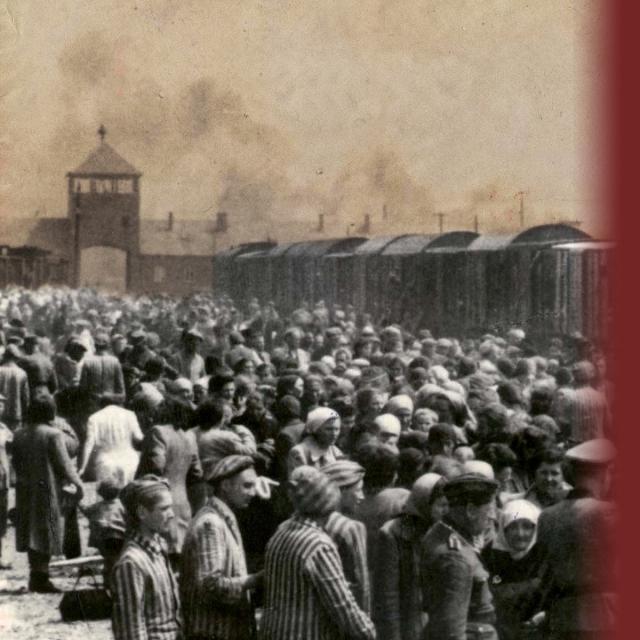
The "Final Solution to the Jewish Question" was the official code name used by Nazi German authorities for the planned annihilation of Jews during World War II. This course focuses on the origins, evolution, and implementation of this deadly operation which led to the murder of six million Jews by the Nazis and their collaborators.

Class Deals by MOOC List - Click here and see Coursera's Active Discounts, Deals, and Promo Codes.

The course is composed of video lectures by world-leading researchers who will share their perspectives on this complex topic. It offers a unique opportunity to learn about the distinct nature of the “Final Solution” and its gradual development, from the rise to power of the Nazi Party in Germany in 1933 until the end of the war in Europe in 1945.

What You Will Learn

  • about the development of Nazi ideology as well as the early measures taken against the Jews and others who were considered "undesirables".
  • about the key decisions and turning points leading to the "Final Solution".
  • about the implementation of the "Final Solution" throughout Europe and the nature of local collaboration.
  • about different approaches to the question of how was it humanly possible.

Syllabus

WEEK 1
Nazi Germany and the Jews
In this week, we will learn about the rise of the Nazi regime to power, about its policies and ideological visions. We will discuss steps taken against the Jews in Nazi Germany prior to the outbreak of World War II in 1939. We will also learn about the ghettoization.

WEEK 2
The Development of the "Final Solution"
In this week, we will learn about how Nazi Germany began to implement the mass murder of Jews in the summer and autumn of 1941 and about the establishment of the first extermination camps in Nazi-occupied Poland. In this week, five renowned historians will present their view on how the “Final Solution” came about.

WEEK 3
The Mechanism of Murder
In this week, we will analyze different Nazi state agencies and mechanisms engaged in the “Final Solution”. We will also deal with some fundamental topics, such as the role of Adolf Hitler in the "Final Solution", the Nazi power apparatus, and the German railway system.

WEEK 4
The "Final Solution" in Local Context
In this week, we will discuss the implementation of the “Final Solution” in different regions of Europe and in different occupation and Nazi-allied zones, examining how different historical contexts influenced the stages of the murder of the Jews.

WEEK 5
The "Final Solution" - Chosen Topics
In this week, we will analyze some additional topics, such as the image of the perpetrators, the place of forced labor and the nature of Jewish resistance to Nazi oppression. We will also ask the question of what the world, the Germans, and the Jews themselves knew about the Nazi plan for their extermination.

Go to Class
MOOC List is learner-supported. When you buy through links on our site, we may earn an affiliate commission.

Related Courses

Miracles of Human Language: An Introduction to Linguistics (Coursera) Coursera
Leiden University,Meertens Instituut - KNAW

Miracles of Human Language: An Introduction to Linguistics (Coursera)

Everywhere, every day, everybody uses language. There is no human society, no matter how small or how isolated, which does not employ a language that is rich and diverse. This course introduces you to linguistics, featuring interviews with well-known linguists and with speakers of many different languages. Join us to explore the miracles of human language!

Aug 17th 2026
5-12 Weeks
Understanding China, 1700-2000: A Data Analytic Approach, Part 1 (Coursera) Coursera
The Hong Kong University of Science and Technology - HKUST

Understanding China, 1700-2000: A Data Analytic Approach, Part 1 (Coursera)

The purpose of this course is to summarize new directions in Chinese history and social science produced by the creation and analysis of big historical datasets based on newly opened Chinese archival holdings, and to organize this knowledge in a framework that encourages learning about China in comparative perspective. Our course demonstrates how a new scholarship of discovery is redefining what is singular about modern China and modern Chinese history.

Aug 3rd 2026
5-12 Weeks
Reimagining Blackness and Architecture (Coursera) Coursera
The Museum of Modern Art

Reimagining Blackness and Architecture (Coursera)

Architecture structures our daily lives. It shapes our homes, streets, neighborhoods, cities and more. But who gets to create and occupy these spaces? In the United States, a long history of anti-Black racism has created spatial inequalities that are built into the physical environment and erased the stories of Black architects and communities. Reimagining Blackness and Architecture explores the relationship between architecture and Blackness as an identity and a lived experience.

Aug 10th 2026
5-12 Weeks
Exploring Beethoven’s Piano Sonatas Part 2 (Coursera) Coursera
Curtis Institute of Music

Exploring Beethoven’s Piano Sonatas Part 2 (Coursera)

Welcome to Part 2 of Exploring Beethoven's Piano Sonatas! I'm delighted to launch another set of new lectures of this course as Part 2. As before, this class is meant for people of all levels of experience with Beethoven's music (including no experience at all!). Remember that you are able to watch the lectures as many times as you like, at whatever pace is comfortable for you.

Aug 10th 2026
5-12 Weeks
The Mediterranean, a Space of Exchange (from the Renaissance to Enlightenment) (Coursera) Coursera
University of Barcelona

The Mediterranean, a Space of Exchange (from the Renaissance to Enlightenment) (Coursera)

The course The Mediterranean, a Space of Exchange (from Renaissance to Enlightenment) aims to explain the Mediterranean, using history and the analysis of the past, as a space generated by routes and circulation. We consider it crucial to disclose mobility as a historical factor: a mobility comprised of four major elements, namely people, objects, ideas and practices.

Aug 14th 2026
5-12 Weeks
The Making of Modern Ukraine (Coursera) Coursera
Yale University

The Making of Modern Ukraine (Coursera)

Ukraine must have existed as a society and polity on 23 February 2022, else Ukrainians would not have collectively resisted Russian invasion the next day. What does it mean for a nation to exist? Is this a matter of structures, actions, or both? Why has the existence of Ukraine occasioned such controversy? In what ways are Polish, Russian, and Jewish self-understanding dependent upon experiences in Ukraine? Just how and when did a modern Ukrainian nation emerge?

Aug 17th 2026
1 Week
Film, Images & Historical Interpretation in the 20th Century: The Camera Never Lies (Coursera) Coursera
University of London,Royal Holloway, University of London

Film, Images & Historical Interpretation in the 20th Century: The Camera Never Lies (Coursera)

This course is a short taster on the topic of the use of Images, Film, and their use in historical interpretation in the 20th century. It is primarily provided for those who have a general interest in history that draws on photojournalism as primary evidence, and films based on historical events.

Aug 10th 2026
5-12 Weeks
The Kennedy Half Century (Coursera) Coursera
University of Virginia

The Kennedy Half Century (Coursera)

When John F. Kennedy entered the presidential limousine at Love Field in Dallas, Texas on November 22, 1963, he began his ride into history. That journey continues even today and we call it the Kennedy legacy. This course will explore the Presidency, assassination, and lasting legacy of President John F. Kennedy. Students will learn how JFK’s life, administration, and tragic death have influenced the general public, the media, and each of the nine U.S. presidents who followed.

Aug 3rd 2026
4 Weeks
Egiptología (Egyptology) (Coursera) Coursera
Universitat Autònoma de Barcelona

Egiptología (Egyptology) (Coursera)

¿Sientes curiosidad por la civilización del antiguo Egipto? ¿Eres un apasionado de su cultura e historia? En este curso nos acercaremos a los templos de los antiguos faraones, a sus complejos funerarios, a sus ciudades, a su escritura jeroglífica, a su religión y a muchos otros aspectos de esta gran civilización.

Aug 3rd 2026
5-12 Weeks
Soul Beliefs: Causes and Consequences - Unit 2: Belief Systems (Coursera) Coursera
Rutgers University

Soul Beliefs: Causes and Consequences - Unit 2: Belief Systems (Coursera)

Throughout history, the vast majority of people around the globe have believed they have, however defined, a “soul.” While the question of whether the soul exists cannot be answered by science, what we can study are the causes and consequences of various beliefs about the soul and its prospects of surviving the death of the body. Why are soul and afterlife beliefs so common in human history? Are there adaptive advantages to assuming souls exist?

Aug 3rd 2026
5-12 Weeks