FUN

Échanges et proximité : la première loi de la géographie (FUN)

Échanges et proximité : la première loi de la géographie (FUN)

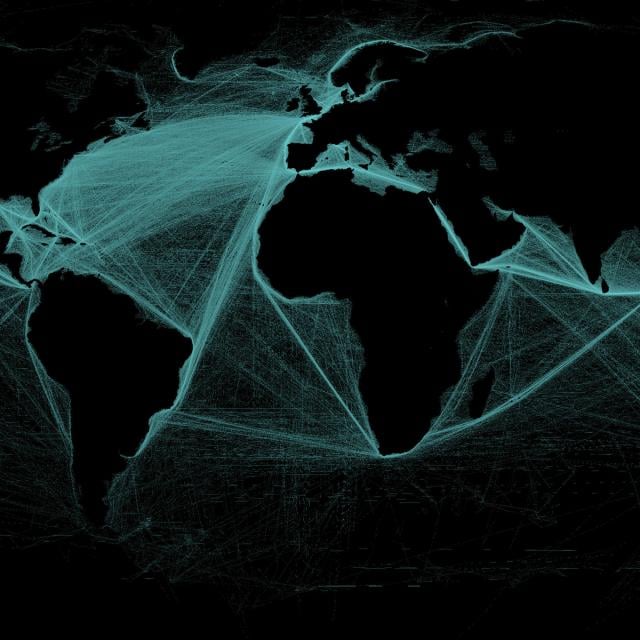
La mondialisation et les nouvelles technologies semblent avoir affaibli les effets de la proximité et de la distance dans l'organisation de l'espace des sociétés. Pourtant les marques profondes laissées par des siècles de restriction des échanges du fait des difficultés et du coût de franchissement de la distance sont encore très apparentes dans l'organisation du monde. Les principales régions économiques, les grandes aires culturelles, des alliances territoriales se sont formées dans ce contexte. Aujourd'hui encore, le potentiel de la proximité continue à structurer les réseaux d'échanges avec leurs inégalités et leurs asymétries.

La première loi de la géographie s'énonce clairement par cette boutade : « Tout interagit avec tout mais deux choses voisines ont plus de chances d'entrer en interaction que deux choses lointaines ». Dans ce cours, on explicitera la signification de cette loi et on en montrera les conséquences. On apprendra à jouer avec cette loi au moyen du modèle gravitaire qui la résume en la formalisant mathématiquement.
A l'issue de ce cours, vous serez familiarisé avec l'observation des flux d'échanges entre lieux, aurez une meilleure compréhension de la modélisation comparativement à des cartes pouvant sembler inextricables et serez en mesure d'utiliser le modèle gravitaire pour comprendre les échanges et les interactions dans l'organisation de l'espace des sociétés.

Format
Le MOOC se déroule sur 5 semaines de cours et propose :

  • de courtes séquences vidéo s'appuyant sur plus de 100 cartes et graphiques (environ une heure par semaine, en séquences de 5 à 10 minutes) ;
  • des documents à télécharger (glossaire, bibliographie, etc.) ;
  • des exercices, simulations, études de cas ;
  • un questionnaire d’auto-évaluation pour faire le point sur vos acquis à la fin de chaque semaine.

Un forum, encourageant l’échange et la discussion, sera animé par l’équipe pédagogique.

Plan du cours

Semaine 1 : De l'observation des flux aux lois de l'échange
Semaine 2 : Calculer et prédire avec le modèle gravitaire
Semaine 3 : Le modèle gravitaire comme filtre révélant les préférences et les barrières
Semaine 4 : La puissance expressive des cartes de potentiel
Semaine 5 : Le modèle gravitaire comme modèle de champ

Go to Class
MOOC List is learner-supported. When you buy through links on our site, we may earn an affiliate commission.

Related Courses

Cultural intelligence: Become a global citizen (Coursera) Coursera
Macquarie University

Cultural intelligence: Become a global citizen (Coursera)

We now live in a truly global, interconnected world in which every manager requires a high level of cultural intelligence. In a diverse work environment, a successful leader must understand the cultural backgrounds, beliefs and attitudes of the people around them – or run the risk of failing to achieve the organisation’s goals. This course, via structured learning activities (video lectures, quizzes, discussion prompts, industry interviews and written assessments), will teach you that those with high ‘cultural intelligence’ – are good at spotting cultural differences and adapt their behaviour accordingly.

Jun 18th 2026
5-12 Weeks
The Dynamic Earth: A Course for Educators (Coursera) Coursera
American Museum of Natural History

The Dynamic Earth: A Course for Educators (Coursera)

The AMNH course The Dynamic Earth: A Course for Educators provides students with an overview of the origin and evolution of the Earth. Informed by the recently released Next Generation Science Standards, this course examines geological time scales, radiometric dating, and how scientists “read the rocks.” We will explore dramatic changes in the Earth over the last 4 billion years, including how the evolution of life on Earth has affected its atmosphere. In addition to looking at geology on a global scale, participants will take to their own backyards to explore and share their local geologic history.

Jun 1st 2026
4 Weeks
International migrations :a global issue (FUN) FUN
Sciences Po

International migrations :a global issue (FUN)

The world is moving, but not all opinions and governments are willing to accept this poorly understood reality. The issue affects both states and the planet, in a process of globalization and of regionalization of migrations, and raises new questions for international relations, now including the South. This course aims at improving knowledge of the subject, addressing the key issues raised by international migration, and assessing the trends of tomorrow.

No sessions available
5-12 Weeks
Introduction to Intercultural Studies: Intercultural Contact (FutureLearn) FutureLearn
University of Leeds

Introduction to Intercultural Studies: Intercultural Contact (FutureLearn)

Learn how the principles of intercultural contact may challenge the way in which you think about social interaction. On this course you will examine the idea of intercultural contact and the effects of cultural interactions from historical and global perspectives. Through videos and articles, you will discover how intercultural contact is experienced in our everyday lives, and learn about the ways in which people develop intercultural competence.

Sep 23rd 2024
2 Weeks
Cities are back in town : sociologie urbaine pour un monde globalisé (Coursera) Coursera
Sciences Po

Cities are back in town : sociologie urbaine pour un monde globalisé (Coursera)

La mondialisation et l'européanisation favorisent le développement rapide des villes à travers le monde. L'urbanisation atteint de nouveaux sommets aujourd’hui avec l'essor des mégacités (plus de 15 millions d'habitants) comme Calcutta, Los Angeles, Dhaka, Le Caire, Tokyo, New York, Shanghai, Mexico ou Séoul. Au-delà de la métropole moderne, les chercheurs tentent de donner un sens à ces grandes régions urbaines au moyen de concepts divers tels que « post-métropoles », « villes globales », et « régions métropolitaines globales ».

Jun 1st 2026
5-12 Weeks
International Business I (Coursera) Coursera
University of New Mexico

International Business I (Coursera)

We live in a world of intensifying global relationships, one in which international business has become the key determinant of economic development and prosperity. This course, Global Business Environment, Part I, introduces students to a fundamental understanding of the socioeconomic political, cultural, and linguistic environment in which international businesses operate.

May 25th 2026
5-12 Weeks
Migrations internationales : un enjeu mondial (Coursera) Coursera
Sciences Po

Migrations internationales : un enjeu mondial (Coursera)

Le monde bouge, mais les opinions et les gouvernements ne sont pas tous prêts à accepter cette réalité mal connue. La question affecte à la fois les Etats, mais aussi la planète, dans un processus de mondialisation et de régionalisation des migrations, et pose de nouvelles questions aux relations internationales, en y incluant le sud. Ce cours cherche à la fois à parfaire la connaissance sur le sujet, à traiter les thèmes essentiels induits par les migrations internationales et à dresser les tendances de demain.

Jun 1st 2026
5-12 Weeks
Political Economy of Institutions and Development (Coursera) Coursera
Leiden University

Political Economy of Institutions and Development (Coursera)

This course is part of the SDG initiative addressing the UN Sustainable Development Goals, specifically for the following SDGs [1, 8, 10 and 16]. We hope you will join in our efforts to reach the SDG’s in small but measurable and actionable ways, cooperating with Development Done Differently. Expand your impact. You can create a better world. In today’s world, politics and economics are interconnected, but what is the nature of this connectivity?

May 18th 2026
5-12 Weeks
The Arctic as a System (Coursera) Coursera
University of Colorado Boulder

The Arctic as a System (Coursera)

In this course you will first learn about the Arctic as a geographic region, the peoples the Arctic, and the long history of Arctic settlement and exploration. Attention then turns to key features of the Arctic environment – its climate and weather, features of the ocean, sea ice, lands and the Greenland Ice Sheet, and some of the rapid changes being observed.

Jun 8th 2026
5-12 Weeks
Economics: Society, Markets, and [In]equality (Coursera) Coursera
Parsons School of Design, The New School

Economics: Society, Markets, and [In]equality (Coursera)

Thinking critically about today's economy can help you understand the world around you. Economics: Society, Markets, and [In]equality will pique your curiosity and inspire you to learn more about the power dynamics that determine how people and resources are valued, how goods move around the world, and how we manage our planet and the future.

Jun 20th 2026
5-12 Weeks
Cities are back in town : sociología urbana para un mundo globalizado (Coursera) Coursera
Sciences Po

Cities are back in town : sociología urbana para un mundo globalizado (Coursera)

Los procesos de globalización y europeización respaldan el rápido desarrollo de las ciudades en distintas partes del mundo. En el mundo contemporáneo, el proceso de urbanización está alcanzando un nuevo pico con el incremento de las megalópolis (más de 15 millones de habitantes) como Calcuta, Los Ángeles, Daca, El Cairo, Tokio, Nueva York, Shanghái, Ciudad de México. o Seúl. Más allá de las metrópolis modernas, los investigadores intentan entender estas grandes zonas urbanas con el uso de distintos conceptos, tales como "posmetrópolis", "ciudades globales" y "ciudades-regiones globales".

Jun 8th 2026
5-12 Weeks