The Dynamic Earth: A Course for Educators (Coursera)

The Dynamic Earth: A Course for Educators (Coursera)

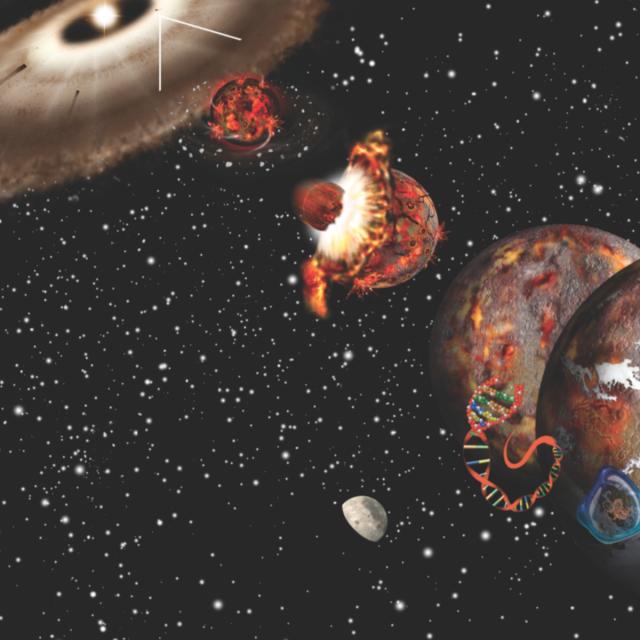
The AMNH course The Dynamic Earth: A Course for Educators provides students with an overview of the origin and evolution of the Earth. Informed by the recently released Next Generation Science Standards, this course examines geological time scales, radiometric dating, and how scientists “read the rocks.” We will explore dramatic changes in the Earth over the last 4 billion years, including how the evolution of life on Earth has affected its atmosphere. In addition to looking at geology on a global scale, participants will take to their own backyards to explore and share their local geologic history.

Class Deals by MOOC List - Click here and see Coursera's Active Discounts, Deals, and Promo Codes.

Course participants will bring their understanding of the dynamic Earth - along with content resources, discussion questions, and assignments - into their own teaching.

Syllabus

WEEK 1
Introduction & The Mystery of Geologic Time
You will explore the ways scientists study the rock record to determine the geologic history of the Earth.

WEEK 2
Evolution of the Atmosphere
You will learn how the evolution of photosynthetic life changed the concentration of oxygen in the oceans and atmosphere, and how this is reflected in the rock record. You will also become familiar with how the Next Generation Science Standards connect to this week’s content. Finally, you will complete a written assignment: an analysis of a local geologic feature.

WEEK 3
Plate Tectonics: Mountain Building
You will learn how convection causes solid rock to flow in the Earth’s mantle and how the movement of the Earth’s tectonic plates forms mountains. You will also learn how to identify and address common student misconceptions about plate tectonics.

WEEK 4
Plate Tectonics: Earthquakes
You will learn about earthquake risk. Using a multimedia teaching case about earthquake risk in Bangladesh, you will learn how scientists define and assess the risk from geologic events. You will also learn how to implement this or similar teaching cases with your students.

Go to Class
MOOC List is learner-supported. When you buy through links on our site, we may earn an affiliate commission.

Related Courses

Educación en Contextos Rurales: Perspectivas en América Latina (Coursera) Coursera
Universidad Austral

Educación en Contextos Rurales: Perspectivas en América Latina (Coursera)

Este curso te permitirá comprender la educación en contextos rurales de América Latina y los desafíos que plantea en la actualidad. A partir de las estadísticas actuales y literatura reciente, se caracterizará esta modalidad educativa, para identificar sus fortalezas y la potencialidad de inspirar, a partir de ellas, mejoras en otros contextos educativos.

Jun 22nd 2026
4 Weeks
Evaluación para el aprendizaje: Enfoque cuantitativo (Coursera) Coursera
Universidad Nacional Autónoma de México

Evaluación para el aprendizaje: Enfoque cuantitativo (Coursera)

La perspectiva contemporánea de la educación ha considerado que dentro del proceso educativo es indispensable la evaluación como una parte esencial de la enseñanza y el aprendizaje. Realizar este proceso de manera adecuada requiere de una formación especializada que nos permita conocer tanto el proceso en sí mismo, así como los elementos involucrados en él y la pertinencia de hacer uso de las técnicas e instrumentos más adecuados y necesarios para cada tipo de evaluación.

Jun 22nd 2026
4 Weeks
Basics of Inclusive Design for Online Education (Coursera) Coursera
University of Colorado Boulder

Basics of Inclusive Design for Online Education (Coursera)

This course provides instruction and strategies to support you in developing a course that is inclusive to students with a wide range of abilities, including students with disabilities. We cover effective practices to increase inclusion and avoid some of the common accessibility issues that can arise in an online course.

Jun 22nd 2026
5-12 Weeks
Seismology to Earthquake Engineering (Coursera) Coursera
École Polytechnique

Seismology to Earthquake Engineering (Coursera)

This course ranges from the earth structure, the generation of earthquakes and seismic waves by faults to the seismic response of soils, foundations and structures as well as seismic risk. It is consequently aimed at undergraduates, graduates and professionals interested in engineering seismology, earthquake engineering or seismic risk. It investigates various technical fields: rock mechanics, soil dynamics, structural dynamics and dynamic soil-structure interaction.

Jun 22nd 2026
5-12 Weeks
Expanding SEL (Coursera) Coursera
University of Colorado Boulder

Expanding SEL (Coursera)

Social and emotional learning, or SEL, programs have flourished in schools during the last decade. In this course the instructors (Emily Price and Ben Kirshner) introduce and help you examine community based and youth-empowerment approaches to social and emotional learning. Some of these approaches address the impact of social and political systems, such as immigration and structural racism, on children’s social and emotional experiences.

Jun 22nd 2026
5-12 Weeks
Disability Inclusion in Education: Building Systems of Support (Coursera) Coursera
University of Cape Town

Disability Inclusion in Education: Building Systems of Support (Coursera)

Worldwide millions of children are not able to fully participate in schooling, and this is especially a problem for children with disabilities. In this course, we explore the support that teachers need in order to meet the needs of children with severe to profound hearing, visual and intellectual disabilities. We consider how this can be done by talking with a range of experts (from teachers to activists) about inclusive education as well as sharing experiences of education.

Jun 22nd 2026
5-12 Weeks
Constructivism and Mathematics, Science, and Technology Education (Coursera) Coursera
University of Illinois at Urbana-Champaign

Constructivism and Mathematics, Science, and Technology Education (Coursera)

This course is designed to help participants examine the implications of constructivism for learning and teaching in science, mathematics, and technology focused areas. Course readings, discussions, and assignments will examine constructivist views of learning, research on students' ideas and idea-based interactions, research on instructional approaches taking student ideas into account, and challenges in implementing constructivist perspectives in instruction.

Jun 22nd 2026
5-12 Weeks
The Arctic as a System (Coursera) Coursera
University of Colorado Boulder

The Arctic as a System (Coursera)

In this course you will first learn about the Arctic as a geographic region, the peoples the Arctic, and the long history of Arctic settlement and exploration. Attention then turns to key features of the Arctic environment – its climate and weather, features of the ocean, sea ice, lands and the Greenland Ice Sheet, and some of the rapid changes being observed.

Jun 22nd 2026
5-12 Weeks
Resilient Teaching Through Times of Crisis and Change (Coursera) Coursera
University of Michigan

Resilient Teaching Through Times of Crisis and Change (Coursera)

Resilient teaching is the ability to facilitate learning experiences that are designed to be adaptable to fluctuating conditions and disruptions. This teaching ability can be seen as an outcome of a design approach that attends to the relationship between learning goals and activities, and the environments they are situated in. Resilient teaching approaches take into account how a dynamic learning context may require new forms of interactions between teachers, students, content, and tools. Additionally, they necessitate the capacity to rethink the design of learning experiences based on a nuanced understanding of context.

Jun 22nd 2026
4 Weeks
Problem-Solving Skills for University Success (Coursera) Coursera
The University of Sydney

Problem-Solving Skills for University Success (Coursera)

In this course, you will learn how to develop your Problem Solving and Creativity Skills to help you achieve success in your university studies. After completing this course, you will be able to: 1-Recognise the importance and function of problem solving and creative thought within academic study and the role of critical thought in creative ideation; 2-Develop a toolkit to be able to identify real problems and goals within ill-defined problems; 3-Recognize and apply analytical problem solving techniques: 4-Recognise and apply creative problem solving techniques; 5-Identify the use of creativity within and types of problems most common to your field; 6-Apply learnt problem solving and creative ideation skills to a real-life context and reflect on personal learning processes

Jun 22nd 2026
5-12 Weeks
Teach English Now! Lesson Design and Assessment (Coursera) Coursera
Arizona State University

Teach English Now! Lesson Design and Assessment (Coursera)

Learners will be introduced to designing lesson plans based on principles and knowledge of learning objectives, assessment plans, methods, materials, and learning activities. Learners will find and prepare appropriate teaching materials through careful analysis, adaptation and creation of professional resources. Learners will also reflect on the cohesion between lesson design and teaching philosophies.

Jun 22nd 2026
5-12 Weeks