EdX

Discrete-Time Signal Processing (edX)

Offered by MIT, MITx,
Discrete-Time Signal Processing (edX)

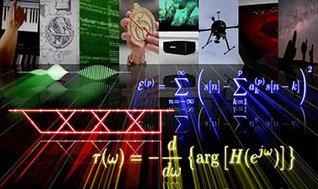
A focused view into the theory behind modern discrete-time signal processing systems and applications. 6.341x is designed to provide both an in-depth and an intuitive understanding of the theory behind modern discrete-time signal processing systems and applications.

Class Deals by MOOC List - Click here and see EdX's Active Discounts, Deals, and Promo Codes.

The course begins with a review and extension of the basics of signal processing including a discussion of group delay and minimum-phase systems, and the use of discrete-time (DT) systems for processing of continuous-time (CT) signals. The course develops flow-graph and block diagram structures including lattice filters for implementing DT systems, and techniques for the design of DT filters. Parametric signal modeling and the efficient implementation of DT multirate and sampling rate conversion systems are discussed and developed. An in-depth development of the DFT and its computation as well as its use for spectral analysis and for filtering is presented. This component of the course includes a careful and insightful development of the relationship between the time-dependent Fourier transform and the use of filter banks for both spectral analysis and signal coding.

6.341x is organized around eleven units each typically consisting of a set of two to four topics. The source material for learning each topic includes suggested reading in the course text, clarifying notes, other related reading, and video excerpts and will include an interactive on-line discussion forum. The course text is the widely used text by Oppenheim and Schafer (third edition). The video segments are adapted from live video recordings of the MIT residential course.
Each topic includes a set of automatically-graded exercises for self-assessment and to help in digesting and understanding the basics of the topic, and in some cases to preview topics. A typical unit in the course concludes with a set of more extensive problems to help in integrating the topics and developing a deeper understanding. Automatic grading of your answers to these problems as well as solutions will be provided.
6.341x and this freely-available version were developed through the support and encouragement of the MIT Department of Electrical Engineering and Computer Science, the MIT Office of Digital Learning, and the MIT Research Laboratory of Electronics.6.341x is organized around eleven units each typically consisting of a set of two to four topics. The source material for learning each topic includes suggested reading in the course text, clarifying notes, other related reading, and video excerpts and will include an interactive on-line discussion forum. The course text is the widely used text by Oppenheim and Schafer (third edition). The video segments are adapted from live video recordings of the MIT residential course.
Each topic includes a set of automatically-graded exercises for self-assessment and to help in digesting and understanding the basics of the topic, and in some cases to preview topics. A typical unit in the course concludes with a set of more extensive problems to help in integrating the topics and developing a deeper understanding. Automatic grading of your answers to these problems as well as solutions will be provided.
6.341x and this freely-available version were developed through the support and encouragement of the MIT Department of Electrical Engineering and Computer Science, the MIT Office of Digital Learning, and the MIT Research Laboratory of Electronics.

Go to Class
MOOC List is learner-supported. When you buy through links on our site, we may earn an affiliate commission.

Related Courses

Wave-Based NDT Methods (edX) EdX
Purdue University,PurdueX

Wave-Based NDT Methods (edX)

Learn how to use wave-based NDT techniques, ultrasonic testing, acoustic emission, etc, to inspect the structural integrity of civil engineering structures, including highways, bridges, dams, and buildings. Wave-based NDT methods allow for reliable and rapid evaluation of civil engineering infrastructure. These methods are particularly useful in long-range inspection; for example, in pipelines, where the wave-based NDT can provide data on hundreds of meters of piping in a matter of seconds.

Feb 14th 2022
5-12 Weeks
Dynamics and Control (edX) EdX
Universitat Politècnica de València,UPValenciaX

Dynamics and Control (edX)

This is an interactive course about the basic concepts of Systems, Control and their impact in all the human activities. First, the basic concepts of systems, dynamics, structure and control are introduced. Then, looking at many examples in Nature and human made devices, we will realize that the dynamic behavior of most systems can be modified by adding a control system. Later we will see how knowing how to evaluate the dynamic behavior of a system and measure its performance will provide the tools to design new controlled systems fulfilling some requirements.

Self Paced
Self-Paced
Robot Mechanics and Control, Part II (edX) EdX
Seoul National University,SNUx

Robot Mechanics and Control, Part II (edX)

A mathematical introduction to the mechanics and control of robots. This course is Part II of a two-part mathematical introduction to the mechanics and control of robots that can be modeled as kinematic chains. Topics covered include the concept of a robot’s configuration space and degrees of freedom, static grasp analysis, the description of rigid body motions, kinematics of open and closed chains, and the basics of robot control.

No sessions available
4 Weeks
Signals and Systems, Part 2 (edX) EdX
IIT Bombay,IITBombayX

Signals and Systems, Part 2 (edX)

This course provides the basic toolkit for any signal processing application - the abstraction of signals and systems, from the point of view of analysis and characterisation. We encounter signals and systems extensively in our day-to-day lives, from making a phone call, listening to a song, editing photos, manipulating audio files, using speech recognition softwares like Siri and Google now, to taking EEGs, ECGs and X-Ray images. Each of these involves gathering, storing, transmitting and processing information from the physical world. This course will equip you to deal with these tasks efficiently by learning the basic mathematical framework of signals and systems.

No sessions available
5-12 Weeks
Energy-The Technology You Must Know in the 21st Century | 能源─21世紀你必須了解的科技! (edX) EdX
OECx

Energy-The Technology You Must Know in the 21st Century | 能源─21世紀你必須了解的科技! (edX)

A comprehensive introduction to existing and emerging energy technologies and their applications. (Taught in Mandarin). Energy technology is a highly multidisciplinary subject, which extends from engineering (e.g. mechanical, chemical, civil, environmental and electrical) to economy and ecology.

No sessions available
4 Weeks
Solar Energy: Photovoltaic (PV) Technologies (edX) EdX
Delft University of Technology,DelftX

Solar Energy: Photovoltaic (PV) Technologies (edX)

Explore the main PV technologies in the current market. Get in-depth knowledge on the design and processing methods of solar cells. The technologies used to produce solar cells and photovoltaic modules are advancing to deliver highly efficient and flexible solar panels. In this course you will explore the main PV technologies in the current market.

Aug 29th 2023
5-12 Weeks
Quantum Detectors (edX) EdX
Purdue University,PurdueX

Quantum Detectors (edX)

Learn about quantum sensors and devices that extract maximal information from the world around us. Classical detectors and sensors are ubiquitous around us from heat sensors in cars to light detectors in a camera cell phone. Leveraging advances in the theory of noise and measurement, an important paradigm of quantum metrology has emerged. Here, ultra-precision measurement devices collect maximal information from the world around us at the quantum limit.

Feb 12th 2024
5-12 Weeks
Introduction to Quantum Transport (edX) EdX
Purdue University,PurdueX

Introduction to Quantum Transport (edX)

This course introduces the non-equilibrium Green’s function (NEGF) method widely used to describe quantum effects in nanoscale devices, along with its applications to spintronic devices. This course introduces the Schrödinger equation, using the tight-binding method to discuss the concept of bandstructure and E(k) relations, followed by an introduction to the NEGF method with simple illustrative examples. Concept of spinors is introduced along with the application of the NEGF method to spintronic devices.

Feb 12th 2024
5-12 Weeks
Management in Engineering: Strategy and Leadership (edX) EdX
MIT,MITx

Management in Engineering: Strategy and Leadership (edX)

Analyze challenging real-life business cases that engineering managers face on a variety of topics. Apply management tools and relevant skills to manage innovation. This course was formerly known as Management in Engineering II. As part of the Principles of Manufacturing MicroMasters program, this course aims to provide exposure to key principles and practices used in engineering management.

Jan 9th 2024
5-12 Weeks
Solid State Devices 1 (edX) EdX
Purdue University,PurdueX

Solid State Devices 1 (edX)

Semiconductor are everywhere in human activities, from your credit card to space exploration. This graduate-level introduction brings aspects of physics, chemistry, and engineering together to understand, analyze, and design transistors and solar cells. This course provides the graduate-level introduction to understand, analyze, characterize and design the operation of semiconductor devices such as transistors, diodes, solar cells, light-emitting devices, and more.

Jan 9th 2023
13-24 Weeks
Discrete Time Signals and Systems, Part 1: Time Domain (edX) EdX
Rice University,RiceX

Discrete Time Signals and Systems, Part 1: Time Domain (edX)

Enter the world of signal processing: analyze and extract meaning from the signals around us! Technological innovations have revolutionized the way we view and interact with the world around us. Editing a photo, re-mixing a song, automatically measuring and adjusting chemical concentrations in a tank: each of these tasks requires real-world data to be captured by a computer and then manipulated digitally to extract the salient information.

No sessions available
5-12 Weeks