EdX

Differential Equations: Linear Algebra and NxN Systems of Differential Equations (edX)

Offered by MIT, MITx,
Differential Equations: Linear Algebra and NxN Systems of Differential Equations (edX)

Learn how to use linear algebra and MATLAB to solve large systems of differential equations. Differential equations are the mathematical language we use to describe the world around us. Most phenomena can be modeled not by single differential equations, but by systems of interacting differential equations. These systems may consist of many equations. In this course, we will learn how to use linear algebra to solve systems of more than 2 differential equations. We will also learn to use MATLAB to assist us.

Class Deals by MOOC List - Click here and see EdX's Active Discounts, Deals, and Promo Codes.

We will use systems of equations and matrices to explore:

  • The original page ranking systems used by Google,
  • Balancing chemical reaction equations,
  • Tuned mass dampers and other coupled oscillators,
  • Threeor more species competing for resources in an ecosystem,
  • The trajectory of a rider on a zipline.

This course is part of the 18.03x Differential Equations XSeries.

What you'll learn
After this course, you will be able to

  • Model and solve different real world phenomena with systems of differential equations.
  • Find the dimension and a basis for a (finite dimensional) vector space.
  • Formulate and solve eigenvalue and eigenvector problems.
  • Use MATLAB to explore solutions to large systems of equations.

Prerequisites
18.031x Introduction to Differential Equations (Scalar equations), 18.032x Differential Equations: 2x2 Systems (2x2 first order differential equations)

Syllabus

Unit 1: Linear Algebra

  1. Solving linear systems: elimination and RREF
  2. Nullspace, vector space
  3. Column space, determinants, and inverses
  4. eigenvalues, eigenvectors, and diagonalization

Unit 2: Systems of Differential Equations

  1. Solving homogeneous NxN systems of differential equations
  2. Matrix exponential and diagonalization
  3. Decoupling and solving inhomogeneous systems of equations
  4. Solving nonlinear systems with MATLAB

Go to Class
MOOC List is learner-supported. When you buy through links on our site, we may earn an affiliate commission.

Related Courses

MATLAB Essentials (edX) EdX
MathWorks

MATLAB Essentials (edX)

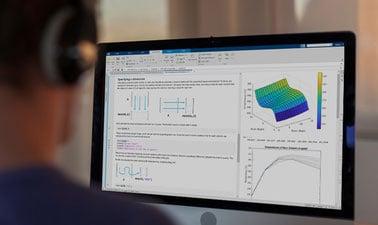
Master the essentials of data visualization, data analysis, programming, and app design interactively with MATLAB. Expand your data analysis and modeling skills in MATLAB, a programming and numeric computing platform used to analyze data, develop algorithms, and create models. Millions of engineers and scientists worldwide use MATLAB to study and build advanced applications in machine learning, deep learning, signal processing, communications, image processing, and control systems.

Self Paced
Self-Paced
Applications of Linear Algebra Part 1 (edX) EdX
Davidson College,DavidsonX

Applications of Linear Algebra Part 1 (edX)

Learn to use linear algebra in computer graphics by making images disappear in an animation or creating a mosaic or fractal and in data mining to measure similarities between movies, songs, or friends. From simulating complex phenomenon on supercomputers to storing the coordinates needed in modern 3D printing, data is a huge and growing part of our world.

No sessions available
4 Weeks
Advanced Linear Algebra: Foundations to Frontiers (edX) EdX
University of Texas at Austin,UTAustinX

Advanced Linear Algebra: Foundations to Frontiers (edX)

Learn advanced linear algebra for computing. Linear algebra is one of the fundamental tools for computational and data scientists. In Advanced Linear Algebra: Foundations to Frontiers (ALAFF), you will build your knowledge, understanding, and skills in linear algebra, practical algorithms for matrix computations, and the analysis of the effects of floating-point arithmetic as performed by computers.

Self Paced
Self-Paced
Algèbre Linéaire (Partie 1) (edX) EdX
École Polytechnique Fédérale de Lausanne,EPFLx

Algèbre Linéaire (Partie 1) (edX)

Un MOOC francophone d'algèbre linéaire accessible à tous, enseigné de manière rigoureuse et ne nécessitant aucun prérequis. Vous voulez apprendre l'algèbre linéaire, un précieux outil complémentaire à vos connaissances acquises durant vos études en économie, ingénierie, physique, ou statistique? Ou simplement pour la beauté de la matière? Alors ce cours est fait pour vous!

Self Paced
Self-Paced
Linear Algebra IV: Orthogonality & Symmetric Matrices and the SVD (edX) EdX
Georgia Institute of Technology,GTx

Linear Algebra IV: Orthogonality & Symmetric Matrices and the SVD (edX)

This course takes you through roughly five weeks of MATH 1554, Linear Algebra, as taught in the School of Mathematics at The Georgia Institute of Technology. In the first part of this course you will explore methods to compute an approximate solution to an inconsistent system of equations that have no solutions. Our overall approach is to center our algorithms on the concept of distance.

Self Paced
Self-Paced
Elements of Structures (edX) EdX
MIT,MITx

Elements of Structures (edX)

An introductory course on statics and on the mechanical behavior of deformable structural elements like beams, shafts and rods. 2.01x introduces principles of structural analysis and strength of materials in applications to three essential types of load-bearing elements: bars in axial loading, axisymmetric shafts in torsion, and symmetric beams in bending.

No sessions available
5-12 Weeks
Mathematical Methods for Quantitative Finance (edX) EdX
MIT,MITx

Mathematical Methods for Quantitative Finance (edX)

Learn the mathematical foundations essential for financial engineering and quantitative finance: linear algebra, optimization, probability, stochastic processes, statistics, and applied computational techniques in R. Modern finance is the science of decision making in an uncertain world, and its language is mathematics. As part of the MicroMasters® Program in Finance, this course develops the tools needed to describe financial markets, make predictions in the face of uncertainty, and find optimal solutions to business and investment decisions.

Jun 26th 2024
5-12 Weeks