EdX

Introduction to Quantum Computing for Everyone 2 (edX)

Introduction to Quantum Computing for Everyone 2 (edX)

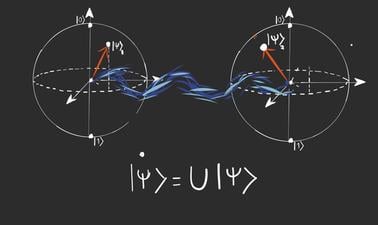
This course focuses on the mathematics, programming, operations, and algorithms of quantum computing. A follow-on to Intro to QC for Everyone 1, this course delves deeper into the mathematical basis for quantum computing and the programming that makes it a reality. Students will be taught all of the mathematical concepts they need to know, build up confidence and experience with individual and small groups of operations, then learn a sequence of important algorithms.

Class Deals by MOOC List - Click here and see EdX's Active Discounts, Deals, and Promo Codes.

What you'll learn

  • The linear algebra concepts that are used to create useful quantum algorithms
  • Small sequences of operations that perform important QC operations
  • How to program with Qiskit, used for the IBM cloud quantum computers
  • Learn several quantum algorithms

This course is part of the Quantum Computing for Everyone Professional Certificate.

Syllabus

  • Linear Algebra
  • Toffoli Gate
  • Phase-Flip
  • EPR Pairs
  • Amplitude Amplification
  • Bernstein-Vazarani algorithm
  • Simon’s algorithm
  • Decoherence
  • Error Correction
Go to Class
MOOC List is learner-supported. When you buy through links on our site, we may earn an affiliate commission.

Related Courses

Advanced Linear Models for Data Science 2: Statistical Linear Models (Coursera) Coursera
Johns Hopkins University

Advanced Linear Models for Data Science 2: Statistical Linear Models (Coursera)

Welcome to the Advanced Linear Models for Data Science Class 2: Statistical Linear Models. This class is an introduction to least squares from a linear algebraic and mathematical perspective. Before beginning the class make sure that you have the following: a basic understanding of linear algebra and multivariate calculus; a basic understanding of statistics and regression models; at least a little familiarity with proof based mathematics; basic knowledge of the R programming language.

Jun 8th 2026
4 Weeks
Matrix Algebra for Engineers (Coursera) Coursera
The Hong Kong University of Science and Technology - HKUST

Matrix Algebra for Engineers (Coursera)

This course is all about matrices, and concisely covers the linear algebra that an engineer should know. The mathematics in this course is presented at the level of an advanced high school student, but typically students should take this course after completing a university-level single variable calculus course. There are no derivatives or integrals in this course, but students are expected to have attained a sufficient level of mathematical maturity. Nevertheless, anyone who wants to learn the basics of matrix algebra is welcome to join.

Jun 8th 2026
4 Weeks
Applications of Linear Algebra Part 2 (edX) EdX
Davidson College,DavidsonX

Applications of Linear Algebra Part 2 (edX)

Explore applications of linear algebra in the field of data mining by learning fundamentals of search engines, clustering movies into genres and of computer graphics by posterizing an image. Our world is in a data deluge with ever increasing sizes of datasets. Linear algebra is a tool to manage and analyze such data. This course is part 2 of a 2-part course, with this part extending smoothly from the first. Note, however, that part 1, is not a prerequisite for part 2.

No sessions available
4 Weeks
Differential Equations: Linear Algebra and NxN Systems of Differential Equations (edX) EdX
MIT,MITx

Differential Equations: Linear Algebra and NxN Systems of Differential Equations (edX)

Learn how to use linear algebra and MATLAB to solve large systems of differential equations. Differential equations are the mathematical language we use to describe the world around us. Most phenomena can be modeled not by single differential equations, but by systems of interacting differential equations. These systems may consist of many equations. In this course, we will learn how to use linear algebra to solve systems of more than 2 differential equations. We will also learn to use MATLAB to assist us.

Jan 11th 2023
5-12 Weeks
Quantum Mechanics (edX) EdX
Georgetown University,GeorgetownX

Quantum Mechanics (edX)

Learn the quantum mechanics needed to prepare you for the second quantum revolution (focused on quantum sensing). We use a new way to teach quantum for undergraduates by focusing on conceptual ideas and operator manipulations. This allows us to discuss more applications to experiment usually done. You need a background in the full calculus sequence and in math methods. Freshman physics and modern physics is recommended. This course is appropriate for physicists, chemists and engineers.

Aug 21st 2023
13-24 Weeks
Quantum Technologies for Decision Makers (edX) EdX
University of Queensland,UQx

Quantum Technologies for Decision Makers (edX)

Quantum technology is all around yet many of us can readily be confused by the science, let alone the trajectories to identifying commercial opportunities. In such a context, making strategic decisions when the science and engineering are shifting presents many innovation dilemmas. Our interest lies in exploring enough of the science to boost our understanding so that we can make informed decisions to allocate resources that create and harness emerging opportunities.

Mar 28th 2023
4 Weeks
Algèbre Linéaire (Partie 3) (edX) EdX
École Polytechnique Fédérale de Lausanne,EPFLx

Algèbre Linéaire (Partie 3) (edX)

Un MOOC francophone d'algèbre linéaire accessible à tous, enseigné de manière rigoureuse et ne nécessitant aucun prérequis. Vous voulez apprendre l'algèbre linéaire, un précieux outil complémentaire à vos connaissances acquises durant vos études en économie, ingénierie, physique, ou statistique? Ou simplement pour la beauté de la matière? Alors ce cours est fait pour vous!

Self Paced
Self-Paced