EdX

Design of mound breakwaters for feasibility studies. Cubipod® Manual 2016 (edX)

Design of mound breakwaters for feasibility studies. Cubipod® Manual 2016 (edX)

The goal of this course is to provide the tools to create feasible designs of mound breakwaters protected with Cubipod® armors fulfiling the prescribed economic, functional and safety requirements. This course is intended for professionals of coastal and port engineering who work in the preliminary design and feasibility studies of breakwaters.

Class Deals by MOOC List - Click here and see EdX's Active Discounts, Deals, and Promo Codes.

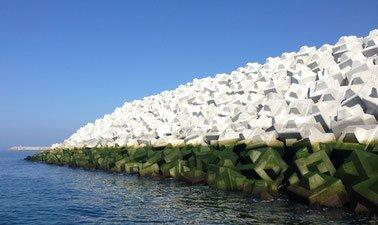
The course is planned for civil engineers and other professionals familiar with common coastal and port engineering concepts and terminology. The goal of this course is to provide the tools to create feasible designs of mound breakwaters protected with Cubipod® armors fulfiling the prescribed economic, functional and safety requirements. Cubipod® is a massive concrete armor unit, the only one which can be safely and easily used in single- and double-layer armoring. This course will be beneficial if you are a civil engineer analyzing variants for breakwaters and feasibility studies.
This course is focused on Cubipod® armored breakwaters, considering the logistic constraints and minimizing the economic cost as well as the carbon and energy footprints. During the feasibility studies, different workable preliminary designs are compared; later, several alternatives are analyzed in detail. This course facilitates the preliminary design of single- and double-layer Cubipod® armored breakwaters. This course is organized in seven modules corresponding to the seven chapters of the Cubipod® Manual 2016, which will be used as the basic reference book.

What you'll learn
In this course you will learn:

  1. the main characteristics of mound breakwaters and armor layers,
  2. the fundamental concepts to be taken into consideration to study alternatives and to estimate costs, with special attention on the use of Cubipods to protect mound breakwaters,
  3. the estimation of the hydraulic stability of single- and double-layer Cubipod® armors, run-up, overtopping and forces on crown walls,
  4. the assessment of the structural integrity of Cubipods, the manufacturing process, handling, stacking and placement on the armor layer and
  5. the rules to make a preliminary design of a Cubipod® armored mound breakwater. The objective is to learn how to find feasible designs of single- or double-layer Cubipod® armored breakwaters fulfiling the prescribed economic, functional and safety requirements.

Syllabus

  1. Introduction
  2. Hydraulic stability of the armor layer
  3. Overtopping and forces on crown wall
  4. Structural integrity of cubipod® armor units
  5. Manufacture, handling and stacking of cubipods
  6. Cubipod® placement in the armor
  7. Example. Preliminary design of a mound breakwater
  8. Final exam

Prerequisites
General knowledge of Civil Engineering and particular knowledge of Coastal and Port Engineering. Previous knowledge of basic concepts and terminology commonly used in Coastal and Port Engineering is also required, such as “significant wave height”, “peak period”, “crown wall”, “return period”, “stability number”, etc.
Go to Class
MOOC List is learner-supported. When you buy through links on our site, we may earn an affiliate commission.

Related Courses

Fundamentos de Mecánica para Ingeniería (edX) EdX
Universitat Politècnica de València,UPValenciaX

Fundamentos de Mecánica para Ingeniería (edX)

Estudiaremos la cinemática y la dinámica del punto, los conceptos de trabajo y potencia y la energía mecánica. Se aborda el estudio del universo físico analizando objetos en movimiento. Se definen y analizan todas las magnitudes y leyes físicas que permiten describir geométrica y causalmente el movimiento de cuerpos representados por un punto.

Self Paced
Self-Paced
The Basics of Transport Phenomena (edX) EdX
Delft University of Technology,DelftX

The Basics of Transport Phenomena (edX)

Learn the basic framework to work on a broad spectrum of engineering problems concerning transfer of heat, mass and momentum. Learn through examples of everyday processes at home, in the lab and in industry. Have you ever wondered why ventilation helps to cool down your hot chocolate? Do you know why a surfing suit keeps you warm? Why iron feels cold, while wood feels warm at room temperature? Or how air is transferred into aqueous liquids in a water treatment plant? How can we sterilize milk with the least amount of energy? How does medicine spread in our tissue? Or how do we design a new cooling tower of a power plant? All these are phenomena that involve heat transfer, mass transfer or fluid flow.

Self Paced
Self-Paced
Fundamentos de la obtención, estructura y modificación de materiales poliméricos (edX) EdX
Universitat Politècnica de València,UPValenciaX

Fundamentos de la obtención, estructura y modificación de materiales poliméricos (edX)

Aprende sobre la gran versatilidad de los polímeros en aplicaciones cotidianas así como también en sectores altamente tecnológicos como la aeronáutica, los deportes de competición y el sector médico. Los materiales poliméricos, se consideran materiales con un gran potencial de uso en el ámbito de la ingeniería. Actualmente, los polímeros se han convertido en materiales fundamentales en nuestra cultura y vida cotidiana, ya que los podemos encontrar en todo tipo de productos como ropa, automóviles, juguetes, etc.

Self Paced
Self-Paced
Dynamics and Control (edX) EdX
Universitat Politècnica de València,UPValenciaX

Dynamics and Control (edX)

This is an interactive course about the basic concepts of Systems, Control and their impact in all the human activities. First, the basic concepts of systems, dynamics, structure and control are introduced. Then, looking at many examples in Nature and human made devices, we will realize that the dynamic behavior of most systems can be modified by adding a control system. Later we will see how knowing how to evaluate the dynamic behavior of a system and measure its performance will provide the tools to design new controlled systems fulfilling some requirements.

Self Paced
Self-Paced
水力学 | Hydraulics (edX) EdX
Tsinghua University,TsinghuaX

水力学 | Hydraulics (edX)

This Hydraulics course explores the science of hydraulics and focuses on hydrodynamic laws and their applications, which are indispensable and a critical factor in the development and utilization of water resources. 水,是人类生活不可或缺的资源。水力学是人类开发利用水资源的有力工具。本课教你认识和掌握水流静止和运动的力学规律,了解在相关领域的工程应用。

Self Paced
Self-Paced
Introduction to Quantum Transport (edX) EdX
Purdue University,PurdueX

Introduction to Quantum Transport (edX)

This course introduces the non-equilibrium Green’s function (NEGF) method widely used to describe quantum effects in nanoscale devices, along with its applications to spintronic devices. This course introduces the Schrödinger equation, using the tight-binding method to discuss the concept of bandstructure and E(k) relations, followed by an introduction to the NEGF method with simple illustrative examples. Concept of spinors is introduced along with the application of the NEGF method to spintronic devices.

Feb 12th 2024
5-12 Weeks
Energy Within Environmental Constraints (edX) EdX
HarvardX,Harvard University

Energy Within Environmental Constraints (edX)

A quantitative introduction to the energy system and its environmental impacts. Humanity faces an immense challenge: providing abundant energy to everyone without wrecking the planet. If we want a high-energy future while protecting the natural world for our children, we must consider the environmental consequences of energy production and use. But money matters too: energy solutions that ignore economic costs are not realistic, particularly in a world where billions of people currently can’t afford access to basic energy services. How can we proceed?

Self Paced
Self-Paced
A System View of Communications: From Signals to Packets (Part 2) (edX) EdX
The Hong Kong University of Science and Technology - HKUST,HKUSTx

A System View of Communications: From Signals to Packets (Part 2) (edX)

Explore the tradeoffs in designing communication systems like mobile phones, and the engineering tools to handle them. Have you ever wondered how information is transmitted using your mobile phone or a WiFi hotspot? This introductory course seeks to enable you to understand the basic engineering tools used and tradeoffs encountered in the design of these communication systems.

Self Paced
Self-Paced
Quantum Detectors (edX) EdX
Purdue University,PurdueX

Quantum Detectors (edX)

Learn about quantum sensors and devices that extract maximal information from the world around us. Classical detectors and sensors are ubiquitous around us from heat sensors in cars to light detectors in a camera cell phone. Leveraging advances in the theory of noise and measurement, an important paradigm of quantum metrology has emerged. Here, ultra-precision measurement devices collect maximal information from the world around us at the quantum limit.

Feb 12th 2024
5-12 Weeks
Modeling and Simulation of Multibody Systems - Part I (edX) EdX
LouvainX,Université Catholique de Louvain - UCL

Modeling and Simulation of Multibody Systems - Part I (edX)

Vehicles, bicycles, cranes, human body and robots are multibody systems. Learn how to model them and compute their kinematic and dynamic characteristics, such as velocities, accelerations and forces. This course aims at acquainting you with the modeling and simulation of complex articulated mechanical systems, denoted as multibody systems, such as vehicles, merry-go-rounds, motorbikes, cranes, human bodies, suspensions, robot manipulators, mechanical transmissions, etc.

Self Paced
Self-Paced
Forensic Engineering: Learning from Failures (edX) EdX
Delft University of Technology,DelftX

Forensic Engineering: Learning from Failures (edX)

Don’t let good failures go to waste! Identify the causes of failure and use this knowledge to enhance safety and improve performance. What do collapsed buildings, infected hospital patients, and crashed airplanes have in common? If you know the causes of these events and conditions, they can all be prevented. In this course, you will learn how to use the TU Delft mind-set to investigate the causes of such events so you can prevent them in the future.

Self Paced
Self-Paced
Decision-Making for Autonomous Systems (edX) EdX
Chalmers University of Technology,ChalmersX

Decision-Making for Autonomous Systems (edX)

Learn effective tactics for making key decisions when working with autonomous, self-driving vehicles. In autonomous vehicles such as self-driving cars, we find a number of interesting and challenging decision-making problems. Starting from the autonomous driving of a single vehicle, to the coordination among multiple vehicles. This course will teach you the fundamental mathematical model for many of these real-world problems.

Self Paced
Self-Paced