Curanderismo: Traditional Healing of the Mind, Energy & Spirit (Coursera)

Curanderismo: Traditional Healing of the Mind, Energy & Spirit (Coursera)

As the third of four courses on Curanderismo, the art of Hispanic/Latino traditional medicine, this course focuses specifically on traditional healing of mind, energy and spirit. As an educational and cultural platform, this course will share a number of traditional body therapies. Trained traditional healers will share their knowledge of cleansings from different cultures such as spiritual, energetic and Tonalli Cleansing.

Class Deals by MOOC List - Click here and see Coursera's Active Discounts, Deals, and Promo Codes.

Learners will not become certified traditional healers at the completion of this course but will be able apply basic principles or traditional medicine for health and illnesses. They will become familiar specifically with the traditional therapy of the sweat lodge temazcal, laugh therapy risaterapia and they will learn about the creation of sacred spaces and healing grief through Día de los Muertos.
The Final Curanderismo course will be:
• Global and Cultural Influences of Traditional Healing: African traditional medicine from Uganda and Gabon; Afro-Latino from Cuba and Puerto Rico, Native American spiritual cleansings and Mayan acupuncture and other topics.

What You Will Learn

  • Provide information on the healing traditions, rituals, and remedies of Curanderismo.
  • Interpret the spiritual/energetic components by observing the importance of creating a sacred space and healing through traditional events.
  • Compare different types of spiritual/energetic cleansings including Tonalli and susto magical fright.
  • Describe the benefits of Laugh theraphy, sound and music and how they can transform your life.

Syllabus

WEEK 1
Spiritual healing (limpias) & healing fright and shock (susto)
Laurencio shows an energetic cleansing and the elements involved in it. Rita explains how to heal traumatic experiences.

WEEK 2
Spiritual cleansings (limpias) & Tonalli cleansing
In this module, students will recognize different types of limpias. Velia highlights the importance of people’s needs whether they are spiritual, mental or physical in this cleansing. In the Tonalli Cleansing, Patricia will explain how to open a power portal that travels through the energetic meridian in a patient.

WEEK 3
Burning incense for harmonising & laugh therapy (risaterapia)
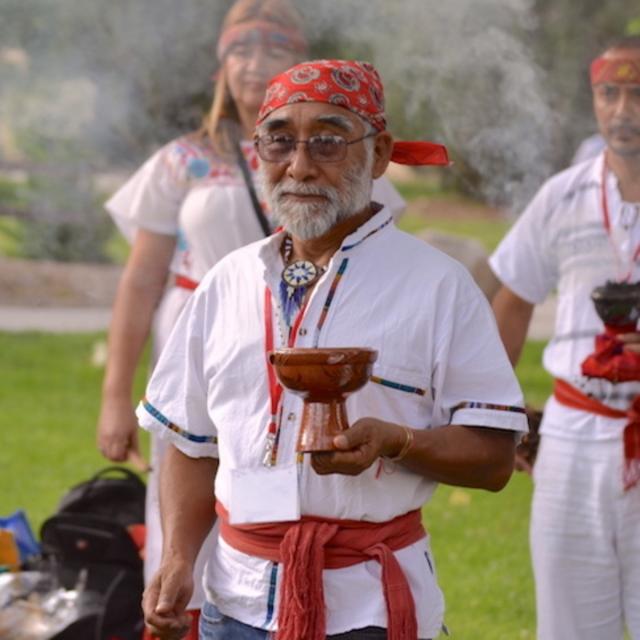
Rita explains the variety of incense burners used in traditional energetic cleansings and demonstrates her own type of cleansing with copal incense. She demonstrates how laughter reduces negativity and hostility and increases efficiency and morale.

WEEK 4
Sweatlodge (temazcal)
Rita and others demonstrate the health benefits of the plants, vibrations of the drum, and other items and elements that are part of the sweatlodge temazcal, ceremony.

WEEK 5
Healing through sound & healing with music
Juan Carlos performs a traditional healing technique by using the vibrations of the conch shell sound in combination with the obsidian stone. Elena discusses the impact of music, sound, and song on our health.

WEEK 6
Creating sacred spaces for healing & healing grief through day of the dead (día de los muertos)
Rita and Tonita, discuss the creation of a sacred space (an altar) that they create with natural elements. This sacred space is part of a temazcal sweat lodge ceremony, which honors the four directions. Dr. Anselmo Torres provides insight on the meaning and significance of one Mexico’s most important celebrations, the Day of the Dead.
Go to Class
MOOC List is learner-supported. When you buy through links on our site, we may earn an affiliate commission.

Related Courses

Introduction to Philosophy (Coursera) Coursera
University of Edinburgh

Introduction to Philosophy (Coursera)

This course will introduce you to some of the main areas of research in contemporary philosophy. Each module a different philosopher will talk you through some of the most important questions and issues in their area of expertise. We’ll begin by trying to understand what philosophy is – what are its characteristic aims and methods, and how does it differ from other subjects? Then we’ll spend the rest of the course gaining an introductory overview of several different areas of philosophy.

Oct 5th 2026
5-12 Weeks
Lesson Planning with the ELL in Mind (Coursera) Coursera
Arizona State University

Lesson Planning with the ELL in Mind (Coursera)

In this course you will learn how to design lesson plans around the needs of your ELL students and their language level through the analysis of content language and cognitive demands. You will learn how to align language objectives to the adopted standards of your school and content area. You will learn how to modify existing course materials as well as develop graphic organizers and languages frames to support ELLs’ access to content. Analysis of second language acquisition theories will be applied to lesson planning.

Sep 21st 2026
5-12 Weeks
Municipal Solid Waste Management in Developing Countries (Coursera) Coursera
École Polytechnique Fédérale de Lausanne

Municipal Solid Waste Management in Developing Countries (Coursera)

Have you come across large piles of garbage in neighborhoods and streets, or smelly waste disposal sites polluting the environment of low and middle income countries? Are you also convinced that improvements are necessary and do you want to know what kind of sustainable solutions are appropriate to better manage waste and enhance recycling and recovery? If yes, this course is for you!

Oct 5th 2026
5-12 Weeks
Understanding Modern Physics III: Simplicity and Complexity (Coursera) Coursera
The Hong Kong University of Science and Technology - HKUST

Understanding Modern Physics III: Simplicity and Complexity (Coursera)

The 20th century was known as the century of physics. In the past 120 years, concepts such as space, time, energy, entropy and particles were understood to much deeper levels. New paradigms of thinking such as relativity and quantum mechanics emerged. This course is the third course in the Understanding Modern Physics series, which covers an introduction to action principle, fundamental particle physics, entropy & information and complexity.

Oct 5th 2026
4 Weeks
Electrodynamics: An Introduction (Coursera) Coursera
Korea Advanced Institute of Science and Technology - KAIST

Electrodynamics: An Introduction (Coursera)

The depth and breadth of electromagnetism, the foundation for many fields including materials science, electrical engineering, and physical chemistry, requires a long, steep, and steady learning curve. This course aims to bridge the gap between the fundamental principles taught in electromagnetism and its practical application to specific fields such as materials, physics, and chemistry related to energy storage and harvesting.

Sep 28th 2026
5-12 Weeks
Global Energy and Climate Policy (Coursera) Coursera
University of London,SOAS University of London

Global Energy and Climate Policy (Coursera)

The Global Energy and Climate Policy course offers an introduction to the theoretical and practical understanding of how energy and climate change policies are designed, shaped, advocated and implemented. As energy markets go truly global, domestic energy policies are becoming more and more entangled with wider issues of international governance. Concurrently, the urgent need to mitigate and adapt to climate change and transition to a low-carbon future is adding a further layer of complexity.

Sep 21st 2026
5-12 Weeks
Soul Beliefs: Causes and Consequences - Unit 3: How Does It All End? (Coursera) Coursera
Rutgers University

Soul Beliefs: Causes and Consequences - Unit 3: How Does It All End? (Coursera)

Throughout history, the vast majority of people around the globe have believed they have, however defined, a “soul.” While the question of whether the soul exists cannot be answered by science, what we can study are the causes and consequences of various beliefs about the soul and its prospects of surviving the death of the body. Why are soul and afterlife beliefs so common in human history? Are there adaptive advantages to assuming souls exist?

Sep 28th 2026
5-12 Weeks
Introduction to Sustainability (Coursera) Coursera
University of Illinois at Urbana-Champaign

Introduction to Sustainability (Coursera)

This course introduces the academic approach of Sustainability and explores how today’s human societies can endure in the face of global change, ecosystem degradation and resource limitations. The course focuses on key knowledge areas of sustainability theory and practice, including population, ecosystems, global change, energy, agriculture, water, environmental economics and policy, ethics, and cultural history.

Sep 28th 2026
5-12 Weeks
Oil & Gas Industry Operations and Markets (Coursera) Coursera
Duke University

Oil & Gas Industry Operations and Markets (Coursera)

The oil and gas industry has an enormous impact on all aspects of daily life. Individuals, corporations, and national governments make financial and policy decisions based on the cost, use, and availability of these two natural resources. This two-week course looks at the two most fundamental aspects of the oil and gas industry, its operations and markets, each of which is addressed as a separate module in the course.

Sep 30th 2026
2 Weeks
General Chemistry: Concept Development and Application (Coursera) Coursera
Rice University

General Chemistry: Concept Development and Application (Coursera)

This course will cover the topics of a full year, two semester General Chemistry course. We will use a free on-line textbook, Concept Development Studies in Chemistry, available via Rice’s Connexions project. The fundamental concepts in the course will be introduced via the Concept Development Approach developed at Rice University. In this approach, we will develop the concepts you need to know from experimental observations and scientific reasoning rather than simply telling you the concepts and then asking you to simply memorize or apply them.

Sep 21st 2026
5-12 Weeks
Wind resources for renewable energies (Coursera) Coursera
École Polytechnique

Wind resources for renewable energies (Coursera)

The main goal of this course is to get the necessary knowledge on atmospheric and fluid dynamics in order to quantify the wind resource of a local or regional area. We’ll learn about basic meteorology, the specific dynamics of turbulent boundary layers and some standard techniques to estimate wind resources regardless of the type of turbine used or the level of efficiency achieved.

Oct 5th 2026
4 Weeks