Extinctions: Past, Present, & Future (Coursera)

Offered by Emory University,
Extinctions: Past, Present, & Future (Coursera)

This course introduces you to the five mass extinctions of the pre-human past, their causes and significance to the history of life on earth, and the current mass extinction happening during our time. We’ll also explore the history of paleontology and geological study and review the key players that influenced the science today.

Class Deals by MOOC List - Click here and see Coursera's Active Discounts, Deals, and Promo Codes.

Regardless of your familiarity with the topic, you'll get portable handouts, lively demonstrations, and quizzes that bridge and enhance your knowledge.

What You Will Learn

  • Summarize extinctions as an important part of the history of life.
  • Identify the probable causes of mass extinctions in the geologic past (before humans).
  • Compare and contrast the Big Five mass extinctions with human-influenced extinctions.
  • Evaluate historical lessons and current trends to predict and prevent extinctions of the future.

Syllabus

WEEK 1: Introduction to Extinctions: Getting Started with the End
WEEK 2: Human Awareness of Extinctions: A History
WEEK 3: Mass Extinctions of the Pre-Human Past
WEEK 4: Extinctions of Pre-History & Near-Present (Pleistocene Epoch & Late Holocene Epoch)
WEEK 5: Extinctions Since European Colonization & Going into the Future


Go to Class
MOOC List is learner-supported. When you buy through links on our site, we may earn an affiliate commission.

Related Courses

The Emergence of the Modern Middle East - Part I (Coursera) Coursera
Tel Aviv University

The Emergence of the Modern Middle East - Part I (Coursera)

This course will review the emergence of the modern Middle East from the fall of the Ottoman Empire, at the end of the First World War to the present. We will discuss the Ottoman legacy in the region and the Western imperial impact on the creation of the Arab state system. The course will review the rise and retreat of Arab nationalism, the problems of internal cohesion of the Arab states, issues of religion and state, and the evolution of Islamist politics. We will also focus on the evolution of the Arab-Israeli conflict and its impact on the region and will conclude with an in depth analysis of the “Arab Spring” by placing these contemporary revolutionary events in their historical context.

Sep 21st 2026
4 Weeks
The History of Modern Israel – Part I: From an Idea to a State (Coursera) Coursera
Tel Aviv University

The History of Modern Israel – Part I: From an Idea to a State (Coursera)

How did the State of Israel come to be? How is it that an idea, introduced in 19th century Europe, became a reality? And how does that reality prevail in the harsh complexities of the Middle East? Presented by Professor Eyal Naveh, with additional units from Professor Asher Sussers' "The Emergence of the Modern Middle East" course, This course will take you on a journey through the history of Modern Israel. In this 1st part of the course we will explore: How did the 19th century idea of a Jewish state become a reality? So the next time you hear about Israel in the news, you will be informed enough about the history of this area to comprehend the many sides and narratives that interact to shape the complex reality of Israel today.

Sep 21st 2026
3 Weeks
Arch of Titus: Rome and the Menorah (Coursera) Coursera
Yeshiva University

Arch of Titus: Rome and the Menorah (Coursera)

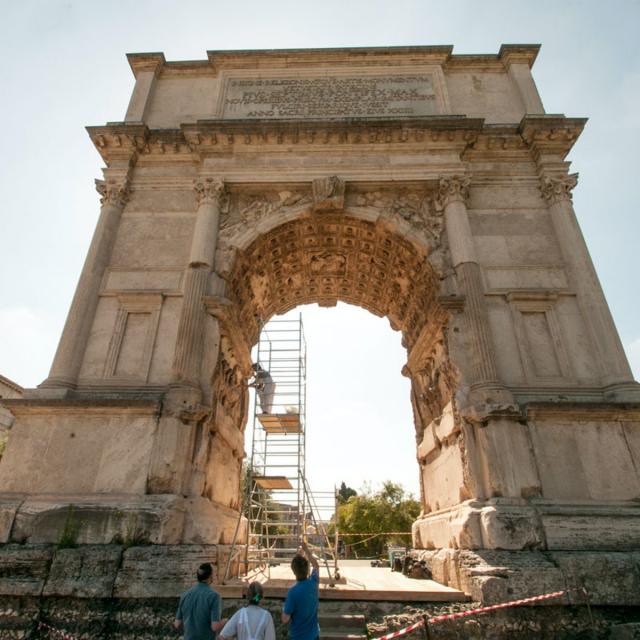
The Arch of Titus: Rome and the Menorah explores one of the most significant Roman monuments to survive from antiquity, from the perspectives of Roman, Jewish and later Christian history and art. The Arch of Titus commemorates the destruction of Jerusalem by the emperor Titus in 70 CE, an event of pivotal importance for the history of the Roman Empire, of Judaism, of Christianity and of modern nationalism. Together with your guide, Professor Steven Fine, you will examine ancient texts and artifacts, gaining skills as a historian as you explore the continuing significance of the Arch of Titus from antiquity to the very present.

Sep 28th 2026
5-12 Weeks
Introduction to Ancient Egypt and Its Civilization (Coursera) Coursera
University of Pennsylvania

Introduction to Ancient Egypt and Its Civilization (Coursera)

Colossal pyramids, imposing temples, golden treasures, enigmatic hieroglyphs, powerful pharaohs, strange gods, and mysterious mummies are features of Ancient Egyptian culture that have fascinated people over the millennia. The Bible refers to its gods, rulers, and pyramids. Neighboring cultures in the ancient Near East and Mediterranean wrote about its god-like kings and its seemingly endless supply of gold. The Greeks and Romans describe aspects of Egypt's culture and history.

Sep 21st 2026
5-12 Weeks
Recovering the Humankind's Past and Saving the Universal Heritage (Coursera) Coursera
Sapienza University of Rome

Recovering the Humankind's Past and Saving the Universal Heritage (Coursera)

Archaeology has as its objective the recovery and revival of humankind past, and as its aim the rescue and preservation of cultural heritage. Archaeology is, among human sciences, the discipline with the strongest importance for the rediscovery, but also for the preservation and protection of cultural heritage, as Humankind’s universal patrimony. You will be introduced to the way we ourselves reflect on and are engaged with the study of human past: from the practical and material recovery of ancient traces in the field to the study and interpretation. On the other hand, the discovery of human past implies the correct conservation and presentation for both experts and general public: the study and protection of the past we share every day prevent from any possible destruction, misuse, abuse and thus cancellation of human memory.

Sep 21st 2026
5-12 Weeks
Soul Beliefs: Causes and Consequences - Unit 2: Belief Systems (Coursera) Coursera
Rutgers University

Soul Beliefs: Causes and Consequences - Unit 2: Belief Systems (Coursera)

Throughout history, the vast majority of people around the globe have believed they have, however defined, a “soul.” While the question of whether the soul exists cannot be answered by science, what we can study are the causes and consequences of various beliefs about the soul and its prospects of surviving the death of the body. Why are soul and afterlife beliefs so common in human history? Are there adaptive advantages to assuming souls exist?

Sep 28th 2026
5-12 Weeks
Greek and Roman Mythology (Coursera) Coursera
University of Pennsylvania

Greek and Roman Mythology (Coursera)

Myths are traditional stories that have endured over a long time. Some of them have to do with events of great importance, such as the founding of a nation. Others tell the stories of great heroes and heroines and their exploits and courage in the face of adversity. Still others are simple tales about otherwise unremarkable people who get into trouble or do some great deed. What are we to make of all these tales, and why do people seem to like to hear them? This course will focus on the myths of ancient Greece and Rome, as a way of exploring the nature of myth and the function it plays for individuals, societies, and nations. We will also pay some attention to the way the Greeks and Romans themselves understood their own myths.

Sep 21st 2026
5-12 Weeks
Patrick Henry: Forgotten Founder (Coursera) Coursera
University of Virginia,UVA Lifetime Learning, Patrick Henry Memorial Foundation

Patrick Henry: Forgotten Founder (Coursera)

“Give me liberty, or give me death:” Remembering Patrick Henry, the Forgotten Founder. Patrick Henry was enormously popular during the American Revolution. Even Thomas Jefferson, who over time developed a deep loathing of Henry (some would say jealousy), had to admit that “it is not now easy to say what we should have done without Patrick Henry.” Edmund Randolph, a patriot leader in his own right, explained that “It was Patrick Henry … awakening the genius of his country, and binding a band of patriots together to hurl defiance at the tyranny of so formidable a nation as Great Britain.”

Sep 21st 2026
5-12 Weeks
The Holocaust: The Destruction of European Jewry (Coursera) Coursera
University of California, Santa Cruz

The Holocaust: The Destruction of European Jewry (Coursera)

The Holocaust: The Destruction of European Jewry is an adaptation of an on-campus course that has been co-taught by Murray Baumgarten, Distinguished Professor of English and Comparative Literature (Literature Department), and Peter Kenez, Professor Emeritus (History Department), for over 20 years at UC Santa Cruz. In this course, you will explore the Holocaust from the overlapping perspectives of literature and history—through memoirs, historical documents, poetry, documentary footage, filmic representations, and novels.

Sep 21st 2026
5-12 Weeks
Seeing Through Photographs (Coursera) Coursera
The Museum of Modern Art

Seeing Through Photographs (Coursera)

Although taking, sharing, and viewing photographs has become second nature for many of us, our regular engagement with images does not necessarily make us visually literate. This course aims to address the gap between seeing and truly understanding photographs by introducing a diversity of ideas, approaches, and technologies that inform their making. In this course you will look closely at 100 photographs from the collection of The Museum of Modern Art, going behind the scenes of the Museum and into artist studios through original films and audio interviews.

Sep 21st 2026
5-12 Weeks
Understanding China, 1700-2000: A Data Analytic Approach, Part 1 (Coursera) Coursera
The Hong Kong University of Science and Technology - HKUST

Understanding China, 1700-2000: A Data Analytic Approach, Part 1 (Coursera)

The purpose of this course is to summarize new directions in Chinese history and social science produced by the creation and analysis of big historical datasets based on newly opened Chinese archival holdings, and to organize this knowledge in a framework that encourages learning about China in comparative perspective. Our course demonstrates how a new scholarship of discovery is redefining what is singular about modern China and modern Chinese history.

Sep 28th 2026
5-12 Weeks