Cosmetic Formulation Science (Coursera)

Offered by Olay,
Cosmetic Formulation Science (Coursera)

The second course in the specialization, Cosmetic Formulation Science, delves deeper into the fundamentals of cosmetic formulations. The focus here is on the selection and use of raw materials, a critical aspect of cosmetic science. You will develop more detailed insight into choosing and using various cosmetic raw materials.

Class Deals by MOOC List - Click here and see Coursera's Active Discounts, Deals, and Promo Codes.

Moreover, you will learn the essentials of safe and effective laboratory work and documentation. This course is a blend of theoretical knowledge and practical application, setting the stage for advanced learning in cosmetic science.
This course is part of the Introduction to Cosmetic Science and Ingredients Specialization.

What you'll learn

  • Develop skills in selecting and using cosmetic raw materials
  • Understand the essentials of cosmetic formulation and laboratory safety
  • Learn effective documentation techniques for cosmetic science.
  • Acquire practical knowledge in writing and processing cosmetic formulas

Syllabus

Introduction to Cosmetic Formulation Science
Welcome to Cosmetic Formulation Science. This is the second course of the P&G Cosmetic Science Specialization program. In this course, you will explore the fundamentals of cosmetic formulations, emphasizing the selection and use of raw materials for your formulations. This week, you will learn about the importance of raw materials in cosmetic formulations. You'll learn to identify and select the ideal raw materials, ensuring your formulations are effective and innovative. This foundational knowledge is essential for anyone aspiring to excel in the cosmetic industry. Let's dive in!

Raw Materials
This week, you will get into the details of the cosmetic formulation process, specifically focusing on surfactants and additives. You'll explore the diverse behaviors of different surfactants and additives and learn about the hydrophilic-lipophilic balance (HLB) scale for emulsifier selection. Additionally, you'll delve into the various categories of preservatives, enriching your understanding of the components that make up effective cosmetic products.

Working in the Lab
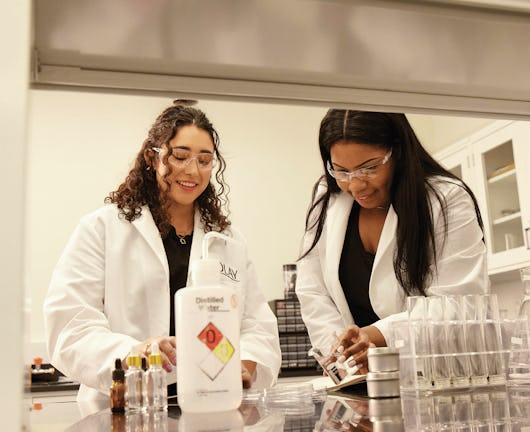
This week, you'll become well-versed in the importance of laboratory safety and the relevant codes that govern it. You'll identify and utilize cosmetic personal protective equipment (PPE) and become familiar with the best practices for working in a cosmetic laboratory. Furthermore, this module will help you develop insights into the importance of meticulous record-keeping, emphasizing the use of laboratory notebooks and digital records.

Formulating Products
In this week, we explore the fundamental concepts of skincare formulation. You will learn about their differences and how to use them effectively in your product formulation. You will explore using weight percentages in formulations and learn how to convert mass percentages accurately. You will also learn about different types of skincare formulations and explore the concept of Certificate analysis and determining specifications.

Go to Class
MOOC List is learner-supported. When you buy through links on our site, we may earn an affiliate commission.

Related Courses

Training and Learning Programs for Volunteer Community Health Workers (Coursera) Coursera
Johns Hopkins University

Training and Learning Programs for Volunteer Community Health Workers (Coursera)

Volunteer community health workers (CHWs) are a major strategy for increasing access to and coverage of basic health interventions. Our village health worker training course reviews the process of training and continuing education of CHWs as an important component of involving communities in their own health service delivery. Participants will be guided through the steps of planning training and continuing education activities for village volunteers. The course draws on real-life examples from community-directed onchocerciasis control, village health worker programs, community case management efforts, peer educators programs and patent medicine vendor training programs, to name a few.

Jun 22nd 2026
5-12 Weeks
The E-waste Challenge (EMMA) EMMA
Climate-KIC

The E-waste Challenge (EMMA)

E-waste can be a threat to our planet: Illegal and poorly managed e-waste is polluting our environment, harming human health, and contributing to human-made climate change. The worst impacts are often in the countries that are least equipped to manage it. Or it can be a valuable resource: By recycling materials contained in e-waste, we can save on greenhouse gas (GHG) emissions from primary mining, we can create green jobs, and we can create economic opportunities.

No sessions available
5-12 Weeks
The E-waste Challenge MOOC (Climate-KIC) Other Providers
United Nations Environment Programme - UNEP,KU Leuven University,Climate-KIC,World Resources Forum

The E-waste Challenge MOOC (Climate-KIC)

With our growing appetite for electrical and electronic products, combined with rapid innovation and ever-shorter product lifespans, e-waste has now become one of the fast growing waste streams. This course will help the participant to understand why and how we must manage e-waste in an environmentally sound manner and how we can take action on e-waste in their own life, business, or organization.

No sessions available
No Information
Waste Management and Critical Raw Materials (edX) EdX
Delft University of Technology,DelftX

Waste Management and Critical Raw Materials (edX)

Learn about waste management and its key role in saving critical raw materials. Gain practical knowledge of the circular economy, recycling, refurbishment, and remanufacturing as a means of identifying new business opportunities. How can we ensure the continuous supply of the increasingly scarce raw materials that are needed to make the products we use every day? In this course, we will look at the potential benefits of circular procurement and how recycling technologies and more efficient ways of collecting and recycling critical raw materials (CRMs) can make your business and production more resource resilient.

Self Paced
Self-Paced
Critical Raw Materials: Managing Resources for a Sustainable Future (edX) EdX
Delft University of Technology,DelftX

Critical Raw Materials: Managing Resources for a Sustainable Future (edX)

Gain a systemic understanding of critical raw materials and learn about strategies and solutions to manage them in a sustainable way. The availability of critical raw materials (CRMs) is under massive pressure. However, these materials are essential for products, technologies and solutions to some of the world’s most crucial issues – such as the energy transition.

Self Paced
Self-Paced
Epidemiology: The Basic Science of Public Health (Coursera) Coursera
University of North Carolina

Epidemiology: The Basic Science of Public Health (Coursera)

Often called “the cornerstone” of public health, epidemiology is the study of the distribution and determinants of diseases, health conditions, or events among populations and the application of that study to control health problems. By applying the concepts learned in this course to current public health problems and issues, students will understand the practice of epidemiology as it relates to real life and makes for a better appreciation of public health programs and policies. This course explores public health issues like cardiovascular and infectious diseases – both locally and globally – through the lens of epidemiology.

Jun 22nd 2026
5-12 Weeks
The Brain and Space (Coursera) Coursera
Duke University

The Brain and Space (Coursera)

This course is about how the brain creates our sense of spatial location from a variety of sensory and motor sources, and how this spatial sense in turn shapes our cognitive abilities. Knowing where things are is effortless. But “under the hood,” your brain must figure out even the simplest of details about the world around you and your position in it.

Jun 22nd 2026
5-12 Weeks
Epidemics - the Dynamics of Infectious Diseases (Coursera) Coursera
Pennsylvania State University

Epidemics - the Dynamics of Infectious Diseases (Coursera)

Not so long ago, it was almost guaranteed that you would die of an infectious disease. In fact, had you been born just 150 years ago, your chances of dying of an infectious disease before you've reached the tender age of 5 would have been extremely high. Since then, science has come a long way in understanding infectious diseases - what they are, how they spread, and how they can be prevented. But diseases like HIV/AIDS, Malaria, Tuberculosis, or the flu are still major killers worldwide, and novel emerging diseases are a constant threat to public health. In addition, the bugs are evolving. Antibiotics, our most potent weapon against bacterial infections, are losing their power because the bacteria are becoming resistant. In this course, we'll explore the major themes of infectious diseases dynamics.

Jun 22nd 2026
5-12 Weeks
Child Nutrition and Cooking (Coursera) Coursera
Stanford University

Child Nutrition and Cooking (Coursera)

Eating patterns that begin in childhood affect health and well-being across the lifespan. The culture of eating has changed significantly in recent decades, especially in parts of the world where processed foods dominate our dietary intake. This course examines contemporary child nutrition and the impact of the individual decisions made by each family.

Jun 22nd 2026
5-12 Weeks
Future Healthcare Payment Models (Coursera) Coursera
Northeastern University

Future Healthcare Payment Models (Coursera)

This course will review the drivers of healthcare cost and solutions that have been proposed to address cost, quality and value of health care. Many point blame for high costs on payment models that pay healthcare providers for every service they provide to patients, essentially paying more for volume and service intensity. This is called a Fee for Service (FFS) payment model. Some solutions, arguably the more sustainable solutions, are the combined strategies of new payment models, care management, insurance plan designs, consumer engagement tools, and technology.

Jun 24th 2026
4 Weeks
Primeros Auxilios Psicológicos (PAP) (Coursera) Coursera
Universitat Autònoma de Barcelona

Primeros Auxilios Psicológicos (PAP) (Coursera)

Este curso on-demand (ABIERTO, se puede cursar en cualquier momento), impartido en castellano por la Universidad Autónoma de Barcelona y el Centro de Crisis de Barcelona, está destinado a entrenar en la aplicación de primeros auxilios psicológicos (PAP) a personas afectadas por situaciones altamente estresantes, abarcando tanto emergencias cotidianas (incidentes críticos estadísticamente frecuentes que afectan de manera muy intensa: un accidente de tráfico, una hospitalización, una agresión o la muerte traumática o repentina de una persona, etc.) como emergencias comunitarias y/o masivas (sucesos infrecuentes, que afectan a muchas personas o a una comunidad entera y que sobrepasan con mucho lo que sucede habitualmente en ella: una catástrofe natural, un accidente ferroviario o aéreo o un atentado).

Jun 22nd 2026
5-12 Weeks