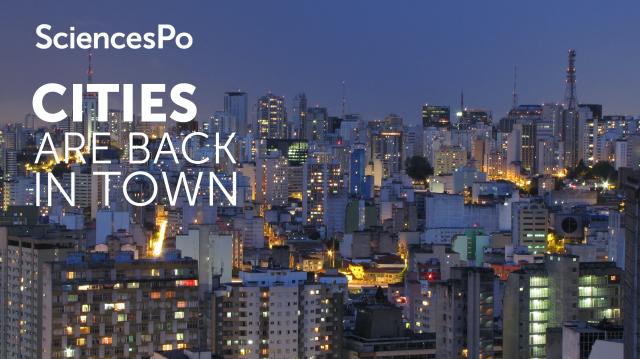
Cities are back in town : urban sociology for a globalizing urban world (Coursera)

Offered by Sciences Po,
Cities are back in town : urban sociology for a globalizing urban world (Coursera)

Urbanization is reaching a new peak in the contemporary world with the rise of mega cities. Researchers try to make sense of these large urban areas using a variety of concepts. The class will review debates and present social science models of cities to analyse and compare contemporary developments. The class will review debates and present social science models of cities and metropolis to analyse and compare contemporary developments.

Class Deals by MOOC List - Click here and see Coursera's Active Discounts, Deals, and Promo Codes.

How can do we study those cities when they become mega urban regions, does size matter and for what? Do we see the making of a vast urban world or by contrast beyond the apparent convergence of complex globalisation processes understood in relation to globalised capitalism, is it possible to identify masked differentiations and the strengthening of different urban worlds?
Globalization, Europeanization processes support the rapid developments of cities in different part of the world. Urbanization is reaching a new high in the contemporary world with the rise of mega cities (beyond 15 million inhabitants) such as Calcutta, Los Angeles, Dhaka, Cairo, Tokyo, New York, Shanghai, Mexico or Seoul. Beyond the modern metropolis, researchers try to make sense of these large urban areas using a variety of concepts such as the ‘postmetropolis’, ‘global cities’, and ‘global city-regions’. How do we make sense of this urban world when cities are not independent units but have to be understood both in terms of territories, rootedness, and at the same time in terms of relations to take into account flux, mobility, circulations ? What is the relevance of social science concepts developed in the Western world to analyse the transformation of Lagos? To what extent may the systematic development of new forms of comparison between northern cities and cities from the South change social sciences and contribute to overcome the bias towards national comparison? For the time being, given current conditions of capitalism, political, economic, cultural and social questions are increasingly becoming urban questions. In the modern conception of the world/globalcity, characterised by size, the aggregation of housing, differentiated divisions of labour, and the density of interaction, several conceptions of cities exist which have become entangled and sometimes opposed to each other. These different conceptions underline different processes of integration: the material city of walls, squares, houses, roads, light, utilities, buildings, waste, and physical infrastructure; the cultural city in terms of imaginations, differences, representations, ideas, symbols, arts, texts, senses, religion, and aesthetics; the politics and policies of the city in terms of domination, power, government, mobilisation, public policies, welfare, education; the social city of riots, ethnic, economic and gender inequalities, everyday life and social movements; and the economy of the city : the division of labour, scale, production, consumption, trade..... Classic urban questions about inequalities, housing, government, integration, are combined with issues about the urban fabric, questions of mobility and rootedness, sustainable development and risks, the making of the cyborg cities, questions of social control and riots, urban culture, innovation and urban economic development.

Syllabus

Week 1: Introduction to urban sociology - Introduction, definition, urban questions and the use of models
Week 2: Introduction to urban sociology - European cities and the weberian model of integration
Week 3: Colonial city model - Colonial and post colonial cities
Week 4: Industrial city model - Industrial cities (and Socialist cities) and Marxist models
Week 5: Metropolis model - The American metropolis and the Chicago School,
Week 6: Global city model - Post metropolis, fragments and differences
Week 7: Post metroplis model - Global cities and mega cities
Week 8: Digital city model - Smart cities and the sociology of science and technology
Go to Class
MOOC List is learner-supported. When you buy through links on our site, we may earn an affiliate commission.

Related Courses

Quantitative Methods (Coursera) Coursera
University of Amsterdam

Quantitative Methods (Coursera)

Discover the principles of solid scientific methods in the behavioral and social sciences. Join us and learn to separate sloppy science from solid research! This course will cover the fundamental principles of science, some history and philosophy of science, research designs, measurement, sampling and ethics. The course is comparable to a university level introductory course on quantitative research methods in the social sciences, but has a strong focus on research integrity. We will use examples from sociology, political sciences, educational sciences, communication sciences and psychology.

Sep 14th 2026
5-12 Weeks
Civic Engagement in American Democracy (Coursera) Coursera
Duke University

Civic Engagement in American Democracy (Coursera)

So how does the American political system work? Who are some of the key actors? What are key concepts for a student trying to understand what’s going on? How can I as a citizen influence politics? Civic Engagement in American Democracy takes on these and other key questions. We’re Dr. Nicholas Carnes and Dr. Bruce Jentleson, the principal course instructors. Along with our Duke faculty colleagues who also contributed modules, we’ve designed the course to provide a strong foundational introduction to US politics.

Sep 7th 2026
4 Weeks
Diversity and Inclusion in Education (Coursera) Coursera
University of Glasgow

Diversity and Inclusion in Education (Coursera)

Student diversity is becoming the rule rather than the exception in education systems across the world. Students bring to classroom different characteristics such as ability and disability, socio-economic background, race, ethnicity, and cultural background, beliefs and religion, and gender characteristics. The United Nations’ Sustainable Development Goal 4 aims to ensure inclusive and equitable quality education and promote lifelong learning opportunities for all (United Nations, 2015).

Sep 7th 2026
4 Weeks
Introduction to Economic Theories (Coursera) Coursera
Erasmus University Rotterdam

Introduction to Economic Theories (Coursera)

Wondering why economists have not predicted serious financial crises? Shocked by economic assumptions of human behavior as self-centered and focusing only on what can be measured? Asking yourself if there are no sensible economic alternatives to free markets? Then you are at the right place to learn economics! This is the first online course that teaches economics from a pluralist perspective. Economic pluralism means that a plurality of theoretical and methodological viewpoints is regarded as valuable in itself and is simply the best way in which economics can make progress in understanding the world.

Aug 31st 2026
5-12 Weeks
Economic Growth and Distributive Justice Part II - Maximize Social Wellbeing (Coursera) Coursera
Tel Aviv University

Economic Growth and Distributive Justice Part II - Maximize Social Wellbeing (Coursera)

If you really care about the big questions in the economies and societies of the 21st century, such as distributive justice - namely, inequality of income or wealth, and its correlation with economic growth - this course is meant for you. The knowledge you will gain can truly change your outlook on our world.

Aug 31st 2026
5-12 Weeks
Serious Gaming (Coursera) Coursera
Erasmus University Rotterdam

Serious Gaming (Coursera)

Have you ever wondered how playing games can help us to train people, deal with societal challenges or raise awareness of contemporary social issues? In this MOOC you will learn the ins and outs of games that are designed with exactly those purposes in mind: serious games. We will define serious games and discuss the different types that have been developed. We will explain why people like to play them and what impact they may have.

Aug 31st 2026
5-12 Weeks
Arctic Economy (Coursera) Coursera
University of Alberta,UiT The Arctic University of Norway

Arctic Economy (Coursera)

Arctic communities have diverse histories and roles in local, regional and global economies. However, the scope and scale of globalization has increased so quickly that vulnerable Arctic communities are facing new kinds of challenges to their survival. In this 3-week MOOC, a unique collaboration between the University of Alberta and UiT The Arctic University of Norway, you will investigate the challenges faced by Indigenous, North American, Russian and Nordic Arctic communities in a modern world. So join us as we venture above the 60th parallel North, and explore how these fascinating communities adjust to change while maintaining their ways of life, socio-economic histories, and cultural traditions.

Sep 14th 2026
4 Weeks
Risk in Modern Society (Coursera) Coursera
Leiden University,LDE Centre for Safety and Security

Risk in Modern Society (Coursera)

Risk has become one of the defining features of modern society. Almost daily, we are preoccupied with assessing, discussing, or preventing a wide variety of risks. It is a cornerstone notion for businesses and organizations, but also for nation states and their many levels of government. And even for individuals, risk and the avoidance or embracing thereof, is a key theme. The course Risk in Modern Society sheds light on the broad concept of risk.

Sep 14th 2026
5-12 Weeks
Game Theory II: Advanced Applications (Coursera) Coursera
Stanford University,The University of British Columbia

Game Theory II: Advanced Applications (Coursera)

Popularized by movies such as "A Beautiful Mind", game theory is the mathematical modeling of strategic interaction among rational (and irrational) agents. Over four weeks of lectures, this advanced course considers how to design interactions between agents in order to achieve good social outcomes. Three main topics are covered: social choice theory (i.e., collective decision making and voting systems), mechanism design, and auctions.

Aug 31st 2026
5-12 Weeks
Afrique et mondialisation, regards croisés (Coursera) Coursera
Sciences Po

Afrique et mondialisation, regards croisés (Coursera)

Au-delà des relations internationales classiques, le processus de mondialisation mobilise quantité d'acteurs économiques, sociaux et culturels, individuels et collectifs, qui agissent dans l'espace mondial. Nous étudions ensemble, Africains, Latino-américains et Européens, comment il en dérive de nouvelles relations internationales. Ce cours prend sa source dans les approches sociologique et historique françaises des relations internationales, comme celles promues en Afrique et en Amérique latine.

Sep 14th 2026
5-12 Weeks
Management of Urban Infrastructures – part 1 (Coursera) Coursera
École Polytechnique Fédérale de Lausanne

Management of Urban Infrastructures – part 1 (Coursera)

Sustainability, Resilience and Efficiency are fundamental considerations for city managers in managing urban infrastructures. Today, more than 3.9 billion people, making up more than 54% of the global population, live in cities. Urbanization is expected to continue in the coming years, raising the urban population to 6.0 billion by 2045. This dramatic increase in urban populations will inevitably increase the demand for energy, mobility (transportation), water, and other urban services in every city around the world. Without functional governance and management structures that ensure efficient, resilient and sustainable performance in cities, the current urbanization growth might become a catastrophic risk threatening the quality of life of the humanity.

Sep 14th 2026
5-12 Weeks