Chemical Hazards: Toxicology & Reactivity (Coursera)

Chemical Hazards: Toxicology & Reactivity (Coursera)

This course aims to provide process safety experience for engineers, particularly relevant to chemical engineering but applicable to any field involving process operations. This course introduces you to the important, practical, value-added skills and information that will aid your career, or preparation for a career, in chemical process engineering.

Class Deals by MOOC List - Click here and see Coursera's Active Discounts, Deals, and Promo Codes.

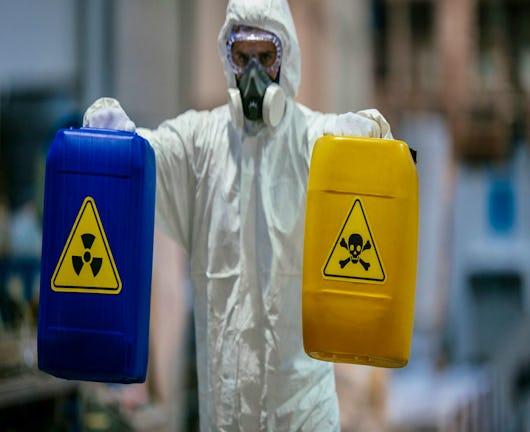
These skills include improving your ability to identify and quantify toxic chemical hazards and be able to identify and mitigate scenarios where reactive chemical hazards are present. You will be able to describe the importance of pressure protection and the general process for pressure relief system design all while using lessons learned from past chemical process incidents to inform the implementation of safer solutions and work practices.

Syllabus

Getting Started & The Importance of Understanding Chemical Hazards
After this module, you will be able to define industrial health and hygiene including important regulatory agencies. You'll be able to describe chemical hazards and the importance of understanding these hazards. You will be able to describe how chemical reactions, when not managed properly, can result in catastrophic scenarios. Finally, you will be able to use the Globally Harmonized System (GHS) for Safety Data Sheets and Labels as well as the National Fire Protection Association (NFPA) diamond.

Toxicology
After this module, you will be able to define, discuss, and use exposure limits such as threshold limit value (TLV) and permissible exposure limit (PEL). You will be able to describe effects of toxicants and quantify impact of exposure using dose versus response curves. You will be able to describe control techniques to prevent exposures, as well as use lessons from past chemical process safety incidents to inform the implementation of solutions and work practices.

Reactive Chemical Hazards
After this module, you will be able to identify processes and situations where reactive chemical hazards are likely to be present. You will be able to create and use a chemical compatibility matrix. And finally, you will be able to describe how to use calorimeter data to characterize chemical reactions.

Pressure Relief
At the end of this module, you will be able to explain the importance of pressure protection and define key terms related to pressure relief devices. You will be able to identify major classes of relief devices and be able to describe options for handling relief effluent. Finally, you'll be able to describe the general process for relief system design.

Go to Class
MOOC List is learner-supported. When you buy through links on our site, we may earn an affiliate commission.

Related Courses

The Science of the Solar System (Coursera) Coursera
Caltech

The Science of the Solar System (Coursera)

Learn about the science behind the current exploration of the solar system in this free class. Use principles from physics, chemistry, biology, and geology to understand the latest from Mars, comprehend the outer solar system, ponder planets outside our solar system, and search for habitability in our neighborhood and beyond. This course is generally taught at an advanced level assuming a prior knowledge of undergraduate math and physics, but the majority of the concepts and lectures can be understood without these prerequisites.

Sep 21st 2026
5-12 Weeks
Evidence-based Toxicology (Coursera) Coursera
Johns Hopkins University

Evidence-based Toxicology (Coursera)

Welcome to the Evidence-based Toxicology (EBT) course. In medicine and healthcare, evidence-based medicine has revolutionized the way that information is evaluated transparently and objectively. Over the past ten years, a movement in North America and Europe has attempted to translate this revolution to the field of toxicology.

Sep 14th 2026
5-12 Weeks
Mastering bitumen for better roads and innovative applications (Coursera) Coursera
École des Ponts ParisTech

Mastering bitumen for better roads and innovative applications (Coursera)

During the four coming weeks, best experts in bitumen will bring you their knowledge and experience to build a strong understanding of today’s realities and new perspectives on the future of bitumen. Total is the European leader on bitumen markets. Innovation has always been the key to sustainability and durability in the products they develop. Their main objective here is to share technical knowledge and experience to insure bitumen are being used in the most effective and efficient ways for their different applications in road works.

Sep 7th 2026
4 Weeks
Introduction to Molecular Spectroscopy (Coursera) Coursera
University of Manchester

Introduction to Molecular Spectroscopy (Coursera)

The course introduces the three key spectroscopic methods used by chemists and biochemists to analyse the molecular and electronic structure of atoms and molecules. These are UV/Visible , Infra-red (IR) and Nuclear Magnetic Resonance (NMR) spectroscopies. The content is presented using short focussed and interactive screencast presentations accompanied by formative quizzes to probe understanding of the key concepts presented. Numerous exercises are provided to facilitate mastery of each topic. A unique virtual spectroscopic laboratory is made available to enable students to measure and analyse spectra online. Assessment is via summative quizzes completed during the course period.

Sep 7th 2026
4 Weeks
Air Pollution – a Global Threat to our Health (Coursera) Coursera
University of Copenhagen

Air Pollution – a Global Threat to our Health (Coursera)

We all have to breathe to live. But the air we breathe is polluted both outdoors and indoors. Each year, this pollution costs 7 million lives across the globe – and a lot of suffering. 1 in 8 deaths is due to air pollution. This course will provide you with an introduction to the most recent research in the field of health effects of air pollution as well as a broader understanding of sources and spread of air pollution and what we should do about it.

Sep 7th 2026
3 Weeks
Material Chemistry and Sustainable Building (Coursera) Coursera
Parsons School of Design, The New School

Material Chemistry and Sustainable Building (Coursera)

This course covers a wide range of concepts related to toxicology and the chemistry of healthier materials. You learn about toxic substances in the built environment, the impact of specific chemicals on human health, unsatisfactory substitutions, and barriers to change. Finally, you examine ways to remove chemicals of concern in common building products. This course is designed to give you a basic understanding of chemistry in the built environment.

Aug 31st 2026
3 Weeks
Quantum Mechanics (Coursera) Coursera
University of Colorado Boulder

Quantum Mechanics (Coursera)

Course 2 of Statistical Thermodynamics presents an introduction to quantum mechanics at a level appropriate for those with mechanical or aerospace engineering backgrounds. Using a postulatory approach that describes the steps to follow, the Schrodinger wave equation is derived and simple solutions obtained that illustrate atomic and molecular structural behavior. More realistic behavior is also explored along with modern quantum chemistry numerical solution methods for solving the wave equation.

Aug 31st 2026
3 Weeks
La Química de las Reacciones (Coursera) Coursera
Universidad Autónoma Metropolitana

La Química de las Reacciones (Coursera)

En este curso aprenderás los conocimientos básicos de reacciones químicas, lo cual te permitirá tener una mejor comprensión del estudio de la química, así como de la naturaleza. En general la mayoría de la gente le tiene miedo a la palabra química; sin embargo, debido a que la química es una ciencia central es necesario comprenderla y hacerla nuestra amiga.

Sep 7th 2026
4 Weeks
Más que química (Coursera) Coursera
Universidad Nacional de Colombia

Más que química (Coursera)

El objeto de la química, como disciplina científica, se enfoca en el estudio de la materia y de los cambios que ésta experimenta. En tanto disciplina científica, a la que se le atribuye la reputación de ser una ciencia complicada y aburrida. Esta reputación, bastante inmerecida, obedece al poco conocimiento que se tiene sobre ella y sobre sus enormes posibilidades de aplicación en el mundo científico, en diferentes campos de la industria y la producción, así como en la vida cotidiana.

Sep 7th 2026
5-12 Weeks
Materials Data Sciences and Informatics (Coursera) Coursera
Georgia Institute of Technology

Materials Data Sciences and Informatics (Coursera)

This course aims to provide a succinct overview of the emerging discipline of Materials Informatics at the intersection of materials science, computational science, and information science. Attention is drawn to specific opportunities afforded by this new field in accelerating materials development and deployment efforts.

Sep 7th 2026
5-12 Weeks
Introduction to Forensic Science (Coursera) Coursera
Nanyang Technological University

Introduction to Forensic Science (Coursera)

We have all seen forensic scientists in TV shows, but how do they really work? What is the science behind their work? The course aims to explain the scientific principles and techniques behind the work of forensic scientists and will be illustrated with numerous case studies from Singapore and around the world.

Aug 24th 2026
5-12 Weeks