Caring with Music: Can Music Do More In Adult Care Settings? (FutureLearn)

Offered by Nordoff Robbins,
Caring with Music: Can Music Do More In Adult Care Settings? (FutureLearn)

Learn how music can help you in your work as an adult caregiver and explore ideas from music therapists to use in care settings. Discover the benefits of using music interactively
Regardless of our language, culture, or abilities, music speaks to all of us. It can enable us to connect with other people and to the world around us. It can help us express our feelings, increase our socialisation, and communicate in new ways. On this six-week course, you’ll explore the reasons why music ‘works’ and learn how to apply this knowledge in your adult care setting for positive change.

Class Deals by MOOC List - Click here and see FutureLearn's Active Discounts, Deals, and Promo Codes.

Using techniques from specially trained Nordoff Robbins music therapists – combined with your own expertise – you’ll explore how to effectively use music with the people you support.
Learn how to use music in care homes and other settings
You’ll explore your own relationship with music before learning how, and why, this can be used as an effective tool in care settings.
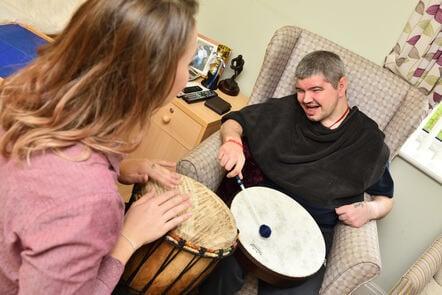
Tuning into the people you support, you’ll identify how you can bring music into the daily life of people you care for, such as creating songs and using musical instruments.
You’ll also learn how to plan and facilitate music activity sessions as well as tips to improve the soundscape of your setting.
Understand how to apply concepts such as active listening in your work
The course will help you apply your learning in a practical way and identify all opportunities to use music to benefit your care setting.
Examining concepts such as individual musicality and active listening, you’ll learn how to use music flexibly to enhance your work and caring environment.
Learn from the specialists at Nordoff Robbins
You’ll learn from the experts at Nordoff Robbins, the UK’s largest music therapy charity, whose practice is informed by research.
The course gives you the opportunity to explore the work of a music therapist and develop skills in this field to help provide better care for the people you support.

Syllabus

Week 1: Everyone has a personal relationship with music
Week 2: 'Tuning in' to the people you support
Week 3: The joy of familiar songs
Week 4: Music as part of your daily care setting
Week 5: Using musical instruments
Week 6: Embedding music into your care setting

What will you achieve?
By the end of the course, you‘ll be able to...

  • Apply active music-making in the everyday life of your adult care setting.
  • Identify your own existing relationship with music
  • Describe the musical identity of someone you support
  • Describe why music 'works' and is a valuable tool in adult care settings
  • Apply musical thinking to different forms of communication
  • Describe how the people you support present in musical terms
  • Explore how to use your voice and movement to engage with people you support
  • Demonstrate how familiar songs can be adapted to interact with people you support
  • Explore the purpose of a new song for someone you support
  • Explore how to create your own song based on a familiar tune and use it flexibly
  • Describe ways in which music can be used to enhance and ease daily routines and difficult moments in care settings
  • Describe the 'soundscape' within your setting and identify how musical changes could help
  • Apply specific musical changes to improve the everyday life of your care setting
  • Explain why specific instruments might be chosen for the people you support
  • Explain how instruments can be used in different ways as a form of expression, and how you can enable the people you support to play in their own way.
  • Identify different musical ideas for using instruments with the people you support, and how to facilitate some appropriate activities
  • Demonstrate how you would set-up and plan for a music activity session within your setting
  • Explore different sources for ideas and resources to further develop your music-making practice in your setting

Who is the course for?
This course is designed for anyone working in an adult care setting wanting to learn how music can support the people you care for.
The content is adaptable to suit a range of care settings, including care homes, day centres, hospices, secure wards, and more.

What software or tools do you need?
To take part in the course you’ll need access to a computer or mobile device. You will also need a ‘reflective journal’ - a means of keeping notes from week to week that you can store confidentially. There will be more information about this during Week 1 of the course.
Go to Class
MOOC List is learner-supported. When you buy through links on our site, we may earn an affiliate commission.

Related Courses

Teoria Musical (Coursera) Coursera
Berklee College of Music

Teoria Musical (Coursera)

Explore os elementos básicos que compoem a música, desenvolva sua percepção, tire músicas de ouvido, e aprenda a ler e escrever usando notação musical. Procuramos criar um curso que unisse a cultura e música brasileira com técnicas de aprendizado de solfejo e leitura rítmica. Você fará parte de uma aula de Percepção Musical ("Ear Training") na Berklee College of Music, cantando e praticando com outros alunos e interagindo com os vídeos. Além disso, você terá acesso a material para praticar, como faixas de acompanhamento e partituras.

Sep 7th 2026
5-12 Weeks
Exploring Beethoven's Piano Sonatas (Coursera) Coursera
Curtis Institute of Music

Exploring Beethoven's Piano Sonatas (Coursera)

Our relationship to Beethoven is a deep and paradoxical one. For many musicians, he represents a kind of holy grail: His music has an intensity, rigor, and profundity which keep us in its thrall, and it is perhaps unequalled in the interpretive, technical, and even spiritual challenges it poses to performers. At the same time, Beethoven’s music is casually familiar to millions of people who do not attend concerts or consider themselves musically inclined. Two hundred years after his death, he is everywhere in the culture, yet still represents its summit. This course takes an inside-out look at the 32 piano sonatas from the point of view of a performer.

Aug 31st 2026
5-12 Weeks
From Notation to Performance: Understanding Musical Scores (FutureLearn) FutureLearn
The Open University

From Notation to Performance: Understanding Musical Scores (FutureLearn)

Find out how musicians turn the notation of a musical score into a memorable performance. Change how you listen to music. Understand musical scores and how musicians use notation. Would you like to know more about what musicians do in rehearsal and performance? Are you keen to learn different techniques for listening to and understanding music?

Self Paced
4 Weeks
Music and Social Action (Coursera) Coursera
Yale University

Music and Social Action (Coursera)

What is a musician’s response to the condition of the world? Do musicians have an obligation and an opportunity to serve the needs of the world with their musicianship? At a time of crisis for the classical music profession, with a changing commercial landscape, a shrinking audience base, and a contraction in the number of professional orchestras, how does a young musician construct a career today? Are we looking at a dying art form or a moment of reinvigoration?

Sep 7th 2026
5-12 Weeks
Korean Music, A Philosophical Exploration (Coursera) Coursera
Sungkyunkwan University - SKKU

Korean Music, A Philosophical Exploration (Coursera)

This course introduces Korean philosophy projected into the subject of Korean music, especially K-POP, which is drawing global attention today. We confirm that Korea's unique philosophy was the basis for maintaining originality while being universally accepted by many people, and seek the role of philosophy for the continuous development and spread of Korean music.

Sep 7th 2026
5-12 Weeks
History of Rock, Part One (Coursera) Coursera
University of Rochester

History of Rock, Part One (Coursera)

This course, part 1 of a 2-course sequence, examines the history of rock, primarily as it unfolded in the United States, from the days before rock (pre-1955) to the end of the 1960s. This course covers the music of Elvis Presley, Chuck Berry, Phil Spector, Bob Dylan, the Beatles, the Rolling Stones, Jimi Hendrix, Cream, and many more artists, with an emphasis both on cultural context and on the music itself. We will also explore how developments in the music business and in technology helped shape the ways in which styles developed.

Aug 31st 2026
5-12 Weeks
Music Moves: Why Does Music Make You Move? (FutureLearn) FutureLearn
University of Oslo

Music Moves: Why Does Music Make You Move? (FutureLearn)

Learn about the psychology of music and movement, and how researchers study music-related movements, with this free online course. Learn about why and how music makes you move. Music is movement. A bold statement, but one that we will explore together in this free online course. Together we will study music through different types of body movement. This includes everything from the sound-producing keyboard actions of a pianist to the energetic dance moves in a club.

Self Paced
5-12 Weeks
History of Rock, Part Two (Coursera) Coursera
University of Rochester

History of Rock, Part Two (Coursera)

This course, part 2 of a 2-course sequence, examines the history of rock, primarily as it unfolded in the United States, from the early 1970s to the early 1990s. This course covers the music of Led Zeppelin, the Allman Brothers, Carole King, Bob Marley, the Sex Pistols, Donna Summer, Michael Jackson, Madonna, Prince, Metallica, Run-DMC, and Nirvana, and many more artists, with an emphasis both on cultural context and on the music itself. We will also explore how developments in the music business and in technology helped shape the ways in which styles developed.

Aug 31st 2026
5-12 Weeks
Princípios Gerais da Técnica do Violino e da Viola de Arco (Coursera) Coursera
Universidade Estadual de Campinas - UNICAMP

Princípios Gerais da Técnica do Violino e da Viola de Arco (Coursera)

Esse curso visa fornecer informações sobre aspectos básicos da técnica do violino e da viola de arco. Ao longo de 18 aulas, com duração média de 7 minutos cada, serão abordados temas como posicionamento do instrumento, maneiras de posicionar a mão esquerda, como segurar o arco, como executar os principais golpes de arco, como estudar mudanças de posição, etapas para desenvolvimento do vibrato e sugestões para a organização do estudo diário do instrumento.

Sep 7th 2026
4 Weeks
Jazz Improvisation (Coursera) Coursera
Berklee College of Music

Jazz Improvisation (Coursera)

Learn the basic concepts of improvisation from Gary Burton, one of the most renowned improvisers in the jazz world, including the mental, melodic, and harmonic processes that contribute to the instinctive skills that an improviser puts to use when taking a solo. While many people are fans of jazz and understand that musicians are often “making up” the notes they are playing during a performance, most people—often including musicians, themselves, who are beginning to learn improvising—aren’t clear about what exact processes take place to enable this to happen. The purpose of this course is to introduce the basic concepts of modern improvisation and how to go about mastering the different musical and mental skills involved.

Sep 7th 2026
5-12 Weeks