Building Arduino robots and devices (Coursera)

Building Arduino robots and devices (Coursera)

For many years now, people have been improving their tools, studying the forces of nature and bringing them under control, using the energy of the nature to operate their machines. Last century is noted for the creation of machines which can operate other machines. Nowadays the creation of devices that interact with the physical world is available to anyone. Our course consists of a series of practical problems on making things that work independently: they make their own decisions, act, move, communicate with each other and people around, and control other devices. We will demonstrate how to assemble such devices and programme them using the Arduino platform as a basis.

Class Deals by MOOC List - Click here and see Coursera's Active Discounts, Deals, and Promo Codes.

After this course, you will be able to create devices that read the data about the external world with a variety of sensors, receive and forward this data to a PC, the Internet and mobile devices, and control indexing and the movement. The creation of such devices will involve design, the study of their components, the assemblage of circuit boards, coding and diagnostics. Along with the creation of the devices themselves, you will perform visualization on a PC, create a web page that will demonstrate one of your devices, and figure out how an FDM 3D-printer is configured and how it functions.
Besides those keen on robotics or looking to broaden their horizons and develop their skills, the course will also be useful to anyone facing the task of home and industrial automation, as well as to anyone engaged in industrial design, advertising and art.
The course does not require any special knowledge from the participants and is open even to students of upper secondary school. Programming skills and the level of English allowing to read technical documentation would be an advantage, but this is not obligatory.
The entire course is dedicated to practice, so the best way for you would be to get hold of some electronics, follow the illustrated examples and experiment on your own.

Syllabus

WEEK 1
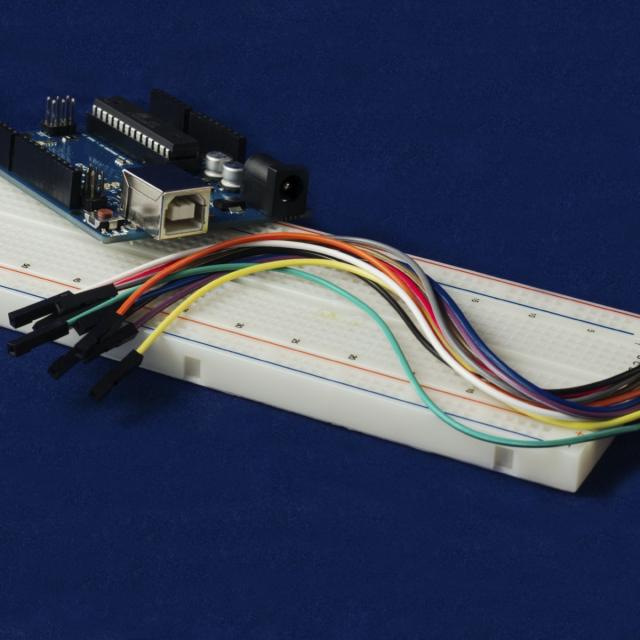
Welcome to the course! During Week 1, we are going to introduce you to the course (go through the Introduction, that’s very important). Then we shall start our work: getting acquainted with Arduino, the development environment and our first components. You will learn how to assemble circuits on a breadboard and will write your first program and assemble your first device. Don’t forget about the DIY section, which is also very important.

WEEK 2
It’s time to learn how to receive data with the help of sensors. During Week 2, we will teach you how to read off digital and analog signals, exchange data with a computer, create more complex algorithms, and use new output devices.

WEEK 3
During Week 3, you will learn to explore the world around you with the help of a distance sensor, and visualize data on a computer. You are also going improve your programming skills by creating a device with moving components.

WEEK 4
After going through Week 4, you will be able to connect your device to a network, plan its creation beforehand , control heavy loads, and power your device correctly.

WEEK 5
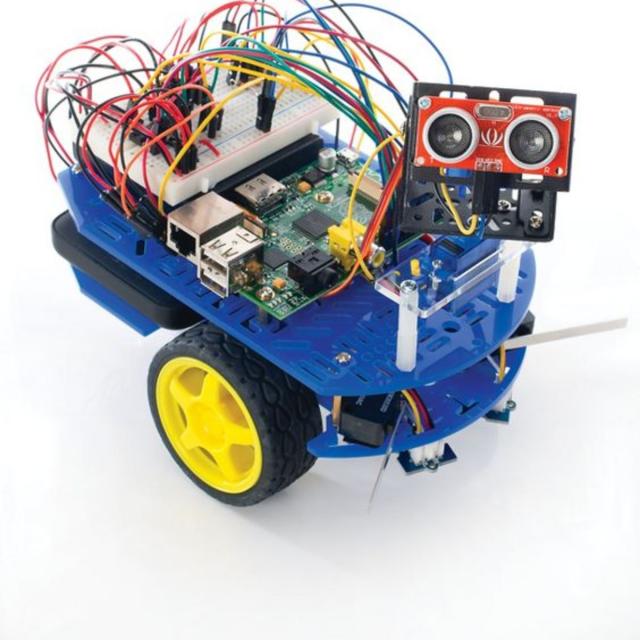
Let’s turn one wheel and then two wheels at once, and the robot car will start moving. It’ll be moving along the line or under your control. It could as well be just messing with your hand with which you are trying to control it.

WEEK 6
Having learnt to create a step motor, you can create devices which can perform very precise actions. For example, a 3D printer, which we will study in detail and then use to print some components.
Go to Class
MOOC List is learner-supported. When you buy through links on our site, we may earn an affiliate commission.

Related Courses

Digital Signal Processing 1: Basic Concepts and Algorithms (Coursera) Coursera
École Polytechnique Fédérale de Lausanne

Digital Signal Processing 1: Basic Concepts and Algorithms (Coursera)

Digital Signal Processing is the branch of engineering that, in the space of just a few decades, has enabled unprecedented levels of interpersonal communication and of on-demand entertainment. By reworking the principles of electronics, telecommunication and computer science into a unifying paradigm, DSP is a the heart of the digital revolution that brought us CDs, DVDs, MP3 players, mobile phones and countless other devices.

Aug 17th 2026
4 Weeks
Internet of Things: Multimedia Technologies (Coursera) Coursera
University of California, San Diego

Internet of Things: Multimedia Technologies (Coursera)

Content is an eminent example of the features that contributed to the success of wireless Internet. Mobile platforms such as the Snapdragon™ processor have special hardware and software capabilities to make acquisition, processing and rendering of multimedia content efficient and cost-effective.

Aug 17th 2026
3 Weeks
Fundamentals of Audio and Music Engineering: Part 1 Musical Sound & Electronics (Coursera) Coursera
University of Rochester

Fundamentals of Audio and Music Engineering: Part 1 Musical Sound & Electronics (Coursera)

In this course students learn the basic concepts of acoustics and electronics and how they can applied to understand musical sound and make music with electronic instruments. Topics include: sound waves, musical sound, basic electronics, and applications of these basic principles in amplifiers and speaker design.

Aug 3rd 2026
5-12 Weeks
The Raspberry Pi Platform and Python Programming for the Raspberry Pi (Coursera) Coursera
University of California, Irvine

The Raspberry Pi Platform and Python Programming for the Raspberry Pi (Coursera)

The Raspberry Pi is a small, affordable single-board computer that you will use to design and develop fun and practical IoT devices while learning programming and computer hardware. In addition, you will learn how to set up up the Raspberry Pi environment, get a Linux operating system running, and write and execute some basic Python code on the Raspberry Pi. You will also learn how to use Python-based IDE (integrated development environments) for the Raspberry Pi and how to trace and debug Python code on the device.

Aug 3rd 2026
4 Weeks
Plastic electronics (Coursera) Coursera
École Polytechnique

Plastic electronics (Coursera)

Plastic electronics is a concept that emerged forty years ago, with the discovery of electrically conductive polymers. Ten years later, the first electronic devices using organic solids in place of the ubiquitous inorganic semiconductors were realised. The best achievement of plastic electronics is constituted by Organic Light-Emitting Diodes (OLEDs) that equip the display of many smartphones, and even TV sets.

Aug 3rd 2026
5-12 Weeks
Modern Robotics, Course 4: Robot Motion Planning and Control (Coursera) Coursera
Northwestern University

Modern Robotics, Course 4: Robot Motion Planning and Control (Coursera)

Do you want to know how robots work? Are you interested in robotics as a career? Are you willing to invest the effort to learn fundamental mathematical modeling techniques that are used in all subfields of robotics? If so, then the "Modern Robotics: Mechanics, Planning, and Control" specialization may be for you. This specialization, consisting of six short courses, is serious preparation for serious students who hope to work in the field of robotics or to undertake advanced study. It is not a sampler.

Aug 3rd 2026
4 Weeks
Fundamentals of particle accelerator technology (NPAP MOOC) (Coursera) Coursera
Lund University

Fundamentals of particle accelerator technology (NPAP MOOC) (Coursera)

Did you know that particle accelerators play an important role in many functions of todays society and that there are over 30 000 accelerators in operation worldwide? A few examples are accelerators for radiotherapy which are the largest application of accelerators, altogether with more than 11000 accelerators worldwide. These accelerators range from very compact electron linear accelerators with a length of only about 1 m to large carbon ion synchrotrons with a circumference of more than 50 m and a huge rotating carbon ion gantry with a weight of 600 tons!

Aug 10th 2026
5-12 Weeks
Foundations of Objective-C App Development (Coursera) Coursera
University of California, Irvine

Foundations of Objective-C App Development (Coursera)

An introduction to the Objective-C programming language. This will prepare you for more extensive iOS app development and build a foundation for advanced iOS development topics. Objective-C programming requires a Mac laptop or desktop computer. An iOS device is optional if the learner is willing to working exclusively with the simulator. Some learners have been able to work with an OS X virtual machine on Windows, but explaining how to do that is beyond the scope of this course.

Aug 3rd 2026
4 Weeks
Julia Scientific Programming (Coursera) Coursera
University of Cape Town

Julia Scientific Programming (Coursera)

This four-module course introduces users to Julia as a first language. Julia is a high-level, high-performance dynamic programming language developed specifically for scientific computing. This language will be particularly useful for applications in physics, chemistry, astronomy, engineering, data science, bioinformatics and many more.

Aug 17th 2026
4 Weeks
Introduction to the Internet of Things and Embedded Systems (Coursera) Coursera
University of California, Irvine

Introduction to the Internet of Things and Embedded Systems (Coursera)

The explosive growth of the “Internet of Things” is changing our world and the rapid drop in price for typical IoT components is allowing people to innovate new designs and products at home. In this first class in the specialization you will learn the importance of IoT in society, the current components of typical IoT devices and trends for the future. IoT design considerations, constraints and interfacing between the physical world and your device will also be covered. You will also learn how to make design trade-offs between hardware and software. We'll also cover key components of networking to ensure that students understand how to connect their device to the Internet.

Aug 3rd 2026
4 Weeks
Introduction to Programming with MATLAB (Coursera) Coursera
Vanderbilt University

Introduction to Programming with MATLAB (Coursera)

This course teaches computer programming to those with little to no previous experience. It uses the programming system and language called MATLAB to do so because it is easy to learn, versatile and very useful for engineers and other professionals. MATLAB is a special-purpose language that is an excellent choice for writing moderate-size programs that solve problems involving the manipulation of numbers.

Aug 3rd 2026
5-12 Weeks