Build your own viral Lens! AR with Snapchat's Lens Studio (OpenLearning)

Offered by Snapchat,
Build your own viral Lens! AR with Snapchat's Lens Studio (OpenLearning)

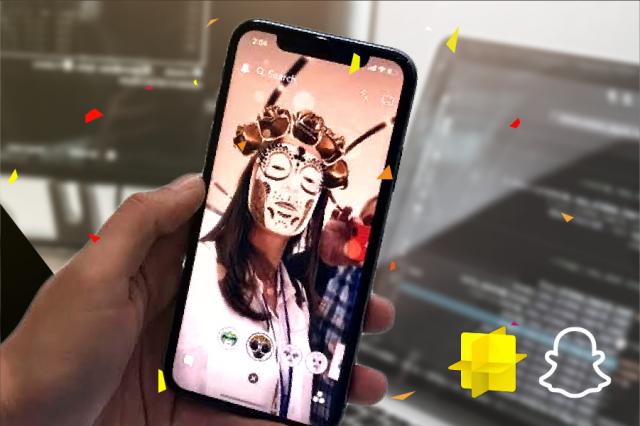
Discover how to create and publish your own AR lens using Snapchat's Lens Studio. Have you ever wondered what it takes to create your very own AR (Augmented Reality) content? Become a Lens Creator and join the Official Lens Creators (OLC) Community to inspire others with your imagination and talent.

Discover Lens Studio and its pre-built templates to get started with creating your own Snapchat lenses. Follow the steps and you'll be creating your first lens in no time at all.

What You Will Learn
Course Outcomes

  • familiarize with Lens Studio
  • Identify different types of templates
  • Create augmented reality lens using Lens Studio

What topics will you cover?

Module 0: Let’s Get Started
This module is for getting you set up and ready to dive into the course, including downloading and setting up the required tools to complete the course.

Module 1: Introduction to Lens Studio
Go through the basics such as the Lens Studio dashboard, lens vs. filter, and an overview of built-in templates in this module.

Module 2: Creating Your First Lens - Face Lens Basic Templates
In this module, you will create your first 'face lens'! We’re going to start with the basics and explore different face lenses that can be created using Lens Studio. Face lens is an AR experience that uses your smartphone selfie camera.

Module 3: World Lens Basic Templates
Make your first 'world lens' in this module! World lens is an AR experience from the world around you, hence we would use our smartphone’s rear camera for this.

What software or tools do you need?
To take part in the course you’ll need:

  1. A Snapchat account
  2. A Smartphone with the Snapchat app (iOS or Android) installed
  3. Lens Studio software (Windows 10 (64 bit); macOS 10.11+)
  4. Hardware (Minimum of Intel Core i3 2.5Ghz or AMD Phenom II 2.6Ghz with 4 GB RAM; Intel HD Graphics 4000 / Nvidia GeForce 710 / AMD Radeon HD 6450 or better; screen resolution of 1280x768 or higher)

Who is the course for?
This course is designed for anyone vying for a customised and personalised AR experience. Zero coding skills are required in order to successfully create your own AR lens.


Go to Class
MOOC List is learner-supported. When you buy through links on our site, we may earn an affiliate commission.

Related Courses

Foundations of User Experience (UX) Design (Coursera) Coursera
Google

Foundations of User Experience (UX) Design (Coursera)

Foundations of User Experience (UX) Design is the first of a series of seven courses that will equip you with the skills needed to apply to entry-level jobs in user experience design. UX designers focus on the interactions that people have with products like websites, mobile apps, and physical objects. UX designers make those everyday interactions usable, enjoyable, and accessible. The role of an entry-level UX designer might include empathizing with users, defining their pain points, coming up with ideas for design solutions, creating wireframes, prototypes, and mockups, and testing designs to get feedback.

Jun 11th 2026
4 Weeks
Story and Narrative Development for Video Games (Coursera) Coursera
California Institute of the Arts

Story and Narrative Development for Video Games (Coursera)

In this course, you will examine how storytelling acts as a vital mechanism for driving video gameplay forward. Looking at several historical and contemporary games, you will be asked to evaluate and interpret different story styles with the goal of identifying themes and procedures for your own game ideas. We'll examine traditional narrative story processes, such as three-act structure, and how they fit into game story flows and the strategic elements of gameplay. Ultimately, you will learn how to define character, setting, and structure to create a compelling game concept.

Jun 8th 2026
4 Weeks
Unreal Engine Interactive 3D: Blueprints, Animation, Audio, & Environments (edX) EdX
Rochester Institute of Technology,RITx

Unreal Engine Interactive 3D: Blueprints, Animation, Audio, & Environments (edX)

Expand your interactive Unreal Engine 3D skills with Blueprints, Landscapes, Audio and AI. In this course, you’ll build on your knowledge from UNRL 101 by learning visual scripting using Blueprints. This node-based system based on C++ enables powerful programming without the syntax typically involved in coding. You will gain basic coding skills to use multiple tools for accelerating work and building immersive interactive functionality.

Self Paced
Self-Paced
AR VR The Promise of Sci-Fi (OpenLearning) OpenLearning
Sunway University

AR VR The Promise of Sci-Fi (OpenLearning)

This course explores how the emerging forms of media and the development in the digital field opens possibilities for exploration of virtual reality and augmented reality that carries potential benefits applicable to various industries portrayed through user experience cases that you will discover throughout this course.

Self Paced
Self-Paced
MOOC on Visual Literacies: Exploring educational practice and technologies (ViliProject) Other Providers
Lancaster University

MOOC on Visual Literacies: Exploring educational practice and technologies (ViliProject)

Welcome to this MOOC on visual literacies where we will be exploring the educational practices and technologies associated with visual communication and visual thinking. In this course you will find out about the transformative power of photos, mind maps, comics, infographics and data visualization; how educators use video and animation and why it works; game-based learning, augmented reality, virtual and mixed reality; and synchronous video communication and holography.

No sessions available
5-12 Weeks
Mobile VR App Development with Unity (Coursera) Coursera
Unity

Mobile VR App Development with Unity (Coursera)

Virtual and Augmented Reality are poised to revolutionize how we interact with computers, with the world and with each other, and Unity is at the forefront of this technology; an estimated 90% of Samsung Gear VR games and 53% of Oculus Rift (games at launch) were Made With Unity. And according to labor market analytics company Burning Glass, "there’s nothing virtual about the jobs in this field. They’re here and now and very real." In this course, you'll learn how to design, develop, troubleshoot, and publish your own mobile VR applications in Unity for Google Daydream, Gear VR, or Oculus Go devices.

Jun 5th 2023
4 Weeks
Information Design (Coursera) Coursera
University of California, San Diego

Information Design (Coursera)

A blank canvas is full of possibility. If you have an idea for a user experience, how do you turn it into a beautiful and effective user interface? This covers covers principles of visual design so that you can effectively organize and present information with your interfaces. You'll learn concrete strategies to create user interfaces, including key lessons in typography, information architecture, layout, color, and more. You’ll learn particular issues that arise in new device contexts, such as mobile and responsive interfaces.

Jun 14th 2026
3 Weeks
Software Processes and Agile Practices (Coursera) Coursera
University of Alberta

Software Processes and Agile Practices (Coursera)

This course delves into a variety of processes to structure software development. It also covers the foundations of core Agile practices, such as Extreme Programming and Scrum. Upon successful completion of this course, you will be able to: distinguish between different process models for organizing software production; gauge the applicability of process models for a software development project; apply the fundamentals of Agile software development and management practices.

Jun 8th 2026
4 Weeks
Biomedical Visualisation (Coursera) Coursera
University of Glasgow

Biomedical Visualisation (Coursera)

Visualisation is a rapidly progressive specialty in academia, research and industry, and becoming the future of science. With the advancement of digital technologies and their applications, biomedical visualisation is an evolving and popular field. With new techniques and technologies to image, process and analyse data related to the human body, and its biological processes, it is at the forefront of the digital revolution.

Apr 20th 2026
4 Weeks