Basics of thermodynamics (Coursera)

Basics of thermodynamics (Coursera)

Our course on the basics of thermodynamics targeting a wide audience includes only what is absolutely necessary, focusing on the most basic issues, excluding less important specialized topics. However, you will learn about unusual phenomena such as stretched liquid and see interesting experiments. A future competent specialist, whose work should be at least somehow connected with physical phenomena, will find this course in thermodynamics useful and necessary.

Class Deals by MOOC List - Click here and see Coursera's Active Discounts, Deals, and Promo Codes.

We tried to explain the basic concepts as clearly and consistently as possible and at the same time remain at a serious physical level. As a result, in a relatively short time, you will receive a core of knowledge that will allow you to easily supplement it with appropriate special tasks in the future. In addition, such an ultra-short extract of the essentials often allows you to look at the course differently: to cover it as a whole, to see the interconnection of the parts. So, it may be of interest even to those who have already studied thermodynamics.

Syllabus

WEEK 1
Temperature and thermal equilibrium
In this module you will become familiar with the basic concepts of thermodynamic equilibrium and temperature, as well as other thermodynamic parameters. You will learn the basic laws, that describe the ideal gas. This module will serve as a starting point for further study of the course.

WEEK 2
The First law of thermodynamics
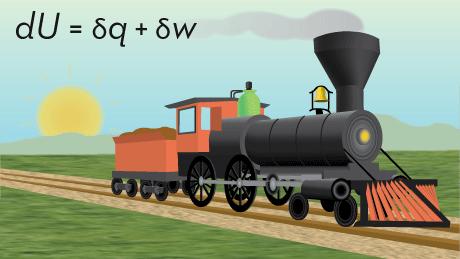
This module focuses on the first law of thermodynamics. You will learn quasistatic processes. You have to study the relationship between internal energy, the amount of heat and the work of a gas, get acquainted with the concept of heat capacity.

WEEK 3
The second law of thermodynamics
This module focuses on the second law of thermodynamics. You will become familiar with the Carnot and Otto cycles, the operation of internal combustion engines, refrigerators and heat pumps.

WEEK 4
Real gases and phase transitions
This module is devoted to real gases and the Van der Waals equation describing them. With its help, you will study such processes as cooling and liquefaction of gases, get acquainted with the unusual states of matter. Interesting physics experiments are waiting for you in this module.

WEEK 5
Heat transfer
In this module you will explore the phenomenon of thermal conductivity. You will get acquainted with the blackbody model, as well as the application of the thermodynamic approach to the description of thermal radiation.


Go to Class
MOOC List is learner-supported. When you buy through links on our site, we may earn an affiliate commission.

Related Courses

AP® Physics 2 - Part 1: Fluids and Thermodynamics (edX) EdX
Rice University,RiceX

AP® Physics 2 - Part 1: Fluids and Thermodynamics (edX)

The first course in a comprehensive series designed to prepare you for the AP Physics 2 exam, focusing on thermodynamics and fluids. Preparing for the AP Physics 2 exam requires a deep understanding of many different topics in physics as well as an understanding of the AP exam and the types of questions it asks. This course is Part 1 of our X-Series: AP Physics 2 and it is designed to prepare you for the AP exam.

No sessions available
4 Weeks
The Basics of Transport Phenomena (edX) EdX
Delft University of Technology,DelftX

The Basics of Transport Phenomena (edX)

Learn the basic framework to work on a broad spectrum of engineering problems concerning transfer of heat, mass and momentum. Learn through examples of everyday processes at home, in the lab and in industry. Have you ever wondered why ventilation helps to cool down your hot chocolate? Do you know why a surfing suit keeps you warm? Why iron feels cold, while wood feels warm at room temperature? Or how air is transferred into aqueous liquids in a water treatment plant? How can we sterilize milk with the least amount of energy? How does medicine spread in our tissue? Or how do we design a new cooling tower of a power plant? All these are phenomena that involve heat transfer, mass transfer or fluid flow.

Self Paced
Self-Paced
Conversion Thermodynamique de la Chaleur : Modéliser et Simuler (FUN) FUN
Institut Mines-Telecom

Conversion Thermodynamique de la Chaleur : Modéliser et Simuler (FUN)

La Conversion Thermodynamique de la Chaleur joue un rôle essentiel dans nos sociétés car elle permet de répondre à des besoins fondamentaux comme le chauffage, la production de froid, l’éclairage, la mobilité, la fourniture d’énergie mécanique, etc. Les systèmes énergétiques qui seront étudiés dans ce MOOC ont donc un impact direct sur notre vie quotidienne à tous. Ce MOOC propose une méthode originale qui permet de dépasser les limites que rencontre l'enseignement de la discipline par les approches classiques.

No sessions available
5-12 Weeks
Phases of Matter: Solid, Liquid, Gas and Beyond (Coursera) Coursera
University of Colorado Boulder

Phases of Matter: Solid, Liquid, Gas and Beyond (Coursera)

Complex systems can exhibit emergent phenomena, wherein the interplay of simple underlying rules governing the constituent parts leads to rich and unexpected behavior of the whole. Condensed matter physics is the branch of physics devoted to understanding such emergence in physical systems. It is the largest subfield of physics, and has developed a wealth of ideas and techniques for taming complexity. The course provides an introduction to this physics of emergence.

Jun 1st 2026
4 Weeks
Thermodynamique : applications (Coursera) Coursera
École Polytechnique Fédérale de Lausanne

Thermodynamique : applications (Coursera)

Ce cours complète le MOOC « Thermodynamique : fondements » qui vous permettra de mettre en application les concepts fondamentaux de la thermodynamique. Pour atteindre cet objectif, le Professeur J.-Ph. Ansermet de l’Ecole Polytechnique Fédérale de Lausanne s’est entouré d’experts et de spécialistes des différents domaines d’application provenant de diverses institutions partenaires du réseau RESCIF. Vous pourrez ainsi voir l’usage de la thermodynamique en chimie, en ingénierie et en physique.

Jun 8th 2026
5-12 Weeks
Understanding Biological Energy (FutureLearn) FutureLearn
Royal Holloway, University of London

Understanding Biological Energy (FutureLearn)

Get an introduction to energy and explore how humans and other living things obtain and use their biological energy sources. Discover applications of biological energy, from human energy to photosynthesis. On this course, you’ll learn what energy actually is and how living things acquire and convert it.

Jun 20th 2022
4 Weeks
Thermodynamics in Energy Engineering (FutureLearn) FutureLearn
Hanyang University

Thermodynamics in Energy Engineering (FutureLearn)

Understand the basic thermodynamic principles widely used in many engineering fields: temperature, free energy and entropy. This free online course introduces the basic thermodynamic principles that are widely used in many engineering fields. It will prepare you for degree-level study, by helping you understand and apply thermodynamic fundamentals through real-world, problem-solving exercises.

No sessions available
5-12 Weeks
Conversion Thermodynamique de la Chaleur : Cycles classiques et innovants (FUN) FUN
Institut Mines-Telecom

Conversion Thermodynamique de la Chaleur : Cycles classiques et innovants (FUN)

La Conversion Thermodynamique de la Chaleur joue un rôle essentiel dans nos sociétés car elle permet de répondre à des besoins fondamentaux comme le chauffage, la production de froid, l’éclairage, la mobilité, la fourniture d’énergie mécanique, etc. Les systèmes énergétiques qui seront étudiés dans ce MOOC ont donc un impact direct sur notre vie quotidienne à tous. Vous souhaitez comprendre comment ces systèmes énergétiques permettent d’effectuer des conversions entre chaleur et travail, mais vous ne supportez plus les développements théoriques fastidieux et inutiles. Ce MOOC propose pour cela une méthode originale qui permet de dépasser les limites que rencontre l'enseignement de la discipline par les approches classiques.

No sessions available
5-12 Weeks
Introduzione alla fisica sperimentale: meccanica, termodinamica (POK) Polimi OPEN KNOWLEDGE
Politecnico di Milano

Introduzione alla fisica sperimentale: meccanica, termodinamica (POK)

Il corso affronta le tematiche della meccanica e della termodinamica partendo dall’applicazione del metodo sperimentale, per prepararsi al meglio all'ingresso all'università. The course addresses the thematic of Mechanics and thermodynamics starting from the applications of the experimental method, to better prepare to start the college experience with the fundamental knowledge.

Available
5-12 Weeks
Chemical Thermodynamics I: Thermodynamics and Statistical Mechanics (edX) EdX
MIT,MITx

Chemical Thermodynamics I: Thermodynamics and Statistical Mechanics (edX)

Based on 5.601 Thermodynamics I, this course introduces learners to fundamental concepts in thermodynamics and statistical mechanics. Learners will develop an understanding of fundamental thermodynamic principles and how they arise from molecular scale system properties. This course is the first in a series of two thermodynamics courses that together, cover chemical thermodynamics, statistical mechanics, phase equilibria, and kinetics.

Apr 14th 2022
5-12 Weeks