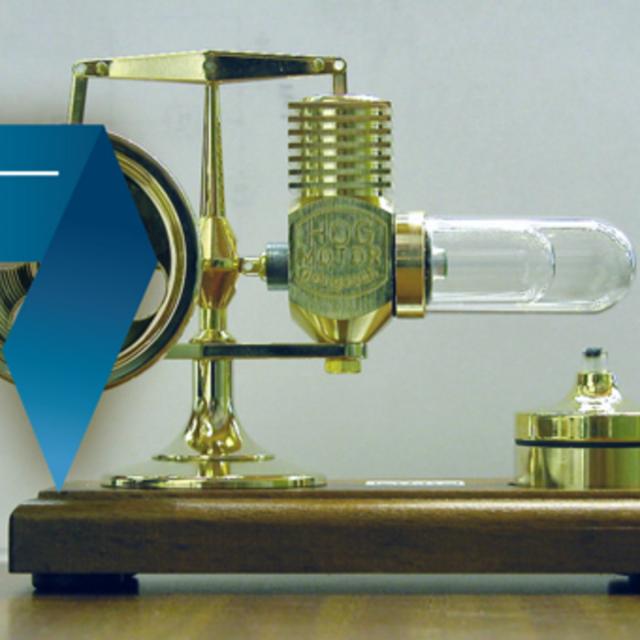
Thermodynamique : fondements (Coursera)

Thermodynamique : fondements (Coursera)

Ce cours vous apportera une compréhension des concepts fondamentaux de la thermodynamique du point de vue de la physique, de la chimie et de l’ingénierie. Il est scindé un deux MOOCs. Dans la première partie, le Professeur J.-Ph. Ansermet de l’EPFL et son collaborateur le Dr. Sylvain Bréchet ont rassemblé en quatre leçons tous les principes fondamentaux de la thermodynamique. La deuxième partie du MOOC illustre l’approche thermodynamique par une série d’applications présentées par des spécialistes provenant de diverses institutions partenaires du réseau RESCIF.

Class Deals by MOOC List - Click here and see Coursera's Active Discounts, Deals, and Promo Codes.

L’objectif du cours est la compréhension et la capacité de mise en application des concepts fondamentaux de la thermodynamique. Après la présentation du premier et deuxième principe de la thermodynamique, l’exposé abordera les questions d’irréversibilité ainsi que les potentiels thermodynamiques.
Après l’établissement de ces bases conceptuelles, leurs applications à l’ingénierie tels que les transferts thermiques, la calorimétrie et les transitions de phases, seront traitées. Ensuite le point de vue de la chimie sera présenté pour aborder la conversion de l’énergie chimique en électricité. Finalement, des sujets plus avancés seront abordés, à savoir les cycles thermodynamiques, les machines thermiques, les concepts de thermodynamique adaptés au milieu continu et finalement les processus de transports.
Le professeur J.-Ph. Ansermet qui est l’instigateur de ce cours s’est entouré d’experts et de spécialistes des différents domaines d’application enseignant la thermodynamique dans diverses institutions partenaires du réseau RESCIF, c’est à dire le Professeur Michael Grätzel et le docteur Sylvain Brechet de l’EPFL, les Professeurs Paul Ekam, Théophile Mband, Marthe Boyomo et André Talla de l’ENSP de Yaoundé, le professeur Miltiadis Papalexandris de UCL à Louvain, le Professeur Etienne Robert du Polytechnique de Montréal, les Professeurs Marwan Brouche et Chantal Maatouk de l’Université St-Joseph de Beyrouth.

Syllabus

WEEK 1
Présentation générale et leçon sur le premier principe
Bienvenue à ce MOOC de thermodynamique. Cette formation de base en thermodynamique est présentée en deux parties. La première partie où vous êtes maintenant pose les fondements de la thermodynamique. La deuxième partie présente des applications. Dans le premier chapitre, le professeur Paul Ekam de l'Institut Polytechnique de Yaoundé au Cameroun définit ce qu'est un système thermodynamique. Le docteur Sylvain Bréchet de l’École Polytechnique Fédérale de Lausanne en Suisse présente le premier principe de la thermodynamique et montre comment le cadre conceptuel de la thermodynamique généralise celui de la mécanique. Il définit en particulier les notions de travail et de chaleur.

WEEK 2
Deuxième principe
Le docteur Sylvain Bréchet de l’École Polytechnique Fédérale de Lausanne en Suisse présente le deuxième principe de la thermodynamique qui permet de distinguer des processus réversibles et irréversibles par rapport à leur symétrie par renversement du temps. Il examine ensuite l'application des principes de la thermodynamique au cas d'un système simple. Le professeur Paul Ekam de l'Institut Polytechnique de Yaoundé au Cameroun introduit les notions d'équation d'état et de diagramme d'état.

WEEK 3
Irréversibilité
Le docteur Sylvain Bréchet de l’École Polytechnique Fédérale de Lausanne en Suisse aborde la thermodynamique d'un système isolé constitué de deux sous-systèmes simples. Il déduit les conditions d'équilibre ainsi que les lois phénoménologiques de Fourier et de Fick qui décrivent le transport de chaleur et de matière.

WEEK 4
Potentiels thermodynamiques
Le docteur Sylvain Bréchet de l’École Polytechnique Fédérale de Lausanne en Suisse établit les relations fondamentales de la thermodynamique, à savoir la relation de Gibbs, la relation d'Euler et la relation Gibbs-Duhem. Il définit la transformation mathématique de Legendre. A l'aide de cette transformation, il définit les potentiels thermodynamiques et leurs différentielles. En se basant sur le théorème de Schwarz, il établit les relations de Maxwell entre les dérivées premières des fonctions d'état.
Go to Class
MOOC List is learner-supported. When you buy through links on our site, we may earn an affiliate commission.

Related Courses

Ethics, Technology and Engineering (Coursera) Coursera
Eindhoven University of Technology

Ethics, Technology and Engineering (Coursera)

There is an increasing attention to ethics in engineering practice. Engineers are supposed not only to carry out their work competently and skilfully, but also to be aware of the broader ethical and social implications of engineering and to be able to reflect on these. According to the Engineering Criteria 2000 of the Accreditation Board for Engineering and Technology (ABET) in the US, engineers must have “an understanding of professional and ethical responsibility” and should "understand the impact of engineering solutions in a global and societal context.”

Aug 31st 2026
5-12 Weeks
Nanotechnology and Nanosensors, Part 1 (Coursera) Coursera
Technion - Israel Institute of Technology

Nanotechnology and Nanosensors, Part 1 (Coursera)

Nanotechnology and nanosensors are broad, interdisciplinary areas that encompass (bio)chemistry, physics, biology, materials science, electrical engineering and more. The present course will provide a survey on some of the fundamental principles behind nanotechnology and nanomaterials and their vital role in novel sensing properties and applications. The course will discuss interesting interdisciplinary scientific and engineering knowledge at the nanoscale to understand fundamental physical differences at the nanosensors.

Sep 7th 2026
5-12 Weeks
Chemical Engineering Thermodynamics 1 (Coursera) Coursera
Korea Advanced Institute of Science and Technology - KAIST

Chemical Engineering Thermodynamics 1 (Coursera)

An appreciation of thermodynamics is required to become a chemical and biomolecular engineer. Thermodynamics can assess the viability of a process and is one of the curriculum's most essential topics. The principles are utilized in following engineering courses (kinetics, mass transfer, design, materials) and are applicable to numerous engineering disciplines. The increased emphasis on energy usage and transformation as a result of rising demand, diminishing supply, and global warming necessitates that the engineers who will tackle these issues have a firm grasp of thermodynamics.

Aug 31st 2026
5-12 Weeks
Microwave engineering and antennas (Coursera) Coursera
Eindhoven University of Technology

Microwave engineering and antennas (Coursera)

This unique Master-level course provides you with in-depth know-how of microwave engineering and antennas. The course combines both passive and active microwave circuits as well as antenna systems. Future applications, like millimeter-wave 5G/beyond-5G wireless communications or automotive radar, require experts that can co-design highly integrated antenna systems that include both antennas and microwave electronics. We will provide you with the required theoretical foundation as well as hands-on experience using state-of-the-art design tools. The web lectures are supported by many on-line quizzes in which you can practice the background theory.

Aug 31st 2026
5-12 Weeks
Image and video processing: From Mars to Hollywood with a stop at the hospital (Coursera) Coursera
Duke University

Image and video processing: From Mars to Hollywood with a stop at the hospital (Coursera)

In this course, you will learn the science behind how digital images and video are made, altered, stored, and used. We will look at the vast world of digital imaging, from how computers and digital cameras form images to how digital special effects are used in Hollywood movies to how the Mars Rover was able to send photographs across millions of miles of space.

Sep 7th 2026
5-12 Weeks
Chemical Biology (Coursera) Coursera
University of Geneva

Chemical Biology (Coursera)

Chemical biology is a burgeoning field that has rapidly risen to prominence. This surge of interest has been fuelled by chemical biology’s applicability to understanding critical processes in live cells or model organisms in real time. This success has arisen because chemical biology straddles a nexus between chemistry, biology, and physics. Thus, chemical biology can harness rapid chemistry to observe or perturb biological processes, that are in turn reported using physical assays, all in an otherwise unperturbed living entity. Although its boundaries are endless, the multidisciplinary nature of chemical biology can make the field seem daunting; we beg to differ! Here, we deconstruct chemical biology into its core components, and repackage the material.

Aug 31st 2026
5-12 Weeks
Ferrous Technology I (Coursera) Coursera
Pohang University of Science and Technology - POSTECH

Ferrous Technology I (Coursera)

Steel, ever-evolving material, has been the most preeminent of all materials since it can provide wide range of properties that can meet ever-changing requirements. In this course, we explore both fundamental and technical issues related to steels, including iron and steelmaking, microstructure and phase transformation, and their properties and applications.

Aug 31st 2026
5-12 Weeks
Thermodynamique : applications (Coursera) Coursera
École Polytechnique Fédérale de Lausanne

Thermodynamique : applications (Coursera)

Ce cours complète le MOOC « Thermodynamique : fondements » qui vous permettra de mettre en application les concepts fondamentaux de la thermodynamique. Pour atteindre cet objectif, le Professeur J.-Ph. Ansermet de l’Ecole Polytechnique Fédérale de Lausanne s’est entouré d’experts et de spécialistes des différents domaines d’application provenant de diverses institutions partenaires du réseau RESCIF. Vous pourrez ainsi voir l’usage de la thermodynamique en chimie, en ingénierie et en physique.

Aug 31st 2026
5-12 Weeks
The Science of Gastronomy (Coursera) Coursera
The Hong Kong University of Science and Technology - HKUST

The Science of Gastronomy (Coursera)

This course introduces a number of basic scientific principles underpinning the methodology of cooking, food preparation and the enjoyment of food. All topics covered have a strong basis in biology, chemistry, and physics application. Among others, they include the consumption of cooked food, the physiological and evolutionary implication of the senses, geographic and cultural influences on food, and the rationale behind food preparation. We will also discuss issues such as coupling of senses to improve sense stimulation; altering flavor by chemical means; and modification of the coloration to improve the appearance of dishes. Following the video demonstrations of the scientific principles of cooking, you will learn to recognize the key ingredients and their combinations for preparing good healthy food.

Sep 1st 2026
5-12 Weeks
Introduction to High-Throughput Materials Development (Coursera) Coursera
Georgia Institute of Technology

Introduction to High-Throughput Materials Development (Coursera)

This course is an introduction to high-throughput experimental methods that accelerate the discovery and development of new materials. This course is an introduction to high-throughput experimental methods that accelerate the discovery and development of new materials. It is well recognized that the discovery of new materials is the key to solving many technological problems faced by industry and society. These problems include energy production and utilization, carbon capture, tissue engineering, and sustainable materials production, among many others. This course will introduce the learner to a remarkable new approach to materials discovery and characterization: high-throughput materials development (HTMD).

Aug 31st 2026
5-12 Weeks
Introduction to Molecular Spectroscopy (Coursera) Coursera
University of Manchester

Introduction to Molecular Spectroscopy (Coursera)

The course introduces the three key spectroscopic methods used by chemists and biochemists to analyse the molecular and electronic structure of atoms and molecules. These are UV/Visible , Infra-red (IR) and Nuclear Magnetic Resonance (NMR) spectroscopies. The content is presented using short focussed and interactive screencast presentations accompanied by formative quizzes to probe understanding of the key concepts presented. Numerous exercises are provided to facilitate mastery of each topic. A unique virtual spectroscopic laboratory is made available to enable students to measure and analyse spectra online. Assessment is via summative quizzes completed during the course period.

Sep 7th 2026
4 Weeks
La Química de las Reacciones (Coursera) Coursera
Universidad Autónoma Metropolitana

La Química de las Reacciones (Coursera)

En este curso aprenderás los conocimientos básicos de reacciones químicas, lo cual te permitirá tener una mejor comprensión del estudio de la química, así como de la naturaleza. En general la mayoría de la gente le tiene miedo a la palabra química; sin embargo, debido a que la química es una ciencia central es necesario comprenderla y hacerla nuestra amiga.

Sep 7th 2026
4 Weeks