EdX

Autonomous Navigation for Flying Robots (edX)

Autonomous Navigation for Flying Robots (edX)

You will learn how to infer the position of the quadrotor from its sensor readings and how to navigate it along a trajectory.

Class Deals by MOOC List - Click here and see EdX's Active Discounts, Deals, and Promo Codes.

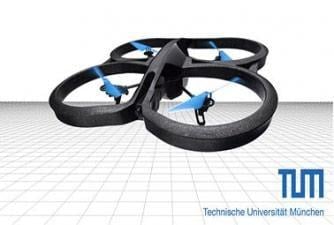
In recent years, flying robots such as miniature helicopters or quadrotors have received a large gain in popularity. Potential applications range from aerial filming over remote visual inspection of industrial sites to automatic 3D reconstruction of buildings. Navigating a quadrotor manually requires a skilled pilot and constant concentration. Therefore, there is a strong scientific interest to develop solutions that enable quadrotors to fly autonomously and without constant human supervision. This is a challenging research problem because the payload of a quadrotor is uttermost constrained and so both the quality of the onboard sensors and the available computing power is strongly limited.
In this course, we will introduce the basic concepts for autonomous navigation for quadrotors.

The following topics will be covered:

  • 3D geometry,
  • probabilistic state estimation,
  • visual odometry, SLAM, 3D mapping,
  • linear control.

In particular, you will learn how to infer the position of the quadrotor from its sensor readings and how to navigate it along a trajectory.
The course consists of a series of weekly lecture videos that we be interleaved by interactive quizzes and hands-on programming tasks. For the flight experiments, we provide a browser-based quadrotor simulator which requires the students to write small code snippets in Python.

What you'll learn
After successful participation of this module, students will be able to

  • Understand the flight principles of quadrotors and their application potential
  • Specify the pose of objects in 3D space and to perform calculations between them (e.g., compute the relative motion)
  • Explain the principles of Bayesian state estimation
  • Implement and apply an extended Kalman filter (EKF), and to select appropriate parameters for it
  • Implement and apply a PID controller for state control, and to fine tune its parameters
  • Understand and explain the principles of visual motion estimation and 3D mapping
Go to Class
MOOC List is learner-supported. When you buy through links on our site, we may earn an affiliate commission.

Related Courses

Quantum Mechanics for Scientists and Engineers 2 (edX) EdX
StanfordOnline

Quantum Mechanics for Scientists and Engineers 2 (edX)

This course covers key topics in the use of quantum mechanics in many modern applications in science and technology, introduces core advanced concepts such as spin, identical particles, the quantum mechanics of light, the basics of quantum information, and the interpretation of quantum mechanics, and covers the major ways in which quantum mechanics is written and used in modern practice.

Self Paced
Self-Paced
Fundamentos de Comunicaciones Ópticas (edX) EdX
Universitat Politècnica de València,UPValenciaX

Fundamentos de Comunicaciones Ópticas (edX)

Se tratan conceptos básicos de las comunicaciones ópticas como el guiado, los modos, la atenuación o la dispersión y el diseño de sistemas. Este curso está destinado a estudiantes universitarios de la rama de las Tecnologías de la Información y las Comunicaciones que quieran conocer los mecanismos fundamentales de las comunicaciones por fibra óptica.

Self Paced
Self-Paced
Building Arduino robots and devices (Coursera) Coursera
Moscow Institute of Physics and Technology

Building Arduino robots and devices (Coursera)

For many years now, people have been improving their tools, studying the forces of nature and bringing them under control, using the energy of the nature to operate their machines. Last century is noted for the creation of machines which can operate other machines. Nowadays the creation of devices that interact with the physical world is available to anyone. Our course consists of a series of practical problems on making things that work independently: they make their own decisions, act, move, communicate with each other and people around, and control other devices. We will demonstrate how to assemble such devices and programme them using the Arduino platform as a basis.

May 9th 2022
5-12 Weeks
Fundamentals of Robotics & Industrial Automation (Coursera) Coursera
L&T EduTech

Fundamentals of Robotics & Industrial Automation (Coursera)

The "Fundamentals of Robotics & Industrial Automation" course is tailored to provide a comprehensive understanding of essential concepts and practical skills necessary for excelling in the field of collaborative robotics. Through three dynamic modules, participants will explore the intricacies of sensors & transducers in machine tools & robots, servo systems, and interfacing and simulation techniques.

Aug 31st 2026
3 Weeks
Building a Future with Robots (FutureLearn) FutureLearn
The University of Sheffield

Building a Future with Robots (FutureLearn)

Explore the role of robots and autonomous systems in the factories, homes, hospitals, schools and cars of our near future. In the near future, many of us will work alongside robots. Knowledge of robotics and autonomous systems will be a helpful skill for a surprising number of today’s careers. On this course, we’ll look at current and future developments in the field of robotics that could shape many different aspects of our daily lives.

Available now
3 Weeks
Begin Robotics (FutureLearn) FutureLearn
University of Reading

Begin Robotics (FutureLearn)

Learn robotics by exploring the history, anatomy and intelligence of robots and test drive robots using exciting simulations Explore our introduction to robotics. Robots today are roving Mars, hoovering our floors, building cars and entertaining us in films. You may even share Stephen Hawking’s world view that super-intelligent ones may one day bring about the end of the human race.

Self Paced
4 Weeks
Electrotechnique II (edX) EdX
École Polytechnique Fédérale de Lausanne,EPFLx

Electrotechnique II (edX)

Découvrez les systèmes alternatifs triphasés et leurs charges associées ainsi que les régimes transitoires, base des alimentations à découpage. Ce cours traite des systèmes alternatifs triphasés, piliers de l'alimentation électrique industrielle et de certains types de machines électriques. Les charges triphasées associées, symétriques ou dissymétriques, seront étudiées ainsi que les puissances actives, réactives et apparentes qui en découlent. Des méthodes de compensation de la puissance réactive seront développées.

Self Paced
Self-Paced
Robotics: Fundamentals (edX) EdX
University of Pennsylvania,PennX

Robotics: Fundamentals (edX)

Master the foundational math concepts that drive robotics and put them into practice using MATLAB. How do you create robots that operate well in the real world? Learn the key math concepts and tools used to design robots that excel in navigating our complex, unstructured world in environments such as aerospace, automotive, manufacturing and healthcare.

No sessions available
5-12 Weeks