Programming Languages, Part C (Coursera)

Programming Languages, Part C (Coursera)

This course is an introduction to the basic concepts of programming languages, with a strong emphasis on functional programming. The course uses the languages ML, Racket, and Ruby as vehicles for teaching the concepts, but the real intent is to teach enough about how any language “fits together” to make you more effective programming in any language -- and in learning new ones.

Class Deals by MOOC List - Click here and see Coursera's Active Discounts, Deals, and Promo Codes.

This course is neither particularly theoretical nor just about programming specifics -- it will give you a framework for understanding how to use language constructs effectively and how to design correct and elegant programs. By using different languages, you will learn to think more deeply than in terms of the particular syntax of one language. The emphasis on functional programming is essential for learning how to write robust, reusable, composable, and elegant programs. Indeed, many of the most important ideas in modern languages have their roots in functional programming. Get ready to learn a fresh and beautiful way to look at software and how to have fun building it.
The course assumes some prior experience with programming, as described in more detail in the first module of Part A. Part B assumes successful completion of Part A.
The course is divided into three Coursera courses: Part A, Part B, and Part C. As explained in more detail in the first module of Part A, the overall course is a substantial amount of challenging material, so the three-part format provides two intermediate milestones and opportunities for a pause before continuing. The three parts are designed to be completed in order and set up to motivate you to continue through to the end of Part C.
Week 1 of Part A has a more detailed list of topics for all three parts of the course, but it is expected that most course participants will not (yet!) know what all these topics mean.

Syllabus

WEEK 1
Introduction, Course-Wide Information, and Software Installation (Start Here)
Welcome! Start here! Learn about this course and how it's organized.
Section 8 and Homework 6 (First Module with Ruby)
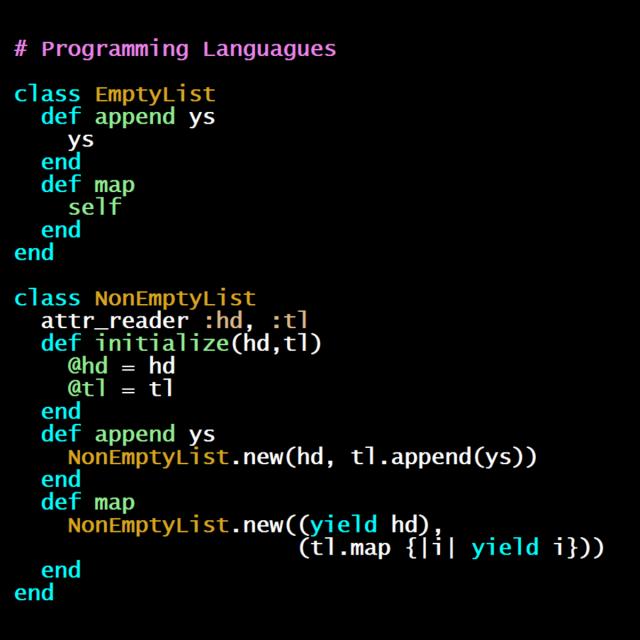
Let's get started programming with Ruby, including learning about Ruby's variant of (almost) function closures and the "inheritance and overriding" that is the essence of object-oriented programming. The welcome message has a few additional comments about "what makes Ruby different" and how to approach the (rather different) homework assignment, so let's get started...

WEEK 2
Section 9 and Homework 7 (Second Module With Ruby)
Welcome to the second week of Part C where we will focus on how functional programming and object-oriented programming encourage such "exactly opposite" decompositions of problems that they are "more alike than you might realize". This is a key opportunity to synthesize much of what we have learned so far. As the welcome message discusses in more detail, we will go a bit beyond this to touch on some related advanced topics and then dive into the last -- and challenging -- programming assignment, which involves porting an interpreter from ML to Ruby.

WEEK 3
Section 10, Final Exam, and Course Wrap-Up
We have reached the last module of Programming Languages! We first study subtyping, how it relates to static types for object-oriented programming, and how it relates to generics. There is no assignment or quiz devoted only to this last "new material", but there is a "final exam" covering Part B and Part C of the course. Enjoy studying for the exam, and don't miss the final "wrap-up" lesson when you're all done!
Go to Class
MOOC List is learner-supported. When you buy through links on our site, we may earn an affiliate commission.

Related Courses

Distributed Programming in Java (Coursera) Coursera
Rice University

Distributed Programming in Java (Coursera)

This course teaches learners (industry professionals and students) the fundamental concepts of Distributed Programming in the context of Java 8. Distributed programming enables developers to use multiple nodes in a data center to increase throughput and/or reduce latency of selected applications. By the end of this course, you will learn how to use popular distributed programming frameworks for Java programs, including Hadoop, Spark, Sockets, Remote Method Invocation (RMI), Multicast Sockets, Kafka, Message Passing Interface (MPI), as well as different approaches to combine distribution with multithreading.

Jun 22nd 2026
4 Weeks
Basic Modeling for Discrete Optimization (Coursera) Coursera
University of Melbourne,The Chinese University of Hong Kong

Basic Modeling for Discrete Optimization (Coursera)

Optimization is a common form of decision making, and is ubiquitous in our society. Its applications range from solving Sudoku puzzles to arranging seating in a wedding banquet. The same technology can schedule planes and their crews, coordinate the production of steel, and organize the transportation of iron ore from the mines to the ports. Good decisions in manpower and material resources management also allow corporations to improve profit by millions of dollars.

Jun 22nd 2026
4 Weeks
Creative Programming for Digital Media & Mobile Apps (Coursera) Coursera
University of London,Goldsmiths, University of London

Creative Programming for Digital Media & Mobile Apps (Coursera)

This course is for anyone who would like to apply their technical skills to creative work ranging from video games to art installations to interactive music, and also for artists who would like to use programming in their artistic practice. This course will teach you how to develop and apply programming skills to creative work. This is an important skill within the development of creative mobile applications, digital music and video games. It will teach the technical skills needed to write software that make use of images, audio and graphics, and will concentrate on the application of these skills to creative projects. Additional resources will be provided for students with no programming background.

Jun 22nd 2026
5-12 Weeks
Introduction to Machine Learning (Coursera) Coursera
Duke University

Introduction to Machine Learning (Coursera)

This course will provide you a foundational understanding of machine learning models (logistic regression, multilayer perceptrons, convolutional neural networks, natural language processing, etc.) as well as demonstrate how these models can solve complex problems in a variety of industries, from medical diagnostics to image recognition to text prediction.

Jun 26th 2026
5-12 Weeks
Interfacing with the Arduino (Coursera) Coursera
University of California, Irvine

Interfacing with the Arduino (Coursera)

Arduino senses the environment by receiving inputs from add-on devices such as sensors, and can control the world around it by adjusting lights, motors, and other actuators. In this class you will learn how and when to use the different types of sensors and how to connect them to the Arduino. Since the external world uses continuous or analog signals and the hardware is digital you will learn how these signals are converted back-and-forth and how this must be considered as you program your device. You'll also learn about the use of Arduino-specific shields and the shields software libraries to interface with the real world.

Jun 22nd 2026
4 Weeks
Big Data Analysis with Scala and Spark (Coursera) Coursera
École Polytechnique Fédérale de Lausanne

Big Data Analysis with Scala and Spark (Coursera)

Manipulating big data distributed over a cluster using functional concepts is rampant in industry, and is arguably one of the first widespread industrial uses of functional ideas. This is evidenced by the popularity of MapReduce and Hadoop, and most recently Apache Spark, a fast, in-memory distributed collections framework written in Scala. In this course, we'll see how the data parallel paradigm can be extended to the distributed case, using Spark throughout.

Jun 22nd 2026
4 Weeks
Fundamentos de Android (Coursera) Coursera
Universidad Nacional Autónoma de México

Fundamentos de Android (Coursera)

Por medio de ejercicios prácticos, serás capaz de manipular las herramientas que Android te ofrece para desarrollar aplicaciones móviles. En este curso, instalarás el entorno de desarrollo Android Studio y manipularás sus más sofisticadas particularidades. Por ejemplo, la composición de archivos de un proyecto Android y los patrones más comunes para el desarrollo de tus aplicaciones.

Jun 22nd 2026
5-12 Weeks
Using Python to Interact with the Operating System (Coursera) Coursera
Google

Using Python to Interact with the Operating System (Coursera)

By the end of this course, you’ll be able to manipulate files and processes on your computer’s operating system. You’ll also have learned about regular expressions -- a very powerful tool for processing text files -- and you’ll get practice using the Linux command line on a virtual machine. And, this might feel like a stretch right now, but you’ll also write a program that processes a bunch of errors in an actual log file and then generates a summary file. That’s a super useful skill for IT Specialists to know.

Jun 23rd 2026
5-12 Weeks
Introduction to Programming with MATLAB (Coursera) Coursera
Vanderbilt University

Introduction to Programming with MATLAB (Coursera)

This course teaches computer programming to those with little to no previous experience. It uses the programming system and language called MATLAB to do so because it is easy to learn, versatile and very useful for engineers and other professionals. MATLAB is a special-purpose language that is an excellent choice for writing moderate-size programs that solve problems involving the manipulation of numbers.

Jun 22nd 2026
5-12 Weeks
Data Structures and Performance (Coursera) Coursera
University of California, San Diego

Data Structures and Performance (Coursera)

How do Java programs deal with vast quantities of data? Many of the data structures and algorithms that work with introductory toy examples break when applications process real, large data sets. Efficiency is critical, but how do we achieve it, and how do we even measure it? This is an intermediate Java course. We recommend this course to learners who have previous experience in software development or a background in computer science, and in particular, we recommend that you have taken the first course in this specialization (which also requires some previous experience with Java).

Jun 22nd 2026
5-12 Weeks
Interfacing with the Raspberry Pi (Coursera) Coursera
University of California, Irvine

Interfacing with the Raspberry Pi (Coursera)

The Raspberry Pi uses a variety of input/output devices based on protocols such as HDMI, USB, and Ethernet to communicate with the outside world. In this class you will learn how to use these protocols with other external devices (sensors, motors, GPS, orientation, LCD screens etc.) to get your IoT device to interact with the real world.

Jun 22nd 2026
4 Weeks