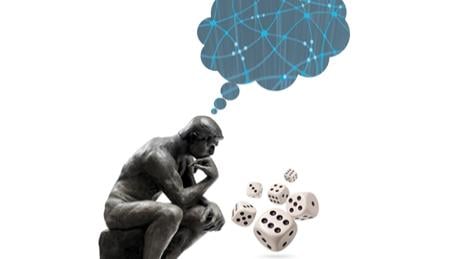
What is “the mind” and what is artificial intelligence? (Coursera)

What is “the mind” and what is artificial intelligence? (Coursera)

In this course, we will explore the history of cognitive science and the way these ideas shape how we think of artificial cognition.

Class Deals by MOOC List - Click here and see Coursera's Active Discounts, Deals, and Promo Codes.

What You Will Learn

  • Describe the details of the Turing test, including its purpose, limitations, and potential impact.
  • Describe the details of Searle’s Chinese Room thought experiment, including its purpose, limitations, and potential impact.
  • Discuss previous and current attempts to create artificial systems that can pass the Turing Test in various domains.
  • Compute and outline the limitations of exponential and factorial growth functions.

Course 1 of 4 in the Mind and Machine Specialization.

Syllabus

WEEK 1
Introduction
This week we will explore the history of automata and machines imitating life.

WEEK 2
Tests and Thought Experiments
This week we will start to define the boundaries of intelligence, understanding, and related ideas from both human and machine perspectives.

WEEK 3
A Hard Problem
For the next two weeks, we will discuss how our understanding of cognition leads to differing definitions of problems.

WEEK 4
Cognitive Problems in Computational Terms
We will continue discussing how our understanding of cognition leads to differing definitions of problems.

Go to Class
MOOC List is learner-supported. When you buy through links on our site, we may earn an affiliate commission.

Related Courses

Neural Networks and Deep Learning (Coursera) Coursera
DeepLearning.AI

Neural Networks and Deep Learning (Coursera)

If you want to break into cutting-edge AI, this course will help you do so. Deep learning engineers are highly sought after, and mastering deep learning will give you numerous new career opportunities. Deep learning is also a new "superpower" that will let you build AI systems that just weren't possible a few years ago. In this course, you will learn the foundations of deep learning.

Jun 22nd 2026
4 Weeks
Matrix Methods (Coursera) Coursera
University of Minnesota

Matrix Methods (Coursera)

Mathematical Matrix Methods lie at the root of most methods of machine learning and data analysis of tabular data. Learn the basics of Matrix Methods, including matrix-matrix multiplication, solving linear equations, orthogonality, and best least squares approximation. Discover the Singular Value Decomposition that plays a fundamental role in dimensionality reduction, Principal Component Analysis, and noise reduction.

Jun 22nd 2026
5-12 Weeks
Cloud Computing Applications, Part 2: Big Data and Applications in the Cloud (Coursera) Coursera
University of Illinois at Urbana-Champaign

Cloud Computing Applications, Part 2: Big Data and Applications in the Cloud (Coursera)

Welcome to the Cloud Computing Applications course, the second part of a two-course series designed to give you a comprehensive view on the world of Cloud Computing and Big Data! In this second course we continue Cloud Computing Applications by exploring how the Cloud opens up data analytics of huge volumes of data that are static or streamed at high velocity and represent an enormous variety of information. Cloud applications and data analytics represent a disruptive change in the ways that society is informed by, and uses information.

Jun 22nd 2026
4 Weeks
Introduction to Recommender Systems: Non-Personalized and Content-Based (Coursera) Coursera
University of Minnesota

Introduction to Recommender Systems: Non-Personalized and Content-Based (Coursera)

This course, which is designed to serve as the first course in the Recommender Systems specialization, introduces the concept of recommender systems, reviews several examples in detail, and leads you through non-personalized recommendation using summary statistics and product associations, basic stereotype-based or demographic recommendations, and content-based filtering recommendations.

Jun 22nd 2026
4 Weeks
Getting started with TensorFlow 2 (Coursera) Coursera
Imperial College London

Getting started with TensorFlow 2 (Coursera)

Welcome to this course on Getting started with TensorFlow 2! In this course you will learn a complete end-to-end workflow for developing deep learning models with Tensorflow, from building, training, evaluating and predicting with models using the Sequential API, validating your models and including regularisation, implementing callbacks, and saving and loading models.

Jun 22nd 2026
5-12 Weeks
Generative AI Essentials: Overview and Impact (Coursera) Coursera
University of Michigan

Generative AI Essentials: Overview and Impact (Coursera)

With the rise of generative artificial intelligence, there has been a growing demand to explore how to use these powerful tools not only in our work but also in our day-to-day lives. Generative AI Essentials: Overview and Impact introduces learners to large language models and generative AI tools, like ChatGPT. In this course, you’ll explore generative AI essentials, how to ethically use artificial intelligence, its implications for authorship, and what regulations for generative AI could look like.

Jun 26th 2026
1 Week
Browser-based Models with TensorFlow.js (Coursera) Coursera
DeepLearning.AI

Browser-based Models with TensorFlow.js (Coursera)

Bringing a machine learning model into the real world involves a lot more than just modeling. This Specialization will teach you how to navigate various deployment scenarios and use data more effectively to train your model. In this first course, you’ll train and run machine learning models in any browser using TensorFlow.js. You’ll learn techniques for handling data in the browser, and at the end you’ll build a computer vision project that recognizes and classifies objects from a webcam.

Jun 22nd 2026
4 Weeks
Navigating Generative AI: A CEO Playbook (Coursera) Coursera
Coursera Instructor Network

Navigating Generative AI: A CEO Playbook (Coursera)

Created by Coursera's CEO, this course is your key to unlocking the transformative power of GenAI. It features hands-on labs with access to Google Gemini Pro in a secure, private environment. These labs not only teach you how to use GenAI, but also how to apply it to design your GenAI strategy, identify specific opportunities to enhance customer value, increase productivity, and navigate risks and ethical considerations in order to move quickly but safely in adopting generative AI.

Jun 25th 2026
5-12 Weeks
Machine Learning With Big Data (Coursera) Coursera
University of California, San Diego

Machine Learning With Big Data (Coursera)

Want to make sense of the volumes of data you have collected? Need to incorporate data-driven decisions into your process? This course provides an overview of machine learning techniques to explore, analyze, and leverage data. You will be introduced to tools and algorithms you can use to create machine learning models that learn from data, and to scale those models up to big data problems.

Jun 22nd 2026
5-12 Weeks
Machine Learning Foundations: A Case Study Approach (Coursera) Coursera
University of Washington

Machine Learning Foundations: A Case Study Approach (Coursera)

Do you have data and wonder what it can tell you? Do you need a deeper understanding of the core ways in which machine learning can improve your business? Do you want to be able to converse with specialists about anything from regression and classification to deep learning and recommender systems? In this course, you will get hands-on experience with machine learning from a series of practical case-studies.

Jun 22nd 2026
5-12 Weeks
Machine Learning: Regression (Coursera) Coursera
University of Washington

Machine Learning: Regression (Coursera)

Case Study - Predicting Housing Prices. In our first case study, predicting house prices, you will create models that predict a continuous value (price) from input features (square footage, number of bedrooms and bathrooms,...). This is just one of the many places where regression can be applied. Other applications range from predicting health outcomes in medicine, stock prices in finance, and power usage in high-performance computing, to analyzing which regulators are important for gene expression.

Jun 22nd 2026
5-12 Weeks