EdX

Useful Genetics, Part 2: Genes and Genetic Inheritance (edX)

Useful Genetics, Part 2: Genes and Genetic Inheritance (edX)

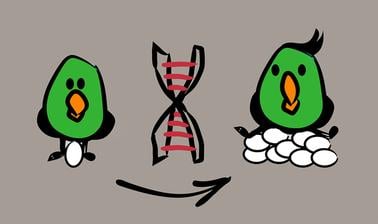
Learn how genes are inherited and how they affect important personal and societal issues. Genetics permeates every aspect of the 21st century, from our doctors' offices to our judicial systems. By the end of this course, you’ll be well prepared to deal with both today’s genetic issues and new questions that are sure to arise in the future.

Class Deals by MOOC List - Click here and see EdX's Active Discounts, Deals, and Promo Codes.

This challenging but very rewarding course focuses on the genetics issues that impact our health and well-being, while providing the same rigorous examination of genetics principles as a college genetics course.

The course is taught in two parts. Part 2 consists of 5 weekly modules, followed by a final exam week. You’ll learn how genes are passed from parents to child, and what you do and don’t inherit from your ancestors. You’ll be able to analyze family relationships and to evaluate and explain to others claims about GMOs, epigenetics and other controversial issues.
What you'll learn:

  • How our genes form new combinations as they pass from parent to child
  • How to predict some genetic outcomes
  • Why other genetic outcomes can’t be predicted
  • How our chromosomes change, and why this matters
  • How to compare GMOs with conventionally-bred plants
  • How to communicate what you’ve learned to your family and community

Go to Class
MOOC List is learner-supported. When you buy through links on our site, we may earn an affiliate commission.

Related Courses

Network Analysis in Systems Biology (Coursera) Coursera
Icahn School of Medicine at Mount Sinai

Network Analysis in Systems Biology (Coursera)

An introduction to data integration and statistical methods used in contemporary Systems Biology, Bioinformatics and Systems Pharmacology research. The course covers methods to process raw data from genome-wide mRNA expression studies (microarrays and RNA-seq) including data normalization, differential expression, clustering, enrichment analysis and network construction. The course contains practical tutorials for using tools and setting up pipelines, but it also covers the mathematics behind the methods applied within the tools.

Aug 3rd 2026
5-12 Weeks
Cell Biology: Signaling (edX) EdX
MIT,MITx

Cell Biology: Signaling (edX)

How do we know what we know about cells? Enhance your scientific thinking and data analysis skills with this in-depth adventure through cell biology. Professors Iain Cheeseman and Frank Solomon guide you through a learning experience where you will discover experiments that answered big questions and find out what is still on the horizon. You will embark on a lively journey through cellular signaling mechanisms, regulation, and specific examples and learn how to apply key concepts and themes of this dynamic experimental science to understand the fundamental workings of cells.

No sessions available
5-12 Weeks
AP® Biology - Part 2: Genetics (edX) EdX
Rice University,RiceX

AP® Biology - Part 2: Genetics (edX)

The second course in a comprehensive series designed to prepare you for the AP Biology exam, focusing on genetics and DNA. Preparing for the AP Biology exam requires a deep understanding of many different topics in biology as well as an understanding of the format of the AP exam and the types of questions it asks. This course is Part 2 of the AP Biology series designed to prepare you for the AP Biology exam.

No sessions available
5-12 Weeks
Introduction to Genetics and Evolution (Coursera) Coursera
Duke University

Introduction to Genetics and Evolution (Coursera)

Introduction to Genetics and Evolution is a college-level class being offered simultaneously to new students at Duke University. The course gives interested people a very basic overview of some principles behind these very fundamental areas of biology. We often hear about new "genome sequences," commercial kits that can tell you about your ancestry (including pre-human) from your DNA or disease predispositions, debates about the truth of evolution, why animals behave the way they do, and how people found "genetic evidence for natural selection." This course provides the basic biology you need to understand all of these issues better, tries to clarify some misconceptions, and tries to prepare students for future, more advanced coursework in Biology (and especially evolutionary genetics). No prior coursework is assumed.

Aug 3rd 2026
5-12 Weeks
Why Do We Age? The Molecular Mechanisms of Ageing (FutureLearn) FutureLearn
University of Groningen,University Medical Center Groningen - UMCG

Why Do We Age? The Molecular Mechanisms of Ageing (FutureLearn)

Why do we age? Is there a limit to human lifespan? Can we prolong our lives? Find out with this free online course. Discover the science behind the ageing process. The “why” and “how” of ageing has puzzled mankind ever since it questioned its place in the universe.

Self Paced
5-12 Weeks
The Genomics Era: the Future of Genetics in Medicine (FutureLearn) FutureLearn
St George's, University of London,St George's University Hospitals NHS Foundation Trust

The Genomics Era: the Future of Genetics in Medicine (FutureLearn)

Get an introduction to the growing role of genomics in healthcare, for patient diagnoses, treatment and disease prevention. This free online course will provide healthcare professionals with a basic grounding in genomic medicine. It will introduce you to new genomic technologies, which are revolutionising medicine and will, in time, provide the mainstay of patient diagnosis, treatment and disease prevention.

Self Paced
5-12 Weeks
Genetics: Analysis and Applications (edX) EdX
MIT,MITx

Genetics: Analysis and Applications (edX)

How do we know what we know about heredity? Enhance your scientific thinking and experimental design skills with this in-depth adventure through genetics. This is the second genetics course in a three-part series. Building upon the concepts from biochemistry, genetics, and molecular biology from our 7.00x Introductory Biology MOOC, these genetics courses go to a new level of depth.

Self Paced
Self-Paced
Advanced Neurobiology II (Coursera) Coursera
Peking University

Advanced Neurobiology II (Coursera)

Hello everyone! Welcome to advanced neurobiology! Neuroscience is a wonderful branch of science on how our brain perceives the external world, how our brain thinks, how our brain responds to the outside of the world, and how during disease or aging the neuronal connections deteriorate. We’re trying to understand the molecular, cellular nature and the circuitry arrangement of how nervous system works.

Aug 10th 2026
5-12 Weeks
Introduction to Statistical Methods for Gene Mapping (edX) EdX
Kyoto University,KyotoUx

Introduction to Statistical Methods for Gene Mapping (edX)

Learn about statistical methods used to identify genetic variants responsible for phenotypes. This data course is a primer to statistical genetics and covers an approach called linkage disequilibrium mapping, which analyzes non-familial data and has been successfully used to identify genetic variants associated with common and complex genetic traits.

This course is archived
4 Weeks
Genomic Medicine Gets Personal (edX) EdX
Georgetown University,GeorgetownX

Genomic Medicine Gets Personal (edX)

This course will provide an introduction to genomic medicine and a better understanding of the issues associated with personal genomic information. While the advances in genomics promise to usher a new era in medical practice and create a major paradigm shift in patient care, the ethical, legal and social impact of genomic medicine will be equally significant. The information and potential use of genomic discoveries are no longer issues left for scientists and medical professionals to handle, but have become ones for the public at large.

No sessions available
4 Weeks
Introduction to Psychology (Coursera) Coursera
Yale University

Introduction to Psychology (Coursera)

What are people most afraid of? What do our dreams mean? Are we natural-born racists? What makes us happy? What are the causes and cures of mental illness? This course tries to answer these questions and many others, providing a comprehensive overview of the scientific study of thought and behavior. It explores topics such as perception, communication, learning, memory, decision-making, persuasion, emotions, and social behavior. We will look at how these aspects of the mind develop in children, how they differ across people, how they are wired-up in the brain, and how they break down due to illness and injury.

Aug 3rd 2026
5-12 Weeks