EdX

Urban Rewilding: Restore Your Local Ecosystem (edX)

Urban Rewilding: Restore Your Local Ecosystem (edX)

Would you like to see your neighbourhood become more liveable and sustainable? To alleviate city-specific challenges – from urban heat islands to mental health issues – we need to first change our minds. From wanting to control nature to leveraging its power, we need to allow nature to do what it does best: grow. Join Wageningen University & Research and rewild your city. With gardens, parks and ponds, with indigenous plants and animals, we will see both ecosystems and our living environment restored.

Class Deals by MOOC List - Click here and see EdX's Active Discounts, Deals, and Promo Codes.

‘In our triumph to dominate the world, we forgot just how much we depend on it.’

Conflict between nature and humans
By 2050, over two-thirds of the world’s population of 10 billion people will be living in cities. This logically leads to increasing competition for natural resources between people and nature. People and businesses struggle to meet their need for space. At the same time, the loss of nature within urban areas leads to a whole host of problems, from heat islands and flooding to air pollution and rising ghg emmisions. This relationship is extremely close, yet, people still tend analyse these issues separately.
Not only does biodiverse and connected greenery and water bodies play a vital role in increasing a city’s climate resilience. Nature is conditional for creating a healthy living environment for its inhabitants. Because when people reconnect to nature, more than a frivolous enjoyment, their physical and mental health improve.

What is urban rewilding
Rewilding is a form of restoration ecology, but not all restoration ecology is rewilding. Though ecology-led, rewilding takes on a multidisciplinary systems level approach to ecosystem structure, function and processes. By prioritizing nature protection and restoration, it creates conditions for complex and self-regulating ecosystems. As such, urban rewilding aims to alleviate disturbances in nature in developed urban areas.

Improve your living environment by reintroducing nature
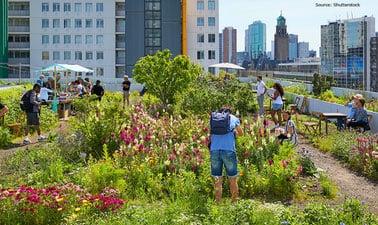
When individual citizens and urban communities prioritize nature-inclusive and climate-adaptive solutions in their neighbourhoods, the balance between city dwellers and nature can be restored. By trading in pavement and parking lots for green roofs, rain gardens and living walls citizens can achieve:

  1. Better climate adaptation: by creating urban storm parcs cities can absorb excess precipitation during extreme weather events, while saving water for dry spells.
  2. Alleviation of urban heat islands: a decrease of up to 1°C daytime temperature can limit excess deaths associated with heatwaves.
  3. (Re)generate urban biodiversity: by choosing the right tree to plant, complete miniature ecosystems can be created, because compared to exotics plants and trees, indigenous vegetation fosters tenfold amounts of biodiversity.

In this course, you will become familiar with various theories and nature-based solutions related to rewilding your surroundings. You will explore examples around you and sort out the role you can play in the process of urban rewilding. Along the way you can start creating your own personal project.

For whom?
Whether you are a city resident interested in improving the living environment of your city or otherwise interested in a citizen’s perspective on sustainable cities and rewilding topics from, this course is for you. Learn how nature is important for cities and city dwellers from a comprehensive, multidisciplinary approach. Join Wageningen University & Research and create the circumstances for effective urban rewilding near you!

What you'll learn

  • Key concepts and different definitions of rewilding
  • Explain environmental challenges that modern day urban areas are faced with
  • Explain how nature has a positive effect on the health of humans
  • Integrate the concept of rewilding in an urban context
  • Compare urban rewilding with Nature Based Solutions
  • Identify challenges for urban rewilding
  • Acquire inspiration on how rewilding can be applied on different settings: big nature reserves; cities; and personal setting.
  • How to plan your own project
  • Reflect on the concept of rewilding in your own environment

Syllabus

Module 1. Rewilding and Cities
This module will set the scene of the course! In this module you will learn what is rewilding is at its traditional sense. You will also learn what challenges our cities face. We introduce the key concepts and start planning your own project of rewilding.

Module 2. Urban Rewilding
This module introduces the key term of the course: urban rewilding. In this module you will learn how rewilding can be applied in cities, how it looks and why it is unique. You will also continue designing your own project and share your discoveries with others.

Module 3. Practice of Urban Rewilding
This module dives into the practical side of rewilding and brings together what you have learned in this course. In this module you will learn about real-life examples of urban rewilding and practical tips on rewilding yourself. You will finalize your own project and share it to the world! You will finalize your own project and share it with your peers and the world. You will look at other examples to explore even more possiblities to apply rewilding in your personal life!
Go to Class
MOOC List is learner-supported. When you buy through links on our site, we may earn an affiliate commission.

Related Courses

Environmental Studies: A Global Perspective (edX) EdX
Curtin University,CurtinX

Environmental Studies: A Global Perspective (edX)

Learn the fundamentals of environmental studies as you explore global and local communities and determine solutions to environmental challenges. This environmental studies course is intended to introduce you to some of the basic principles in environmental studies, and how those are manifested in urban, rural and natural areas throughout the world.

No sessions available
5-12 Weeks
Sustainability in Everyday Life (edX) EdX
Chalmers University of Technology,ChalmersX

Sustainability in Everyday Life (edX)

This course will arm you with the information and skills required to make more sustainable choices everyday! Daily headlines warn of new chemical dangers, species on the edge of extinction, global warming-- framing our planet as “at risk.” Some people stop listening, others get alarmed, while some others want to learn more in hopes of making a difference in the world.

No sessions available
5-12 Weeks
Sustainability, Resilience, and Society (edX) EdX
University of Washington,UWashingtonX

Sustainability, Resilience, and Society (edX)

What is sustainability, and how are we active participants in it? How does our individual ‘ecological footprint’ matter among the billions of humans’ footprints on earth? How are we alike and different in our impacts, depending on where we live; and how does civic and governmental attitude impact sustainability and resilience in the future?

No sessions available
5-12 Weeks
Making Sense of Climate Science Denial (edX) EdX
University of Queensland,UQx

Making Sense of Climate Science Denial (edX)

Climate change is real, so why the controversy and debate? Learn to make sense of the science and to respond to climate change denial. In public discussions, climate change is a highly controversial topic. However, in the scientific community, there is little controversy with 97% of climate scientists concluding humans are causing global warming.

Self Paced
Self-Paced
CitiesX: The Past, Present and Future of Urban Life (edX) EdX
HarvardX,Harvard University

CitiesX: The Past, Present and Future of Urban Life (edX)

Explore what makes cities energizing, amazing, challenging, and perhaps humanity’s greatest invention. For the first time in human history, more than fifty percent of the world’s population lives in urban areas. Cities allow for the exchange of ideas, and generate remarkable innovations in business, art, and ideas. Cities are also home to millions living in poverty. Urban living can provide a pathway to a better life, but that’s not always the case for many people around the world.

Self Paced
Self-Paced
As above, so below: An introduction to soils, ecosystems and livelihoods in the Tropics (edX) EdX
KU Leuven University,KULeuvenX

As above, so below: An introduction to soils, ecosystems and livelihoods in the Tropics (edX)

The tropics are as beautiful and diverse below-ground as they are above-ground. Learn how to use knowledge about the natural variability in soil properties for the sustainable management of ecosystems and farms. Soils form the foundation of sustainable development. They grow our food, fiber and fuel, are a habitat for organisms, buffer and purify water and safeguard archaeological legacies.

Self Paced
Self-Paced
Stakeholder Outreach: Effective Communication of Complex Environmental Threats (edX) EdX
University of Maryland, College Park,University System of Maryland - USM,USMx,UMD,University of Maryland Center for Environmental Science - UMCES,UMCES

Stakeholder Outreach: Effective Communication of Complex Environmental Threats (edX)

Learn how to engage communities through powerful storytelling, data visualization, and persuasive presence to motivate action on complex environmental projects. In this course you’ll learn how to improve your project management communication in your work environment and motivate and engage communities with clear communication to address complex environmental problems.

Self Paced
Self-Paced
(Re)Imagining Port Cities: Understanding Space, Society and Culture (edX) EdX
Delft University of Technology,DelftX

(Re)Imagining Port Cities: Understanding Space, Society and Culture (edX)

Port city regions are at the forefront of many urgent contemporary issues such as migration, climate change, digitization, etc. Addressing these challenges and developing sustainable solutions, requires more than technical interventions, it requires rethinking and redesigning the basic spatial and socio-cultural paradigms that prevail at present. In this course we will analyze examples of port cities from a multi-disciplinary, cross-cultural perspective. You will develop the skills to identify and address the challenges port cities face now and into the future.

Self Paced
Self-Paced
Climate Change Education (edX) EdX
Inter-American Development Bank - IDB,IDBx

Climate Change Education (edX)

Learn how to work with your students to help them explore climate change through the use of interactive and engaging activities. These activities are designed for students at the primary and secondary levels. Our climate is changing rapidly, and now more than ever we need to be ready to act and prepare the next generation to take care of our planet. This course explores the basic science behind climate change and presents the tools to teach it in a positive, engaging and participatory way. The course also introduces some of the ethical and social issues around climate change.

Self Paced
Self-Paced
Small Organisms, Big Solutions: Microbiomes & Sustainability (edX) EdX
National University of Singapore,NUS

Small Organisms, Big Solutions: Microbiomes & Sustainability (edX)

The course is an introduction to microbiomes and sustainability. It argues that global microbiomes are fundamentally relevant to sustainability. Topics include principles of sustainability, sustainable development, microbiomes in humans and the environment, bioremediation, and bioretention.

Apr 20th 2022
4 Weeks