Tinkering Fundamentals: Circuits (Coursera)

Offered by Exploratorium,
Tinkering Fundamentals: Circuits (Coursera)

The Tinkering Fundamentals course will offer educators and enthusiasts an opportunity to develop a practice of tinkering and making. We see tinkering as a serious endeavor -- one that is generalizable across content and especially good at interweaving disciplines in a way that leads to complex projects and individualized learning opportunities.

Class Deals by MOOC List - Click here and see Coursera's Active Discounts, Deals, and Promo Codes.

Tinkering has recently been introduced into the educational field as a potential driver of creativity, excitement, and innovation in science learning. It is seen by many as an effective means to engage in exploring STEM concepts, practices and phenomena. Tinkering typically blends the high and low tech tools of science along with a strong aesthetic dimension that supports children’s (and adults) self expression.
For over a decade, the Exploratorium has been developing science-rich tinkering activities for both children and adults. We see tinkering as a fun yet serious endeavor—spanning many disciplines and content areas and fostering connections between art, science, and technology. Learners follow their own path to understanding by investigating tools and materials and exploring questions that interest them. This opens up a wide range of possible answers rather than any “right” one, particularly for teaching STEM (Science, Technology, Engineering, Math) subjects in the classroom. This course centers on circuit-related activities, which offer a wealth of opportunities for thinking through making.
In this course, we won’t just show you how we develop tinkering activities; we’ll also delve into why. We’ll focus on three important aspects: activity design around specific materials, facilitation strategies, and environmental organization. We’ll also share some guiding principles and learning indicators we’ve developed that can help you integrate tinkering into your elementary and middle-school science program. Whether you’re new to making or a seasoned tinkerer, we hope this course will help you take the next step!

Syllabus

WEEK 1
Introduction to Tinkering
What is tinkering? What does it mean to you? Is it different from engineering or other forms of making? We'll explore these questions in the readings and forums while getting a sneak preview of the activities we'll be sharing over the following modules.

WEEK 2
Initial Explorations
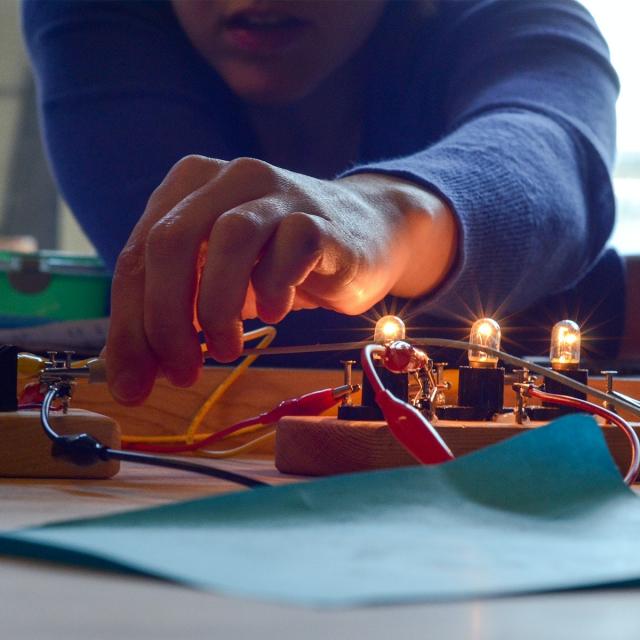
Tinkering is all about making, so let's get started. In this module we begin with a basic circuit board activity, which helps learners make physical and conceptual connections between electrical components. You will learn how to build your own set to play with and why we designed it this way.

WEEK 3
Learning Dimensions
In this module, we'll explore erratic motion and art-making with an activity called Scribbling Machines. We'll also investigate how tinkering maps on to different indicators of learning.

WEEK 4
Tinkering Tenets and Personal Expression
We'll explore the aesthetic dimensions of tinkering with a full rundown of our Paper Circuits and Sewn Circuits activities, including key design elements and important principles.

WEEK 5
Coding, Computation and Facilitation Strategies
A look at the high-tech side of tinkering. In this module, we'll also explore strategies for facilitation and deep engagement.

WEEK 6
Putting It All Together
It's your turn! How will you take what you've learned in this class and apply it to your own life and practice? We'll help you come up with a detailed action plan and get feedback from other students in the class. By the end of this module you'll complete your project, your peer assessments and review other people's work.
Go to Class
MOOC List is learner-supported. When you buy through links on our site, we may earn an affiliate commission.

Related Courses

University Teaching (Coursera) Coursera
University of Hong Kong

University Teaching (Coursera)

University Teaching is an introductory course in teaching and learning in tertiary education, designed by staff at the Centre for the Enhancement of Teaching and Learning at the University of Hong Kong. With input from instructors, guests and interviewees, including teaching award winners, students, and experts in the fields, you will be exposed to research evidence in relation to effective university teaching and practical instructional design strategies. You will also be exposed to multiple examples of effective teaching, and hear the views of teachers whose teaching has been judged to be excellent.

Jun 8th 2026
5-12 Weeks
Learning to Teach Online (Coursera) Coursera
UNSW Sydney - University of New South Wales

Learning to Teach Online (Coursera)

Are you an educator? Have you ever wanted to understand more about how to design your class to make better use of educational technology – whether fully online or in blended contexts? Would you like to learn from those who have extensive practical experience with online technologies? The Learning to Teach Online (LTTO) MOOC will help you develop a working understanding of successful online teaching strategies that you can apply in your own practice. The course is based upon the multi award winning open educational resource developed by Dr Simon McIntyre and Karin Watson.

Jun 8th 2026
5-12 Weeks
Design Thinking for the Greater Good: Innovation in the Social Sector (Coursera) Coursera
University of Virginia

Design Thinking for the Greater Good: Innovation in the Social Sector (Coursera)

Do you work for a nonprofit or in the social sector? Are you struggling to solve the problems and meet the needs of the people you serve? Come learn more about how design thinking, a human-centered approach to problem solving, can help you truly understand an issue, generate ideas worth testing and iterate to find solutions that make a real difference. Through global stories from areas as diverse as government, health care, and education, we’ll show you the tools, techniques and mindset needed to use design thinking to uncover new and creative solutions in the social sector.

Jun 8th 2026
4 Weeks
Teaching Science at University (Coursera) Coursera
University of Zurich

Teaching Science at University (Coursera)

This course will prepare you for teaching science in higher education. In this MOOC you will learn to make your knowledge as an excellent researcher accessible to your students. We will show you how to communicate science to novices as well as advanced students in science.

Jun 8th 2026
5-12 Weeks
Perfect Tenses and Modals (Coursera) Coursera
University of California, Irvine

Perfect Tenses and Modals (Coursera)

This is the first course in the Learn English: Intermediate Writing specialization. In this course, you will learn about important intermediate verb tenses, including present perfect, present perfect progressive, past perfect, and past perfect progressive. You will also learn about common modal verbs used in English. This course is designed for learners who have a basic understanding of English grammar but who want to learn more and improve their skills for everyday speaking or writing, as well as for academics. It will be a fun class with lots of entertaining and informative video lectures.

Jun 8th 2026
4 Weeks
Information & Digital Literacy for University Success (Coursera) Coursera
The University of Sydney

Information & Digital Literacy for University Success (Coursera)

This Specilaization is aimed at preparing students for undergraduate study in an English-speaking university. The course equips you for full participation and engagement with your studies by building awareness and understanding of the core values and expectations of academic culture, and providing you with practical strategies to apply to your studies. In this course, you will learn how to develop your Information & Digital Literacy Skills to help you achieve success in your university studies.

Jun 8th 2026
5-12 Weeks
Understanding China, 1700-2000: A Data Analytic Approach, Part 1 (Coursera) Coursera
The Hong Kong University of Science and Technology - HKUST

Understanding China, 1700-2000: A Data Analytic Approach, Part 1 (Coursera)

The purpose of this course is to summarize new directions in Chinese history and social science produced by the creation and analysis of big historical datasets based on newly opened Chinese archival holdings, and to organize this knowledge in a framework that encourages learning about China in comparative perspective. Our course demonstrates how a new scholarship of discovery is redefining what is singular about modern China and modern Chinese history.

Jun 8th 2026
5-12 Weeks
Overcoming Dyslexia (Coursera) Coursera
Yale University

Overcoming Dyslexia (Coursera)

Dyslexia is everywhere, touching so many children and adults, and while science has made extraordinary progress in understanding and clarifying the condition, this incredible powerful knowledge rarely reaches those who most need to know and would greatly benefit from it. Our goal is to change all this with the Coursera you are about to view, produced by Dr. Sally Shaywitz, the Audrey G. Ratner Professor in Learning Development, both the leading scientist studying dyslexia and the most devoted advocate for helping those who are dyslexic.

Jun 13th 2026
5-12 Weeks
Emerging Trends & Technologies in the Virtual K-12 Classroom (Coursera) Coursera
University of California, Irvine

Emerging Trends & Technologies in the Virtual K-12 Classroom (Coursera)

Welcome to Emerging Trends and Technologies in K-12! This course will help you evaluate and implement technology in the most useful way within your virtual classroom setting. We will discuss the possibilities and challenges of using technology in fully online environments, although many of the ideas can be applied to blended and traditional environments as well.

Jun 8th 2026
4 Weeks
How to Write and Publish a Scientific Paper (Project-Centered Course) (Coursera) Coursera
École Polytechnique

How to Write and Publish a Scientific Paper (Project-Centered Course) (Coursera)

In this project-based course, you will outline a complete scientific paper, choose an appropriate journal to which you'll submit the finished paper for publication, and prepare a checklist that will allow you to independently judge whether your paper is ready to submit. What you'll need to get started: This course is designed for students who have previous experience with academic research - you should be eager to adapt our writing and publishing advice to an existing personal project.

Jun 8th 2026
4 Weeks