Teaching the Violin and Viola: Creating a Healthy Foundation (Coursera)

Teaching the Violin and Viola: Creating a Healthy Foundation (Coursera)

Join us as we explore the fundamental principles and early stages of teaching violin and viola through a series of engaging video lectures and lesson demonstrations, including: 1) Master classes with some of the world’s top string pedagogues, 2) Individual lesson demos of teaching violin/viola set up, left and right hand technique and pieces from the early violin/viola repertoire, 3) Group lesson demos of teaching music theory, ear training and fun activities that encourage good playing habits, and 4) A “field trip” to the violin shop, where we will outfit a new beginning student with a proper instrument and bow.

Class Deals by MOOC List - Click here and see Coursera's Active Discounts, Deals, and Promo Codes.

You’ll also engage in a series of discussions and reflections with colleagues and peers across the globe. Upon completion of this course, we hope you’ll return to your studio with confidence, a new curriculum, and a renewed approach to sharing with your students the joyful experience of making beautiful music.

Syllabus

WEEK 1
Beginning Stages
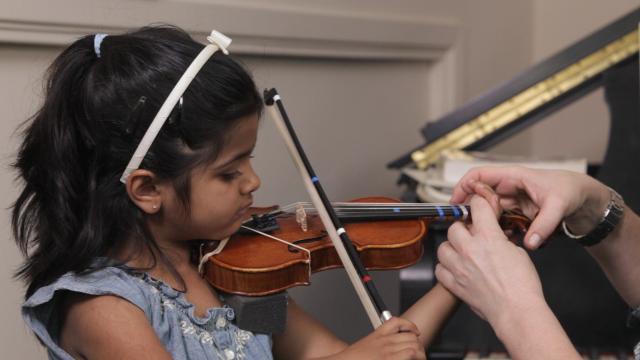
Welcome to Teaching the Violin and Viola: Creating a Healthy Foundation! We will begin by covering leading philosophies and pedagogical theories about teaching children the violin and viola. The beginning stages will cover the child’s setup, posture and first left hand techniques.

WEEK 2
Bow Arm and Hand
To introduce the use of the right hand, we start by creating a “pinky house” for the child’s bow. We delve further into the violin setup and positioning through various creative exercises.

WEEK 3
Putting It All Together
Now we get to put it all together by slowly incorporating the different movements of the right and left hand through four different pieces.

WEEK 4
Pieces in the Key of A Major
After good setup and posture have been established, we start teaching the fundamentals through elementary pieces in the key of A Major. We also get to learn our first scale!

WEEK 5
Playing with the Whole Bow
To transition to using the full bow, we introduce the “adult “ bow hold and a series of exercises to extend the bow stroke. Pieces include Long, Long Ago, O Come, Little Children, and Butterfly, Flutterby.

WEEK 6
Pieces in the Key of D Major
We can now introduce the key of D Major. Students learn the D major scale along with pieces such as Bach Musette and Hushabye Lullaby.

WEEK 7
Pieces in the Key of G Major
When we progress to the G Major scale and arpeggio, we start adding etudes and more advanced technical concepts. Pieces covered include Minuet and Happy Farmer.

WEEK 8
Note Reading, Vibrato, and the Group Class
To teach note reading, we will cover the best-practice teaching techniques for note reading and vibrato. We will also explore group teaching, group games, and group dynamics.

WEEK 9
Favorite Exercises for the Older Student
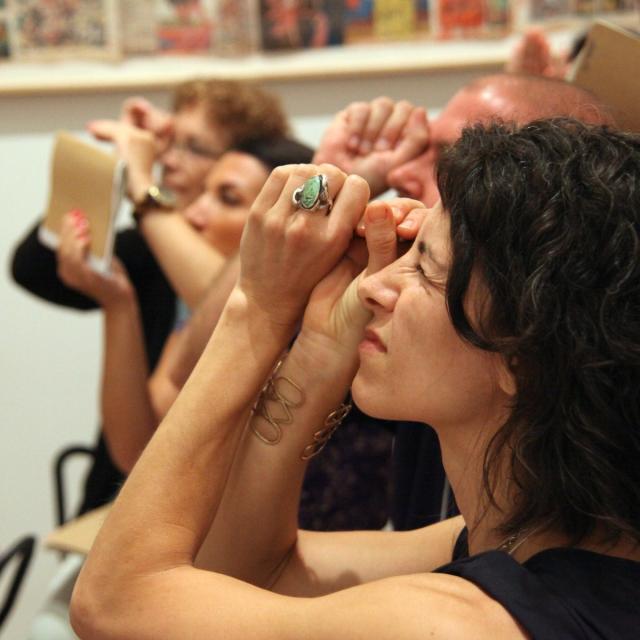
Now that our students are getting more advanced, we can begin to cover our favorite exercises for the older student. Exercises include "Poof Bow" and the "Invisible Violin."

WEEK 10
The Master Class
In our final segment, we will learn from top pedagogues Mimi Zweig and Roland and Almita Vamos in a master class setting.
Go to Class
MOOC List is learner-supported. When you buy through links on our site, we may earn an affiliate commission.

Related Courses

History of Rock, Part Two (Coursera) Coursera
University of Rochester

History of Rock, Part Two (Coursera)

This course, part 2 of a 2-course sequence, examines the history of rock, primarily as it unfolded in the United States, from the early 1970s to the early 1990s. This course covers the music of Led Zeppelin, the Allman Brothers, Carole King, Bob Marley, the Sex Pistols, Donna Summer, Michael Jackson, Madonna, Prince, Metallica, Run-DMC, and Nirvana, and many more artists, with an emphasis both on cultural context and on the music itself. We will also explore how developments in the music business and in technology helped shape the ways in which styles developed.

Oct 26th 2026
5-12 Weeks
Exploring Beethoven's Piano Sonatas Part 4 (Coursera) Coursera
Curtis Institute of Music

Exploring Beethoven's Piano Sonatas Part 4 (Coursera)

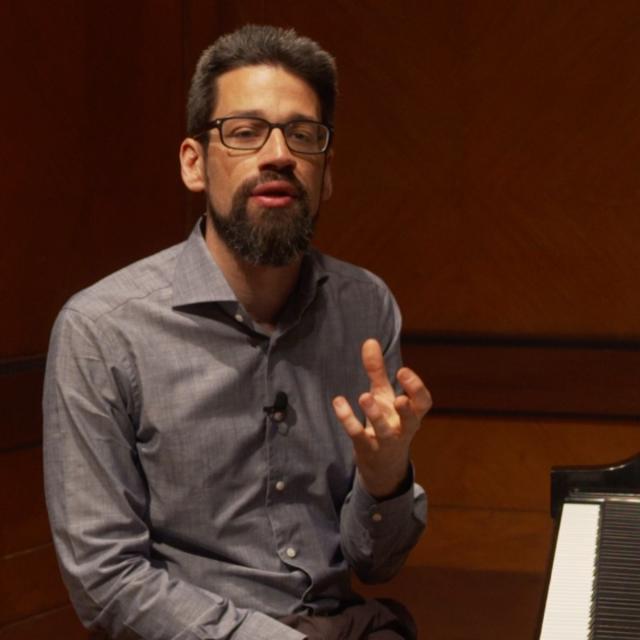
Please join us for Part 4 of Exploring Beethoven's Piano Sonatas course, taught by Curtis faculty member and extraordinary concert artist, Jonathan Biss. This course is new and contains separate sets of lectures and sonatas that we not previously discussed. Specifically, in Part 4, we will cover Beethoven's Piano Sonatas Op. 2, No. 2, Op. 10, No. 3, Op. 28 and Op. 110.

Oct 23rd 2026
5-12 Weeks
Electronic Music Performance Techniques (Coursera) Coursera
Berklee College of Music

Electronic Music Performance Techniques (Coursera)

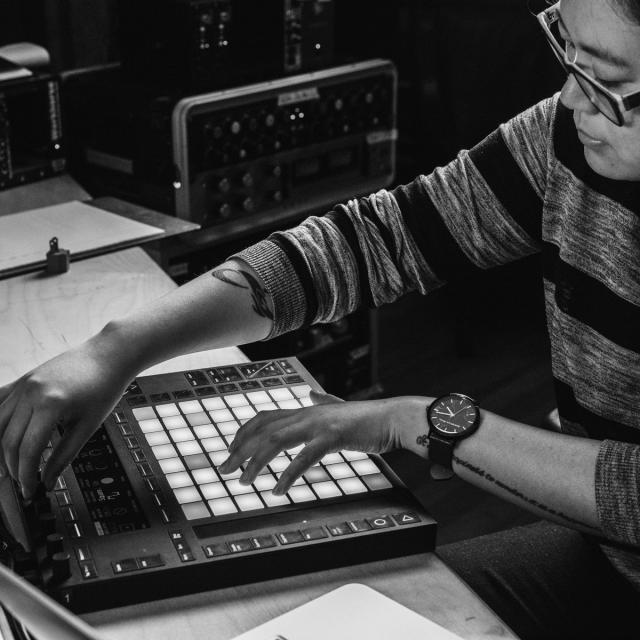
From the Moog analog synthesizers in the 1960s to the contemporary usage of computers, performance controllers, and mobile devices, Electronic Digital Instruments (EDIs) have long been capable of offering artists a new range of musical expression. In this one-of-a-kind course, you'll learn the essential skills you need to perform on an EDI.

Oct 26th 2026
4 Weeks
Sharpened Visions: A Poetry Workshop (Coursera) Coursera
California Institute of the Arts

Sharpened Visions: A Poetry Workshop (Coursera)

Why just write poems when you can write better ones? This course is built on the notion that the most exciting writing begins after the first draft. It is specifically for folks who believe that writing poems just to express oneself is like using the Internet just for email. After all, poetry can change the way you and your readers think of the world and its inhabitants; it can break new ground for language; turn a blank sheet of paper into a teeming concert of voices and music.

Oct 26th 2026
5-12 Weeks
Music as Biology: What We Like to Hear and Why (Coursera) Coursera
Duke University

Music as Biology: What We Like to Hear and Why (Coursera)

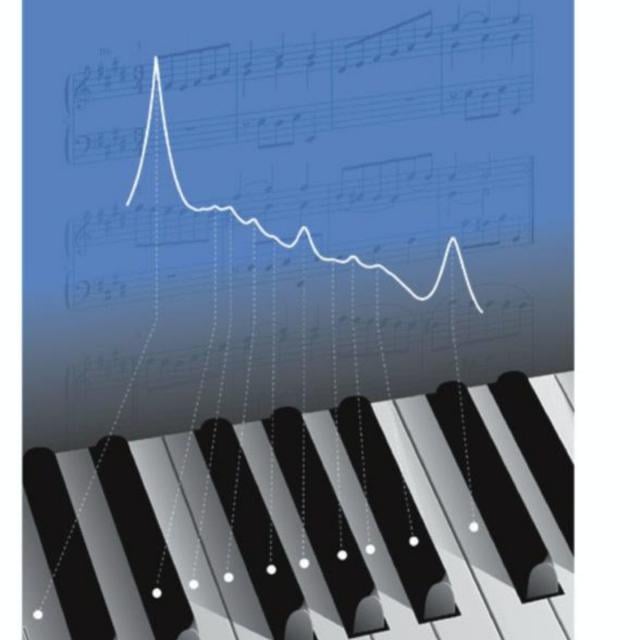
The course will explore the tone combinations that humans consider consonant or dissonant, the scales we use, and the emotions music elicits, all of which provide a rich set of data for exploring music and auditory aesthetics in a biological framework. Analyses of speech and musical databases are consistent with the idea that the chromatic scale (the set of tones used by humans to create music), consonance and dissonance, worldwide preferences for a few dozen scales from the billions that are possible, and the emotions elicited by music in different cultures all stem from the relative similarity of musical tonalities and the characteristics of voiced (tonal) speech.

Oct 19th 2026
5-12 Weeks
History of Rock, Part One (Coursera) Coursera
University of Rochester

History of Rock, Part One (Coursera)

This course, part 1 of a 2-course sequence, examines the history of rock, primarily as it unfolded in the United States, from the days before rock (pre-1955) to the end of the 1960s. This course covers the music of Elvis Presley, Chuck Berry, Phil Spector, Bob Dylan, the Beatles, the Rolling Stones, Jimi Hendrix, Cream, and many more artists, with an emphasis both on cultural context and on the music itself. We will also explore how developments in the music business and in technology helped shape the ways in which styles developed.

Oct 26th 2026
5-12 Weeks
20世纪西方音乐 Western Music in the 20th Century (Coursera) Coursera
Peking University

20世纪西方音乐 Western Music in the 20th Century (Coursera)

课程所涉不仅涵盖古典音乐如新古典主义、表现主义、民族主义等流派,也对爵士乐、摇滚乐与流行音乐在20世纪的风格情状投以深切关注;在将包括中国音乐在内的世界各国民族民间音乐纳入20世纪大背景予以研究探索之同时,关于大型综合艺术品例如歌剧、音乐剧、电影音乐的考察与分析,也设为专题,绝无偏废。

Oct 19th 2026
5-12 Weeks
Art & Activity: Interactive Strategies for Engaging with Art (Coursera) Coursera
The Museum of Modern Art

Art & Activity: Interactive Strategies for Engaging with Art (Coursera)

Art can be a powerful catalyst for building skills and understanding a range of subjects. Intended for primary and secondary teachers of all disciplines, Art & Activity builds upon the inquiry-based approaches of Art and Inquiry: Museum Teaching Strategies for Your Classroom, while delving into activity-based strategies that will make your students empowered participants.

Oct 26th 2026
4 Weeks
Videojuegos: ¿de qué hablamos? (Coursera) Coursera
Universitat Autònoma de Barcelona

Videojuegos: ¿de qué hablamos? (Coursera)

Probablemente, todos hemos jugado a algún videojuego, pero ¿qué hay detrás de él? Podemos decir que - con independencia del videojuego - hay un árduo trabajo multidisciplinar que incluye desde aspectos de diseño hasta la programación como tal del videojuego. Este curso pretende ser un curso introductorio que muestre qué aspectos hay que considerar en el videojuego, y que permita con posterioridad abordar individualmente los temas que se consideran nucleares: diseño, arte, motor del videojuego y 'game play'.

Oct 19th 2026
5-12 Weeks