Supply Chain Management: A Learning Perspective (Coursera)

Supply Chain Management: A Learning Perspective (Coursera)

As a human being, we all consume products and/or services all the time. This morning you got up and ate your breakfast, e.g., eggs, milk, bread, fresh fruits, and the like. After the breakfast, you drove your car to work or school. At your office, you used your computer, perhaps equipped with 27” LCD monitor. During your break, you drank a cup of coffee and played with your iPhone. So on and so forth. You probably take it for granted that you can enjoy all of these products. But if you take a closer look at how each of these products can be made and eventually delivered to you, you will realize that each one of these is no short of miracle.

Class Deals by MOOC List - Click here and see Coursera's Active Discounts, Deals, and Promo Codes.

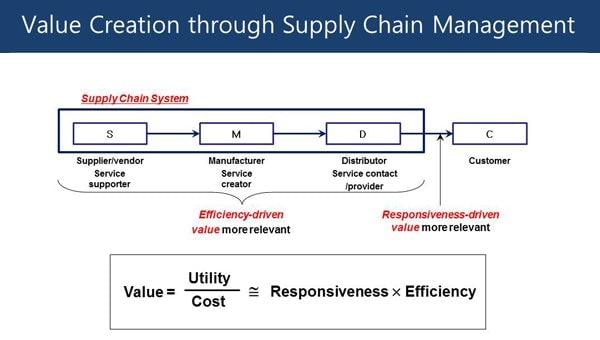
For example, which fruit do you like? Consider fresh strawberries. In order for the strawberries to be on your breakfast table, there must be numerous functions, activities, transactions, and people involved in planting, cultivating, delivering, and consuming strawberries. Moreover, all of these functions, activities, transactions, and people are connected as an integral chain, through which physical products like strawberries themselves and virtual elements such as information and communication flow back and forth constantly. By grouping related functions or activities, we have a supply chain, comprised of four primary functions such as supplier, manufacturer, distributor, and finally consumer. A supply chain is essentially a value chain.
For the society or economy as a whole, the goal is to maximize value, i.e., to create satisfactory value without spending too much. In order to create the maximum value for the strawberry supply chain, every participant in the chain must carry out its function efficiently. In addition, all of the members must coordinate with each other effectively in order to ensure value maximization. We have to face the same issues for almost all the products and services we take for granted in our everyday life, e.g., cars, hamburgers, haircuts, surgeries, movies, banks, restaurants, and you name it!
In this course, we want to understand fundamental principles of value creation for the consumers or the market. We try to answer questions like how the product or service is made, how the value-creating activities or functions are coordinated, who should play what leadership roles in realizing all these, and so on. As our course title hints, we approach all of these issues from a learning perspective, which is dynamic in nature and emphasizes long-term capability building rather than short-term symptomatic problem solving.

Syllabus

WEEK 1
Re-opening Introduction
In this chapter, Professor Bowon Kim briefly introduces students to this course. It is about philosophical and moral foundation of a supply chain management.

WEEK 2
Introduction to Value, Value Creation, and Supply Chain Management
In this chapter, we will learn what a supply chain is, what supply chain management is all about, and why it is important to grasp the fundamentals of supply chain management in creating real value for the customers.

WEEK 3
Management Capability
Effective SCM requires the firm to have strong operations capabilities. One can group various operations capabilities into three representative capabilities: Controllability, flexibility, and integrating capability. In order to be competitive in the market, the firm must retain high levels of these capabilities. In this chapter, we will discuss what the management capabilities are and the relationship among these capabilities.

WEEK 4
Learning Perspective
Learning is an essential part of any creative activity. In this chapter, we will learn what the learning capability is and its dynamics in supply chain management. We will also look into the learning propensity model and how the learning processes influence the performance of a supply chain system.

WEEK 5
Quality Management
Quality is one of the most important factors that determine the utility. That is, the higher the quality, the larger the utility experienced by the customer. But, quality is not a one-dimensional concept. In fact, it is a highly complex, multi-layered one. In this chapter, we will explore this complex concept, 'Quality'. We will learn dimensions of quality, total quality management (TQM), quality dynamics and statistical process control (SPC) in detail.

WEEK 6
New Product Innovation
New product innovation is the key to firm's success. In order to sustain successful business, the firm must design and manage its new product process effectively and efficiently. In this chapter, we will learn new product innovation and new product development process. Especially, we will look into and compare two approaches, traditional approach and cross-functional approach.

WEEK 7
Supply Chain Strategy I: Structural and Infrastructural Dimensions
In order to optimize the supply chain performance, the firm must design its supply chain effectively. In this chapter, we will talk about how to design the effective supply chain and look into the designing factors of supply chain management in detail.

WEEK 8
Supply Chain Strategy II: Coordination for Value Creation
Coordination is the key dimension of infrastructure in supply chain management. In this chapter, we will talk about what supply chain coordination is and why it is important. And we will learn vendor-managed inventory (VMI) and postponement in detail.

WEEK 9
Supply Chain Globalization and Sustainability
Why is the effective SCM important for the firm to gain competitive advantage in the global market? In this chapter, we will consider crucial issues related to the question and deal with global supply chain management and value chain sustainability.

WEEK 10
Final Exam

Go to Class
MOOC List is learner-supported. When you buy through links on our site, we may earn an affiliate commission.

Related Courses

Fundamentals of Project Planning and Management (Coursera) Coursera
University of Virginia

Fundamentals of Project Planning and Management (Coursera)

Projects are all around us. Virtually every organization runs projects, either formally or informally. We are engaged in projects at home and at work. Across settings, planning principles and execution methodologies can offer ways in which projects can be run more effectively and efficiently. Project management provides organizations (and individuals) with the language and the frameworks for scoping projects, sequencing activities, utilizing resources, and minimizing risks.

Jun 29th 2026
4 Weeks
Powerful Tools for Teaching and Learning: Digital Storytelling (Coursera) Coursera
University of Houston System

Powerful Tools for Teaching and Learning: Digital Storytelling (Coursera)

Powerful Tools for Teaching and Learning: Digital Storytelling introduces educators to digital storytelling and explores ways to use digital stories to enhance students’ learning experiences. The course is designed to be comprehensive yet fundamental. By comprehensive we mean that the course provides a solid foundation for all of the components of a digital story and illustrates these components with tutorials, example stories, and links to additional readings. The course also provides a hands-on opportunity for learners to create their own digital stories. The course is fundamental because it covers the basic process of creating a digital story starting with just a simple script and as little as one image.

Jun 29th 2026
5-12 Weeks
Foundations of Teaching for Learning: Developing Relationships (Coursera) Coursera
Commonwealth Education Trust

Foundations of Teaching for Learning: Developing Relationships (Coursera)

The Foundations of Teaching for Learning programme is for anyone who is teaching, or who would like to teach, in any subject and any context - be it at school, at home or in the workplace. With dynamic lessons taught by established and respected professionals from across the Commonwealth, this eight course programme will see you develop and strengthen your skills in teaching, professionalism, assessment, and more. As you carry on through the programme, you will find yourself strengthening not only your skills, but your connection with colleagues across the globe. A professional development opportunity not to be missed.

Jun 29th 2026
5-12 Weeks
Teaching Impacts of Technology: Relationships (Coursera) Coursera
University of California, San Diego

Teaching Impacts of Technology: Relationships (Coursera)

In this course you’ll focus on how “smart” devices have changed how we interact with others in personal ways, impacting how we stay connected in our increasingly mobile society. This will be done through a series of paired teaching sections, exploring a specific “Impact of Computing” in your typical day and the “Technologies and Computing Concepts” that enable that impact, all at a K12-appropriate level.

Jul 1st 2026
4 Weeks
Engaging in Service Innovation and Management (Coursera) Coursera
Northeastern University

Engaging in Service Innovation and Management (Coursera)

This course is the continuation of "Introduction to Service Innovation and Management". If you have not yet taken "Introduction to Service Innovation and Management", it is recommended that you complete that course prior to this course. The foundational knowledge and project plan from the introduction are carried through in this deeper dive into service innovation and management. This course will give you tools to examine initial plans for healthcare service/process redesign.

Jun 30th 2026
4 Weeks
Tinkering Fundamentals: Circuits (Coursera) Coursera
Exploratorium

Tinkering Fundamentals: Circuits (Coursera)

The Tinkering Fundamentals course will offer educators and enthusiasts an opportunity to develop a practice of tinkering and making. We see tinkering as a serious endeavor -- one that is generalizable across content and especially good at interweaving disciplines in a way that leads to complex projects and individualized learning opportunities.

Jun 29th 2026
5-12 Weeks
Learning How To Learn for Youth (Coursera) Coursera
Arizona State University

Learning How To Learn for Youth (Coursera)

Based on the most popular open online course in the world, this course gives you easy access to the learning techniques used by experts in art, music, literature, math, science, sports, and many other disciplines. No matter what your current skill level, using these approaches can help you master new topics, change your thinking and improve your life.

Jul 3rd 2026
3 Weeks
Teamwork Skills: Communicating Effectively in Groups (Coursera) Coursera
University of Colorado Boulder

Teamwork Skills: Communicating Effectively in Groups (Coursera)

Effective teamwork and group communication are essential for your professional and personal success. In this course you will learn to: make better decisions, be more creative and innovative, manage conflict and work with difficult group members, negotiate for preferred outcomes, improve group communication in virtual environments, develop a better overall understanding of human interaction, and work more effectively as a team. Our goal is to help you understand these important dynamics of group communication and learn how to put them into practice to improve your overall teamwork.

Jul 5th 2026
4 Weeks
Scaling operations: Linking strategy and execution (Coursera) Coursera
Northwestern University

Scaling operations: Linking strategy and execution (Coursera)

Over the past several decades, operations strategy has played an increasingly important role in business’ success. In this course, we will equip you with concepts and tools to build operations in a way that not only supports your competitive strategy, but also allows you to create new opportunities in the market place.

Jun 29th 2026
5-12 Weeks
Intro to Strategic Management for Healthcare Organizations (Coursera) Coursera
Northeastern University

Intro to Strategic Management for Healthcare Organizations (Coursera)

This course is best suited for individuals currently in the healthcare sector, as a provider, payer, or administrator. Individuals pursuing a career change to the healthcare sector may also be interested in this course. In this course, you will have an opportunity to explore general business strategy concepts as they relate to the healthcare industry. You will also examine how strategic decisions are made within organizations.

Jul 1st 2026
4 Weeks
Foundations of Teaching for Learning: Being a Professional (Coursera) Coursera
Commonwealth Education Trust

Foundations of Teaching for Learning: Being a Professional (Coursera)

The Foundations of Teaching for Learning programme is for anyone who is teaching, or who would like to teach, in any subject and any context - be it at school, at home or in the workplace. With dynamic lessons taught by established and respected professionals from across the Commonwealth, this eight course programme will see you develop and strengthen your skills in teaching, professionalism, assessment, and more. As you carry on through the programme, you will find yourself strengthening not only your skills, but your connection with colleagues across the globe. A professional development opportunity not to be missed.

Jun 29th 2026
5-12 Weeks
Cultural intelligence: Become a global citizen (Coursera) Coursera
Macquarie University

Cultural intelligence: Become a global citizen (Coursera)

We now live in a truly global, interconnected world in which every manager requires a high level of cultural intelligence. In a diverse work environment, a successful leader must understand the cultural backgrounds, beliefs and attitudes of the people around them – or run the risk of failing to achieve the organisation’s goals. This course, via structured learning activities (video lectures, quizzes, discussion prompts, industry interviews and written assessments), will teach you that those with high ‘cultural intelligence’ – are good at spotting cultural differences and adapt their behaviour accordingly.

Jul 2nd 2026
5-12 Weeks