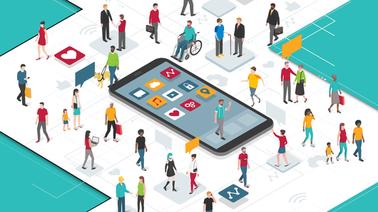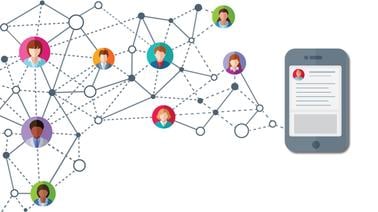
Discover where social media came from, how it became integral to our everyday lives, and how that has changed the way we communicate. Social media and online communication dominate our daily lives in an unprecedented manner. Wireless connectivity, mobile devices and wearable technologies mean that social media is always on, always part of everyday life for billions of people across the world.
Class Deals by MOOC List - Click here and see EdX's Active Discounts, Deals, and Promo Codes.
While the term ‘social media’ is barely a decade old, the story of how people started using the internet in a social manner is a much longer and more interesting one. This course will increase learners’ understanding of social media by looking at the ways networked connectivity let users become 'social', how this was amplified with the emergence of the web, and how social media became the default mode of the mobile web we use today.
This course is part of the From Digital Technologies to Social Media XSeries Program.
What you'll learn
By completing this course, you should be able to:
- Map significant milestones in the emergence of social media
- Differentiate between 'Web 2.0' and participatory culture
- Understand the differences in the way users and social media companies utilise and think about social media
- Extrapolate current social trends online and map possible directions in social media.
Syllabus
Module 1: Social Media before the Web
Examines social tools, protocols and ways of communicating that developed in the first two decades of the internet, and the surprising dominance of social communication using networks that were initially designed for very different purposes.
- The internet’s first ‘killer app’: email
- Newsgroups and BBS Bulletin Boards
- The emergence of online communities
- Aliases, avatars and pseudonyms: identity experimentation.
Module 2: Web 2.0 and Participatory Culture
Examines the explosion of networked interaction after the emergence of the World Wide Web in the 1990s, through to the most well-known early examples of social media: blogs and wikis.
- Blogs: the democratisation of publication
- Wikis: participatory culture, collective intelligence and the emergence of the Wikipedia
- 'Web 2.0' and the selling of social media
- The emergence of social presence: you are your web presence.
Module 3: Social Platforms
Examines the way that the dominant social media platforms took centre stage, and how these spaces made social media a normal part of everyday life and changed political communication.
- Facebook: how people became profiles
- Twitter: how 140 characters became the new politics
- Google’s YouTube: social meets video, and the challenges of building communities on ever-expanding platforms
- The ‘real name’ web: the push to make online and offline identities the same.
Module 4: Social Goes Everywhere: The Mobile Web
Examines the way social media changes when phones and tablets let users be online at every moment, in every place and space, and how devices, not just people, start to send social signals.
- Snapchat and Instagram: mobile, visual and the communication that deletes-by-default
- Locative media: how places are augmented by a social layer
- Wearables: FitBits and trackers as social media
- Owning big data: are users a source of big data, and how might that be used?