Sistemas Digitales: De las puertas lógicas al procesador (Coursera)

Sistemas Digitales: De las puertas lógicas al procesador (Coursera)

En este curso aprenderemos los fundamentos del diseño de los circuitos digitales actuales, siguiendo una orientación eminentemente práctica. A diferencia de otros cursos más "clásicos" de Circuitos Digitales, nuestro interés se centrará más en el Sistema que en la Electrónica que lo sustenta. Este enfoque nos permitirá sentar las bases del diseño de Sistemas Digitales complejos.

Class Deals by MOOC List - Click here and see Coursera's Active Discounts, Deals, and Promo Codes.

Se trata de un curso muy adecuado para estudiantes de primeros cursos de carreras de Ingenierías cercanas a las TIC (Tecnologías de la Información y de las Comunicaciones), y para todas aquellas personas que deseen introducirse en el mundo de los Sistemas Digitales. Por otra parte, este primer curso de Sistemas Digitales es un paso obligado para aquellas personas que deseen posteriormente profundizar en temas como el hardware de computadores y/o los circuitos integrados de aplicación específica, con todas las aplicaciones que ello implica (robótica, biónica, control industrial, etc.).
Al acabar el curso serás capaz de:

  • Diseñar Sistemas Digitales de complejidad media.
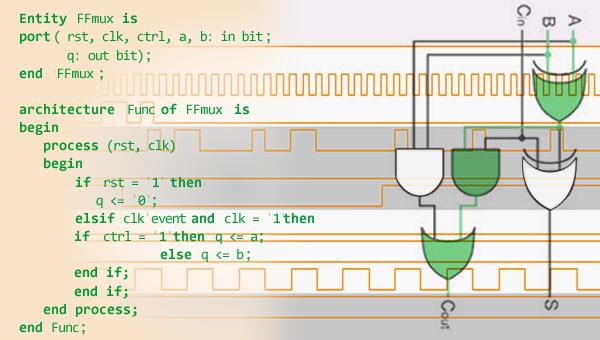
  • Comprender la descripción de Sistemas Digitales mediante lenguajes de alto nivel como VHDL.
  • Comprender el funcionamiento de los computadores a su nivel más básico (lenguaje máquina), así como su materialización e interpretación a través de sistemas digitales algorítmicos.

Syllabus:

Week 1: Todo lo que necesitas saber para comenzar el curso. ¿Qué son los Sistemas Digitales?
Week 2: Circuitos Combinacionales (I)
Week 3: Circuitos Combinacionales (II)
Week 4: Circuitos aritméticos + Introducción al VHDL
Week 5: Circuitos Secuenciales (I)
Week 6: Circuitos Secuenciales (II)
Week 7: Máquinas de estados finitos
Week 8: Implementación de sistemas digitales

Go to Class
MOOC List is learner-supported. When you buy through links on our site, we may earn an affiliate commission.

Related Courses

Major Engineering Projects: Governance, Risk and Scope (Coursera) Coursera
University of Leeds

Major Engineering Projects: Governance, Risk and Scope (Coursera)

Gain confidence when dealing with stakeholders of major projects by learning to identify and manage those that are involved in the project planning and delivery. This course will enable you to explore project governance in theory and practice. Through real life examples you’ll understand how the critical challenges of the governance in major projects are resolved.

Sep 7th 2026
5-12 Weeks
Financing and Initiating Major Engineering Projects (Coursera) Coursera
University of Leeds

Financing and Initiating Major Engineering Projects (Coursera)

To successfully lead major projects you have to understand typical investor and project financing approaches. In this course, you’ll learn to interpret some key contractual instruments that are relevant for the financing of major engineering projects so that you are in a position to ensure the financially secure delivery of your project. You’ll explore the concept of “time value of money” and be able to compute key indicators such as “Pay-back time”, “Net Present value” and “Internal Rate of Return”.

Sep 7th 2026
5-12 Weeks
Solving Algorithms for Discrete Optimization (Coursera) Coursera
University of Melbourne,The Chinese University of Hong Kong

Solving Algorithms for Discrete Optimization (Coursera)

Discrete Optimization aims to make good decisions when we have many possibilities to choose from. Its applications are ubiquitous throughout our society. Its applications range from solving Sudoku puzzles to arranging seating in a wedding banquet. The same technology can schedule planes and their crews, coordinate the production of steel, and organize the transportation of iron ore from the mines to the ports.

Sep 7th 2026
4 Weeks
Advanced Engineering Systems in Motion: Dynamics of Three Dimensional (3D) Motion (Coursera) Coursera
Georgia Institute of Technology

Advanced Engineering Systems in Motion: Dynamics of Three Dimensional (3D) Motion (Coursera)

This course is an advanced study of bodies in motion as applied to engineering systems and structures. We will study the dynamics of rigid bodies in 3D motion. This will consist of both the kinematics and kinetics of motion. Kinematics deals with the geometrical aspects of motion describing position, velocity, and acceleration, all as a function of time. Kinetics is the study of forces acting on these bodies and how it affects their motion.

Sep 7th 2026
5-12 Weeks
Fundamentals of Engineering Exam Review (Coursera) Coursera
Georgia Institute of Technology

Fundamentals of Engineering Exam Review (Coursera)

The purpose of this course is to review the material covered in the Fundamentals of Engineering (FE) exam to enable the student to pass it. It will be presented in modules corresponding to the FE topics, particularly those in Civil and Mechanical Engineering. Each module will review main concepts, illustrate them with examples, and provide extensive practice problems.

Sep 7th 2026
5-12 Weeks
Algorithmic Thinking (Part 1) (Coursera) Coursera
Rice University

Algorithmic Thinking (Part 1) (Coursera)

Experienced Computer Scientists analyze and solve computational problems at a level of abstraction that is beyond that of any particular programming language. This two-part class is designed to train students in the mathematical concepts and process of "Algorithmic Thinking", allowing them to build simpler, more efficient solutions to computational problems.

Sep 7th 2026
4 Weeks
Cómo autoconstruir tu vivienda (Coursera) Coursera
Universidad Nacional Autónoma de México

Cómo autoconstruir tu vivienda (Coursera)

Aprenderás las bases y los procedimientos precisos paso a paso para que puedas llevar a cabo la autoconstrucción de una vivienda básica, segura y económica para ti y tu familia; también te será de gran utilidad si estás buscando aprender a reparar, mejorar la estructura de tu vivienda e incluso si buscas autoemplearte.

Sep 14th 2026
4 Weeks
Analytic Combinatorics (Coursera) Coursera
Princeton University

Analytic Combinatorics (Coursera)

Analytic Combinatorics teaches a calculus that enables precise quantitative predictions of large combinatorial structures. This course introduces the symbolic method to derive functional relations among ordinary, exponential, and multivariate generating functions, and methods in complex analysis for deriving accurate asymptotics from the GF equations. All the features of this course are available for free. It does not offer a certificate upon completion.

Sep 7th 2026
5-12 Weeks
Thermodynamique : fondements (Coursera) Coursera
École Polytechnique Fédérale de Lausanne

Thermodynamique : fondements (Coursera)

Ce cours vous apportera une compréhension des concepts fondamentaux de la thermodynamique du point de vue de la physique, de la chimie et de l’ingénierie. Il est scindé un deux MOOCs. Dans la première partie, le Professeur J.-Ph. Ansermet de l’EPFL et son collaborateur le Dr. Sylvain Bréchet ont rassemblé en quatre leçons tous les principes fondamentaux de la thermodynamique. La deuxième partie du MOOC illustre l’approche thermodynamique par une série d’applications présentées par des spécialistes provenant de diverses institutions partenaires du réseau RESCIF.

Sep 14th 2026
4 Weeks
Problem Solving Using Computational Thinking (Coursera) Coursera
University of Michigan

Problem Solving Using Computational Thinking (Coursera)

Have you ever heard that computers "think"? Believe it or not, computers really do not think. Instead, they do exactly what we tell them to do. Programming is, "telling the computer what to do and how to do it." Before you can think about programming a computer, you need to work out exactly what it is you want to tell the computer to do. Thinking through problems this way is Computational Thinking. Computational Thinking allows us to take complex problems, understand what the problem is, and develop solutions. We can present these solutions in a way that both computers and people can understand.

Sep 14th 2026
5-12 Weeks