EdX

Shakespeare’s Othello: The Moor (edX)

Shakespeare’s Othello: The Moor (edX)

Explore acts of storytelling in Shakespeare's Othello alongside world-class artists who interpret Othello's story in new forms and contexts today. In this course, we'll read William Shakespeare’s Othello and discuss the play from a variety of perspectives. The goal of the course is not to cover everything that has been written on Othello.

Class Deals by MOOC List - Click here and see EdX's Active Discounts, Deals, and Promo Codes.

Rather, it is to find a single point of entry to help us think about the play as a whole. Our entry point is storytelling.
We'll look at the ways in which Shakespeare's characters tell stories within the play––about themselves, to themselves, and to each other. We'll consider, too, how actors, directors, composers, and other artists tell stories through Othello in performance. By focusing on storytelling, we can see how the play grapples with larger issues including power, identity, and the boundary between fact and fiction.
From lectures filmed on-location in Venice and conversations with artists, academics, and librarians at Harvard, students will have unprecedented access to a range of resources for "unlocking" Shakespeare's classic play.
This course is part of the Shakespeare’s Outsiders XSeries Program.

What you'll learn

  • Develop a critical stance on Othello and its protagonist, the “Moor of Venice,” through the central motif of storytelling.
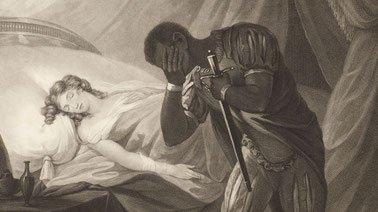
  • Use primary sources, including sixteenth-century accounts of Africa and nineteenth- and twentieth-century performance artifacts, to evaluate the play in multiple historical contexts.
  • Looking at adaptations of the play from the nineteenth century to the present, evaluate Othello as a platform for conversations about race, gender, class, and nationality.

Syllabus

Part 1: Story and Identity
In Part 1, we read Acts 1–2, considering the ways in which Othello represents himself to Desdemona and to the Venetian Senate through fantastic tales.
By the end of this unit, you will be able to:

  • Analyze Othello’s monologue in Act 1, Scene 3 and use it as a lens through which to view the play as a whole
  • Assess the way storytelling is associated with witchcraft, lying, and other subversive behavior, setting up the tragedy of Othello and Desdemona’s relationship
  • Understand the historical contexts for Shakespeare’s representations of Othello
  • Explore how Shakespeare transformed his sources in creating his character and the play as a whole

Part 2: Story as Fabrication
Part 2 brings us to Acts 3–4, where we see how Iago stages scenes to convince Othello that Desdemona is unfaithful.
By the end of this unit, you will be able to:

  • Compare and contrast Othello’s storytelling with Iago’s machinations to sabotage Othello and Desdemona’s relationship, considering the thin line the play draws between fiction and lying
  • Use Othello’s monologue in Act 4 to interpret the handkerchief, one of the play’s most central props/symbols
  • Evaluate the multiple meanings available in the play’s variant versions and their implications for performance
  • Discover how two famous African-American actors, among the first black actors to play Othello, interpreted the play and leveraged it for their own activism

Part 3: Operatic Othellos
Part 3 introduces us to Giuseppe Verdi's Otello and Mehmet Ali Sanlikol's Othello in the Seraglio.
By the end of this unit, you will be able to:

  • Delve into the history of operatic adaptations of Othello, beginning with the nineteenth-century Italian composers Verdi and Rossini
  • Discover Otello in the Seraglio, which transposes the play to the Ottoman court, revising the “orientalism” of both the play and its operas
  • Explore music as a means for telling Othello’s “story,” including representing gender, nationality, and race
  • Consider how adaptations bring new meaning to old texts through setting, language, medium, and other artistic choices

Part 4: Revisionist Othellos
In Part 4, we continue our study of Othello's afterlives with Toni Morrison's Desdemona and Keith Hamilton Cobb's American Moor.
By the end of this unit, you will be able to:

  • Weigh divergent feminist responses to Othello by Toni Morrison, Djanet Sears, Paula Vogel, and Ann-Marie MacDonald
  • Consider how genre becomes a tool for rewriting Othello from a female perspective
  • Encounter American Moor, a new play that dramatizes a black actor’s experience auditioning to play Othello
  • Evaluate why Othello provides continuing material for engaging issues surrounding race, gender, class, colonialism, and other topics
Go to Class
MOOC List is learner-supported. When you buy through links on our site, we may earn an affiliate commission.

Related Courses

Artful Medicine: Art’s Power to Enrich Patient Care (edX) EdX
Brown University,BrownX

Artful Medicine: Art’s Power to Enrich Patient Care (edX)

Discover how the medical community harnesses the power of art and empathy to improve patient care. What impact can art and the humanities have on patient care? Can art enhance medical caregivers’ powers of observation and humanize their interactions with patients? Through presence alone, can caregivers heal what they cannot cure?

No sessions available
3 Weeks
Modern Masterpieces of World Literature (edX) EdX
HarvardX,Harvard University

Modern Masterpieces of World Literature (edX)

Examine how great modern writers capture the intricacies of our globalized world and how their works circulate within that world to find their own audiences. Based on the second half of the Masterpieces of World Literature edX MOOC, this short literature course examines how writers reach beyond national and linguistic boundaries as worldly readers and travelers, and how their modern fictions rise to the status of world literature.

Self Paced
Self-Paced
The Einstein Revolution (edX) EdX
HarvardX,Harvard University

The Einstein Revolution (edX)

Traces Albert Einstein’s engagement with relativity, quantum mechanics, Nazism, nuclear weapons, philosophy, the arts, and technology. Albert Einstein has become the icon of modern science. Following his scientific, cultural, philosophical, and political trajectory, this course aims to track the changing role of physics in the 20th and 21st centuries.

Self Paced
Self-Paced
Professional Business Presentations (edX) EdX
DoaneX,Doane University

Professional Business Presentations (edX)

Professional Business Presentations, will dive into the world of presenting information both in written and verbal form. This course discusses how to effectively create presentations with quality formatting, the proper design elements and organization. The learner will identify the proper presentation format and software for their audience. Learners will have the opportunity to utilize the skills gained to create an engaging PowerPoint presentation. Learners will also utilize their skills to create a professional handout and record a video presentation, which will be graded by staff, as part of their final project in the course.

Self Paced
Self-Paced
Cosmopolitan Tang: Aristocratic Culture in China (edX) EdX
HarvardX,Harvard University

Cosmopolitan Tang: Aristocratic Culture in China (edX)

Explore the reunification of China under the Tang with a focus on aristocratic culture — from poetry to calligraphy to literature. By the Tang period, China was divided into northern and southern dynasties with different rulers and political systems. The north was conquered by relatively unsophisticated barbarians, but in the south, the aristocratic families established a refined appreciation of writing and literature.

Self Paced
Self-Paced
Visualización de Datos y Storytelling (edX) EdX
Tecnológico de Monterrey,TecdeMonterreyX

Visualización de Datos y Storytelling (edX)

Aprende en este curso en línea que es la visualización de datos, sus usos; los elementos que la conforman y la forma de poder utilizarla para el apoyo en la toma de las mejores decisiones para las empresas basadas en el análisis de datos. Digamos que necesitas comprender big data; miles o incluso millones de filas de datos, y tienes poco tiempo para hacerlo. los datos pueden provenir de tu equipo, en cuyo caso tal vez ya estés familiarizado con lo que estás midiendo y de los resultados que se esperan. O puede provenir de otro equipo, o tal vez de varios equipos a la vez, y estar completamente familiarizado.

Self Paced
Self-Paced
Inspiring and Motivating Arts and Culture Teams (edX) EdX
University of Michigan,MichiganX

Inspiring and Motivating Arts and Culture Teams (edX)

Learn critical leadership skills that enable you to inspire and motivate individuals and teams, specifically in Arts and Culture organizations. Offered by the Ross School of Business at the University of Michigan in collaboration with National Arts Strategies Senior Management Institute, this course focuses on equipping senior leaders of arts and culture organizations and/or nonprofits with the critical skills for inspiring employee engagement and performance while motivating people to adjust behavior and embrace change.

Self Paced
Self-Paced
Shakespeare's The Merchant of Venice: Shylock (edX) EdX
HarvardX,Harvard University

Shakespeare's The Merchant of Venice: Shylock (edX)

An exploration of the magnetic and ambivalent character of Shylock in William Shakespeare’s The Merchant of Venice. In the first act of William Shakespeare’s The Merchant of Venice , the Jewish moneylender Shylock proposes a “merry sport” to the merchant Antonio: he will lend Antonio the money he needs if Antonio agrees to let Shylock take a pound of his flesh should he default. Shylock calls this contract a “merry bond,” and Shakespeare’s First Folio calls the play a comedy. But what does Shylock want from the bond, and how merry does the play ultimately prove?

Self Paced
Self-Paced
Invitation to The Tale of Genji: The Foundational Elements of Japanese Culture (edX) EdX
Waseda University,WasedaX

Invitation to The Tale of Genji: The Foundational Elements of Japanese Culture (edX)

Explore the world's oldest novel written in the eleventh century and develop the perspective to understand Japanese classical literature and the foundation of Japanese culture. The Tale of Genji (Genji Monogatari) is a long-form narrative composed in Japan at the beginning of the eleventh century. It depicts relationships both harmonious and discordant among a wide cast of the men and women of the Heian court. These revolve around the many love affairs of the main character, the Shining Genji (Hikaru Genji).

Self Paced
Self-Paced
Masterpieces of World Literature (edX) EdX
HarvardX,Harvard University

Masterpieces of World Literature (edX)

Embark on a global journey to explore the past, present, and future of World Literature. This literature course explores how great writers refract their world and how their works are transformed when they intervene in our global cultural landscape today. No national literature has ever grown up in isolation from the cultures around it; from the earliest periods, great works of literature have probed the tensions, conflicts, and connections among neighboring cultures and often more distant regions as well.

Self Paced
Self-Paced