EdX

Revenue Forecasting and Analysis (edX)

Revenue Forecasting and Analysis (edX)

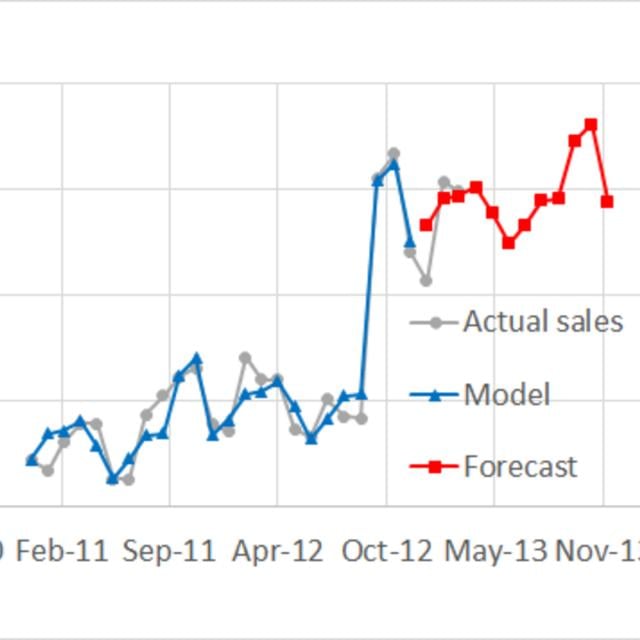
Presented by the IMF Fiscal Affairs Department, the course offers hands-on learning that will help students build foundational knowledge on the different quantitative models and techniques that can be used to forecast revenues and undertake tax policy analysis, while also exploring related issues such as the features of a sound institutional framework and the key principles of tax policymaking.

Class Deals by MOOC List - Click here and see EdX's Active Discounts, Deals, and Promo Codes.

Revenue forecasting refers to the use of analytical techniques to produce estimates of future financial inflows for the government. It is of crucial importance to policymakers, as it helps them devise sound public polices and plan spending programs based on these projected revenues. While governments derive revenues from various sources, taxes typically are the main funding mechanism. Therefore, this course focuses on the forecasting and analysis of tax revenue.
We first pinpoint places where data can be accessed and guide you on how to assess the quality of your data. We then move to general forecasting techniques. We apply these techniques to forecast major tax revenue items such as: value added taxes, import duties, excises, personal income tax and corporate income tax. The course also provides an introduction to techniques that can be used to estimate the revenue effects of policy changes and their distributional impact.

What you'll learn
Upon completion of this course, participants should be able to:

  1. Analyze fundamental principles and trends in tax revenue analysis.
  2. Explain the key features of an effective institutional framework for revenue forecasting.
  3. Identify data requirements and recognize potential data issues.
  4. Produce revenue forecasts using different methods.
  5. Recognize the strengths and limitations of different forecasting methods.
  6. Quantify the revenue impact of tax policy changes, using input-output tables and micro-simulation models.

Go to Class
MOOC List is learner-supported. When you buy through links on our site, we may earn an affiliate commission.

Related Courses

Probability and Statistics I: A Gentle Introduction to Probability (edX) EdX
Georgia Institute of Technology,GTx

Probability and Statistics I: A Gentle Introduction to Probability (edX)

This course provides an introduction to basic probability concepts. Our emphasis is on applications in science and engineering, with the goal of enhancing modeling and analysis skills for a variety of real-world problems. In order to make the course completely self-contained (and to bring back long-lost memories), we’ll start off with Bootcamp lessons to review concepts from set theory and calculus.

Self Paced
Self-Paced
Collaborative Foresight: How to Game the Future (Coursera) Coursera
Institute for the Future

Collaborative Foresight: How to Game the Future (Coursera)

You’ll never have a complete picture of what's possible in the future if you look at it from just one point of view. The best way to expand your vision? Engage as many people as you can, and “game out” the possibilities together. In this course, you’ll learn how to use collaborative gaming techniques to go beyond your own thinking and see many, many different sides of the same future.

Jun 1st 2026
5-12 Weeks
Flood Risk Management (edX) EdX
RWTH Aachen,Technische Universität München - TUM,RWTHx,TUMx

Flood Risk Management (edX)

Understand the fundamentals of flood risk management and forecasting and learn how to implement ideas and measures to prevent damage. In the last decades, the reported damages caused by natural hazards increased tremendously. Flood risk management aims to prevent the loss of properties, assets and life caused by floods. The MOOCs focus is on aspects of flood risk management, forecasting and protection measures.

No sessions available
5-12 Weeks
Statistics for Business Analytics: Modelling and Forecasting (edX) EdX
University of Queensland,UQx

Statistics for Business Analytics: Modelling and Forecasting (edX)

This is a great course for anyone who wants to gain foundational and critical analysis and statistics skills with no prior background. In this course, we explore statistical methods for examining the relationships between variables. We also consider how data from the past can be used to make forecasts about likely future trends.

Apr 7th 2023
4 Weeks
Random Models, Nested and Split-plot Designs (Coursera) Coursera
Arizona State University

Random Models, Nested and Split-plot Designs (Coursera)

Many experiments involve factors whose levels are chosen at random. A well-know situation is the study of measurement systems to determine their capability. This course presents the design and analysis of these types of experiments, including modern methods for estimating the components of variability in these systems. The course also covers experiments with nested factors, and experiments with hard-to-change factors that require split-plot designs.

Jun 1st 2026
3 Weeks
Macroeconometric Forecasting (edX) EdX
International Monetary Fund - IMF,IMFx

Macroeconometric Forecasting (edX)

Learn how to create and assess forecasting models to predict macroeconomic variables such as inflation and economic growth. In this macroeconomics course, you will learn to predict macroeconomic variables such as inflation, growth or consumption, and to create statistical models in economics and use them to predict responses to economic policy.

Self Paced
Self-Paced
Big Data Science with the BD2K-LINCS Data Coordination and Integration Center (Coursera) Coursera
Icahn School of Medicine at Mount Sinai

Big Data Science with the BD2K-LINCS Data Coordination and Integration Center (Coursera)

In this course we briefly introduce the DCIC and the various Centers that collect data for LINCS. We then cover metadata and how metadata is linked to ontologies. We then present data processing and normalization methods to clean and harmonize LINCS data. This follow discussions about how data is served as RESTful APIs. Most importantly, the course covers computational methods including: data clustering, gene-set enrichment analysis, interactive data visualization, and supervised learning. Finally, we introduce crowdsourcing/citizen-science projects where students can work together in teams to extract expression signatures from public databases and then query such collections of signatures against LINCS data for predicting small molecules as potential therapeutics.

Jun 1st 2026
5-12 Weeks
Monetary Policy Analysis and Forecasting (edX) EdX
International Monetary Fund - IMF,IMFx

Monetary Policy Analysis and Forecasting (edX)

Learn about the macroeconomic motivation of the quarterly projection model (QPM), its key properties, model calibration, data filtration, and how to implement the QPM in MATLAB software in order to learn and understand practical model building and model operation as it is usually done in central banks. This online course, presented by the IMF's Institute for Capacity Development, introduces participants to quarterly projection macroeconomic models developed as a core of FPAS (Forecasting and Policy Analysis Systems) and how to implement the key canonical quarterly projection model (QPM) equations in a macroeconomic modeling software.

Self Paced
Self-Paced