Real-Time Embedded Systems Theory and Analysis (Coursera)

Real-Time Embedded Systems Theory and Analysis (Coursera)

This course provides an in-depth and full mathematical derivation and review of models for scheduling policies and feasibility determination by hand and with rate monotonic tools along with comparison to actual performance for real-time scheduled threads running on a native Linux system.

Class Deals by MOOC List - Click here and see Coursera's Active Discounts, Deals, and Promo Codes.

By the end of this course the learner will be able to full derive the fixed priority rate monotonic least upper bound for feasibility as well as justifying the rate monotonic policy and will be able to compare to dynamic priority scheduling including earliest deadline first and least laxity policies.
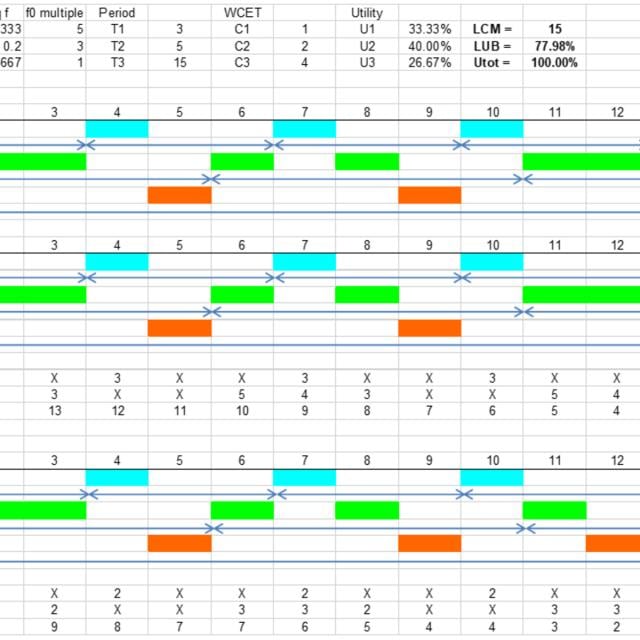
At the end of this course learners will be able to fully derive and explain the math model for the rate monotonic least upper bound as well as performing timing diagram analysis for fixed and dynamic priority software services. Tools to provide analysis will be learned (Cheddar) to automate timing analysis and to compare to actual performance.
Specific objectives include:

  • Rate monotonic theory (complete math models)
  • Differences between fixed priority rate monotonic policy and dynamic priority earliest deadline first and least laxity policies
  • Scheduling theory and practice writing code for multi-frequency executives, priority preemptive RTOS services, and real-time threaded services on traditional operating systems (Linux)
  • Building a simple Linux multi-service system using POSIX real-time extensions on Raspberry Pi 3b using sequencing and methods to log and verify agreement between theory and practice
  • Timing diagram generation and analysis using Cheddar

Course 2 of 4 in the Real-Time Embedded Systems Specialization

What You Will Learn

  • Methods to analyze dynamic priority real-time service feasibility
  • Methods to control unbounded priority inversion problems
  • Avoiding and recovering from deadlock
  • Avoiding and recovering from unbounded priority inversion

Syllabus

WEEK 1
Real-Time Scheduling and Rate Monotonic Least Upper Bound Derivation
At the end of this module, you will be able to analyze the mathematics involved in Rate Monotonic Least Upper Bound Condition along with its challenges and alternatives to it. An extension to RM scheduling policy i.e. Deadline Monotonic Scheduling Policy along with implementation of completion test for determining exact feasibility for Rate Monotonic Scheduling policy is also in scope of this module. Working on Programming assignments will give system level implementation of real time services and determining the best scheduling policies for meeting the deadlines for the designed real-time systems along with their trade offs.

WEEK 2
Service Design Feasibility Analysis Practice and Methods of Implementation
At the end of this module learners will be able to describe the design pattern for real-time services, describe implementation challenges such as unbounded blocking and describe normal operation - request for service synchronization between an ISR and each thread or task, initialization, keep-alive posting, error handling, and termination.

WEEK 3
Dynamic priority Earliest Deadline First and Least Laxity First
At the end of this Module learners will know when to use dynamic priority policies, advantages of them for soft real-time, disadvantages for error detection and recovery, challenges of feasibility determination and efficiency compared to fixed priority.

WEEK 4
Synchronization and Bounded vs. Unbounded Blocking
At the end of this Module learners will be able to describe issues with resources used beyond CPU (memory, I/O, and storage) and how to avoid problems or recover from them.

Go to Class
MOOC List is learner-supported. When you buy through links on our site, we may earn an affiliate commission.

Related Courses

Embedded Systems Essentials with Arm: Get Practical with Hardware (edX) EdX
Arm Education,ArmEducationX

Embedded Systems Essentials with Arm: Get Practical with Hardware (edX)

Spark your creativity with Arm. Level up your Embedded Systems skills by developing working embedded prototypes using the Mbed API and an Arm-based development board, and unlock the boundless opportunities of the Internet of Things. Embedded systems are the fundamental building blocks of our connected world, and Arm-based devices are the industry standard. This course will provide you with the practical skills and confidence to build your own embedded system using the popular and affordable ST Nucleo F401RE development board.

Self Paced
Self-Paced
Introduction to Architecting Smart IoT Devices (Coursera) Coursera
EIT Digital

Introduction to Architecting Smart IoT Devices (Coursera)

Embedded Systems are so ubiquitous that some of us take them for granted: we find them in smartphones, GPS systems, airplanes and so on. But have you ever wondered how these devices actually work? If so, you're in the right place! In this course, you'll learn about the characteristics of embedded systems: the possibilities, dangers, complications and recipes for success.

Jun 15th 2026
3 Weeks
System Validation: Automata and behavioural equivalences (Coursera) Coursera
EIT Digital

System Validation: Automata and behavioural equivalences (Coursera)

Have you ever experienced software systems failing? Websites crash, calendar not synchronising, or even a power blackout. Of course you have! But did you know that many of these errors are the result of communication errors either within a system or between systems? Depending on the system, the impact of software failures can be huge, even resulting in massive economic damage or loss of lives. Software, and in particular the communication between software-intensive systems, is very complex and very difficult to get right. However, we _need_ dependability in the systems we use, directly or indirectly, to support us in our everyday lives.

Jun 1st 2026
3 Weeks
Design and Prototype Embedded Computer Systems (FutureLearn) FutureLearn
Raspberry Pi Foundation,National Centre for Computing Education

Design and Prototype Embedded Computer Systems (FutureLearn)

Discover embedded system design and work your way through the product design lifecycle. Supported by Google. Learn how to design your own embedded system. On this course from the Raspberry Pi Foundation, you will explore how embedded systems are used in the world around us. You will learn what makes an embedded system different from a general purpose system (such as a PC) and discover how embedded systems are specialised for a particular use case.

Nov 1st 2021
3 Weeks
Systèmes embarqués et objets connectés - Démarche de conception (FUN) FUN
Université Fédérale Toulouse Midi-Pyrénées

Systèmes embarqués et objets connectés - Démarche de conception (FUN)

Coproduit par l'INP Toulouse et l'INSA Toulouse, ce MOOC constitue un module de positionnement général des systèmes embarqués et objets connectés dans leurs contextes opérationnels. Fortement novateur, il aborde ces systèmes selon un ensemble de points de vue pluridisciplinaires. L'objectif de ce MOOC est de vous permettre d'acquérir une démarche méthodologique, de mettre en place une pensée globale prenant en compte l'écosystème du domaine des systèmes embarqués et objets connectés dans une finalité de compréhension générale du système.

No sessions available
5-12 Weeks
Embedded Systems (Udacity) Udacity
Georgia Institute of Technology,Udacity

Embedded Systems (Udacity)

The goal of this course is to take a holistic view of the embedded system stack with a focus on processor architectures, instruction sets and the associated advanced compiler optimizations that take advantage of the same. In the 21st century, embedded systems are the systems of future with cellular phones, smart-phones, tablets becoming the dominant platforms for computing and communication. The ubiquity of information and the associated need for the computation that accompanies it is driving this revolution only to be accelerated by the new paradigms such as the Internet-of-Things (IoT).

Self Paced
Self-Paced
System Validation (Canvas Network) Canvas Network
Halmstad University

System Validation (Canvas Network)

Anyone who has ever designed an embedded system or a communication protocol involving several components executing simultaneously knows that such software is inherently susceptible to bugs. Typical problems include race conditions, deadlocks, and unexpected interplay between different components. The parallel nature of these systems makes it notoriously hard to detect such bugs using testing (timing, e.g., plays a crucial role). This course is designed to provide an introduction to the problems that arise in the design of such systems. It provides ways to model such systems and reason about them.

Self Paced
Self-Paced
Let Us PIC: A Datasheet Approcah for PIC Programming (Skillshare) Skillshare
Skillshare

Let Us PIC: A Datasheet Approcah for PIC Programming (Skillshare)

This course introduces basic concepts of PIC micro-controller programming using C. Starting from installation of required software, this course gives insight of programming the PIC microcontroller to access General Purpose Input Output (GPIO) pins, Configuring external interrupts, Timers and counters, ADCs, LCD and Keypad interfacing, PWM generation and few communication protocols like UART, I2C and SPI.

Self Paced
Self-Paced
CPS Design with ARM Core using MicroPython for Industries (Coursera) Coursera
L&T EduTech

CPS Design with ARM Core using MicroPython for Industries (Coursera)

This course equips participants with the knowledge and hands-on skills needed to design and implement ARM Processor with Micro python in Cyber-Physical Systems (CPS) for industrial and use. Covering foundational concepts and practical development with Micro python programming on ARM processors, participants will explore the Consumer Industry, Smart City Perspective of CPS, and gain expertise to design and control the evolving smart systems.

Jun 15th 2026
5-12 Weeks