EdX

Embedded Systems - Shape The World: Microcontroller Input/Output (edX)

Embedded Systems - Shape The World: Microcontroller Input/Output (edX)

Introduction to the world of embedded systems with a focus on microcontroller input/output in this hands-on, lab-based course. Learn how electronic gadgets are designed, developed, and built as embedded systems that shape the world.

Class Deals by MOOC List - Click here and see EdX's Active Discounts, Deals, and Promo Codes.

This is part one of a two part sequence. Together these are hands-on, learn-by-doing courses that show you how to build solutions to real-world problems using embedded systems. In this course, we take a bottom-up approach to problem solving, building gradually from simple interfacing of switches and LEDs to complex concepts like a microcontroller-based pacemaker, digital lock, and a traffic light controller. We will present both general principles and practical tips for building circuits and programming the microcontroller in the C programming language. You will develop debugging skills using oscilloscopes, logic analyzers, and software instrumentation. Laboratory assignments are first performed in simulation, and then you will build and debug your system on the real microcontroller. At the conclusion of this part 1 you will possess the knowledge to build your own traffic light controller from the ground up.

This is the fourth time we have offered this course. Since the reviews have been overwhelmingly positive we do not plan major changes over the previous offerings of the course. We did however break the large class into two smaller classes. There are eight labs in part 1 and six labs in part 2. Students can pick and choose a subset of labs to achieve certification. The three labs that students found most rewarding in this part were designing the software algorithm for a demand pacemaker, interfacing switches and LEDS, and the finite state machine traffic light controller.
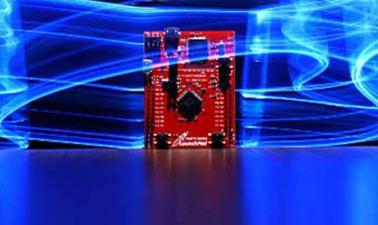
To complete this course, you will be required to purchase a Texas Instruments TM4C123 microcontroller kit and a few electronic components.
This microcontroller has a state-of-the-art ARM Cortex-M4 processor.

What you'll learn

  • Understanding of embedded systems using modular design and abstraction
  • C programming: considering both function and style
  • Build and test circuits with switches, LEDs, resistors, potentiometers, and liquid crystal displays
  • Synchronizing hardware and software input/output with switches, lights, sound, sensors. motors, and liquid crystal displays
  • Learn how to solve problems using a finite state machine
  • Debug using oscilloscopes, logic analyzers, and software instrumentation
  • Learn how to read a data sheet
  • Construct traffic light controller

Syllabus

The best way to understand what you will learn in this class is to list the labs you will complete and the example projects we will build. You will complete each lab first in simulation and then on the real board. For each module we will design a system and you will build and test a similar system.
Module 1: Welcome and introduction to course and staff

  • Module 2: Fundamental concepts: numbers, computers, and the ARM Cortex M processor *

Lab 2. Run existing project on LaunchPad with switch input and LED output

  • Module 3: Electronics: resistors, voltage, current and Ohm’s Law _**
  • Module 4: Digital Logic: transistors, flip flops and logic functions *

Lab 4. Debug a system with two inputs and two outputs

  • Module 5: Introduction to C programming *

Lab 5. Write a C function and perform input/output

  • Module 6: Microcontroller Input/Output *

Lab 6. Write C software that inputs from a switch and toggles an LED output

  • Module 7: Design and Development Process *

Lab 7. Write C functions that inputs from a switch and outputs to two LEDs, which is a virtual pacemaker

  • Module 8: Interfacing Switches and LEDs *

Lab 8. Interface an external switch and LED and write input/output software

  • Module 9: Arrays and Functional Debugging *

Lab 9. Write C functions using array data structures that collect/debug your system

  • Module 10: Finite State Machines *

Lab 10. Interface 3 switches and 6 LEDs and create a traffic light finite state machine
Go to Class
MOOC List is learner-supported. When you buy through links on our site, we may earn an affiliate commission.

Related Courses

Designing Electronics for Recycling in a Circular Economy (edX) EdX
Delft University of Technology,DelftX

Designing Electronics for Recycling in a Circular Economy (edX)

Discover the latest developments in Design for Recycling (DfR) of electrical and electronic equipment (EEE) and the application of recycled plastics into new products. Electronic products bring countless benefits to society, but their production and waste treatment also lead to numerous negative environmental and economic impacts. Since E-waste is the world’s fastest growing waste stream, governments are setting ambitious targets to help this industry transition towards a circular economy.

Nov 15th 2023
4 Weeks
Web Connectivity and Security in Embedded Systems (Coursera) Coursera
EIT Digital

Web Connectivity and Security in Embedded Systems (Coursera)

In this course, we will explore several technologies that bring modern devices together, facilitating a network of connected things and making devices internet enabled. We will discuss rules, protocols, and standards for these devices to communicate with each other in the network. We will also go through security and privacy issues and challenges in cyber physical systems (CPS). We will explore measures and techniques for securing systems from different perspectives. Possible attack models are introduced and solutions to tackle such attacks are discussed. Moreover, some basic concepts related to privacy in cyber physical systems are presented.

Jun 22nd 2026
5-12 Weeks
UX and Interface Design for Embedded Systems (Coursera) Coursera
University of Colorado Boulder

UX and Interface Design for Embedded Systems (Coursera)

UX and Interface Design for Embedded Systems is the first of three classes in the Embedded Interface Design (EID) specialization, an online version of the on-campus EID class taught in graduate embedded systems design. This first course is focused on user experience (UX) and the related methods, practices, and principles that will help ensure your embedded interface designs for devices and systems are what your users both need and want.

Jun 22nd 2026
5-12 Weeks
Embedded Systems Essentials with Arm: Get Practical with Hardware (edX) EdX
Arm Education,ArmEducationX

Embedded Systems Essentials with Arm: Get Practical with Hardware (edX)

Spark your creativity with Arm. Level up your Embedded Systems skills by developing working embedded prototypes using the Mbed API and an Arm-based development board, and unlock the boundless opportunities of the Internet of Things. Embedded systems are the fundamental building blocks of our connected world, and Arm-based devices are the industry standard. This course will provide you with the practical skills and confidence to build your own embedded system using the popular and affordable ST Nucleo F401RE development board.

Self Paced
Self-Paced
The Mechatronics Revolution: Fundamentals and Core Concepts (edX) EdX
Georgia Institute of Technology,GTx

The Mechatronics Revolution: Fundamentals and Core Concepts (edX)

In this course, students will learn to harness the power of microcontrollers, sensors, and actuators to build useful and interesting robotic devices. The Mechatronics Revolution is upon us. Never before has it been easier to build robotic devices and computer-controlled machines. The confluence of low-cost embedded computers, sensors, and actuators has made experimentation and prototyping easier than ever.

Self Paced
Self-Paced
Electromagnetic Compatibility Essentials (edX) EdX
Graz University of Technology,TUGrazX

Electromagnetic Compatibility Essentials (edX)

Advance your career by learning the basics of EMC. Explore all the different aspects and challenges every electronics engineer must be aware of. This course is designed to gain essential know-how in today’s world of very high frequencies. For instance, smartphone CPUs already work with clock frequencies above 3 GHz. But did you know that such fast switching disturbs other devices nearby? Such disturbances are either simply annoying or can become a real problem. As a consequence, international regulations exist which demand for emission and immunity tests before selling an electronic device.

Self Paced
Self-Paced
Microcontroller Applications with RISC-V (edX) EdX
Linux Foundation,LinuxFoundationX

Microcontroller Applications with RISC-V (edX)

Create simple embedded applications with a RISC-V microcontroller using a user-friendly integrated development environment (IDE). This course provides some basic experience in designing and developing deeply embedded bare metal applications using a microcontroller with a RISC-V core. The course is the first step to creating embedded systems using a host of new microcontrollers that use an open instruction set architecture (ISA) as an alternative to a proprietary option.

Self Paced
Self-Paced
Fundamentals of TinyML (edX) EdX
HarvardX,Harvard University

Fundamentals of TinyML (edX)

Focusing on the basics of machine learning and embedded systems, such as smartphones, this course will introduce you to the “language” of TinyML. What do you know about TinyML? Tiny Machine Learning (TinyML) is one of the fastest-growing areas of Deep Learning and is rapidly becoming more accessible. This course provides a foundation for you to understand this emerging field.

Self Paced
Self-Paced
Introduction to the Internet of Things (edX) EdX
Universitat Politècnica de València,UPValenciaX

Introduction to the Internet of Things (edX)

This is a preliminary course in which we deal with the basics of electronics and programming using Arduino and ESP boards. Internet of Things (IoT) is the present and the future of technology. Either, if you have none, few or some experience with electronics and you want to develop it projects this course will give you the necessary kick start to start creating amazing devices capable of sensing, controlling physical signals.

Self Paced
Self-Paced