R Programming (Coursera)

R Programming (Coursera)

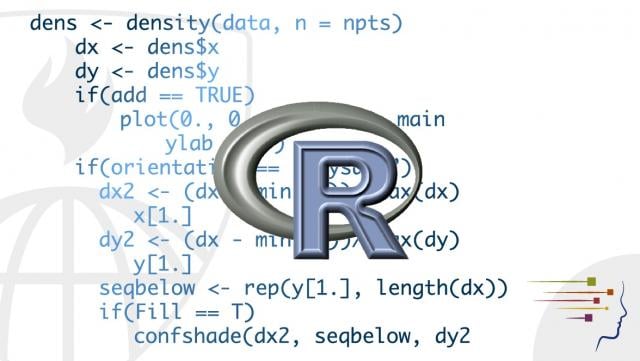
In this course you will learn how to program in R and how to use R for effective data analysis. You will learn how to install and configure software necessary for a statistical programming environment and describe generic programming language concepts as they are implemented in a high-level statistical language.

Class Deals by MOOC List - Click here and see Coursera's Active Discounts, Deals, and Promo Codes.

The course covers practical issues in statistical computing which includes programming in R, reading data into R, accessing R packages, writing R functions, debugging, profiling R code, and organizing and commenting R code. Topics in statistical data analysis will provide working examples.
This course can be applied to multiple Specializations or Professional Certificates programs. Completing this course will count towards your learning in any of the following programs:

What You Will Learn

  • Understand critical programming language concepts
  • Configure statistical programming software
  • Make use of R loop functions and debugging tools
  • Collect detailed information using R profiler

Syllabus

WEEK 1
Background, Getting Started, and Nuts & Bolts
This week covers the basics to get you started up with R. The Background Materials lesson contains information about course mechanics and some videos on installing R. The Week 1 videos cover the history of R and S, go over the basic data types in R, and describe the functions for reading and writing data. I recommend that you watch the videos in the listed order, but watching the videos out of order isn't going to ruin the story.

WEEK 2
Programming with R
Welcome to Week 2 of R Programming. This week, we take the gloves off, and the lectures cover key topics like control structures and functions. We also introduce the first programming assignment for the course, which is due at the end of the week.

WEEK 3
Loop Functions and Debugging
We have now entered the third week of R Programming, which also marks the halfway point. The lectures this week cover loop functions and the debugging tools in R. These aspects of R make R useful for both interactive work and writing longer code, and so they are commonly used in practice.

WEEK 4
Simulation & Profiling
This week covers how to simulate data in R, which serves as the basis for doing simulation studies. We also cover the profiler in R which lets you collect detailed information on how your R functions are running and to identify bottlenecks that can be addressed. The profiler is a key tool in helping you optimize your programs. Finally, we cover the str function, which I personally believe is the most useful function in R.

Go to Class
MOOC List is learner-supported. When you buy through links on our site, we may earn an affiliate commission.

Related Courses

Programming Mobile Applications for Android Handheld Systems: Part 1 (Coursera) Coursera
University of Maryland, College Park

Programming Mobile Applications for Android Handheld Systems: Part 1 (Coursera)

This course introduces you to the design and implementation of Android applications for mobile devices. You will develop an app from scratch, assuming a basic knowledge of Java, and learn how to set up Android Studio, work with various Activities and create simple user interfaces to make your apps run smoothly.

Jun 8th 2026
5-12 Weeks
Introduction to Machine Learning (Coursera) Coursera
Duke University

Introduction to Machine Learning (Coursera)

This course will provide you a foundational understanding of machine learning models (logistic regression, multilayer perceptrons, convolutional neural networks, natural language processing, etc.) as well as demonstrate how these models can solve complex problems in a variety of industries, from medical diagnostics to image recognition to text prediction.

Jun 12th 2026
5-12 Weeks
Data Visualization (Coursera) Coursera
Ball State University

Data Visualization (Coursera)

In the era of big data, acquiring the ability to analyze and visually represent “Big Data” in a compelling manner is crucial. Therefore, it is essential for data scientists to develop the skills in producing and critically interpreting digital maps, charts, and graphs. Data visualization is an increasingly important topic in our globalized and digital society. It involves graphically representing data or information, enabling decision-makers across various industries to comprehend complex concepts and processes that may otherwise be challenging to grasp.

Jun 9th 2026
5-12 Weeks
Reproducible Research (Coursera) Coursera
Johns Hopkins University

Reproducible Research (Coursera)

This course focuses on the concepts and tools behind reporting modern data analyses in a reproducible manner. Reproducible research is the idea that data analyses, and more generally, scientific claims, are published with their data and software code so that others may verify the findings and build upon them. The need for reproducibility is increasing dramatically as data analyses become more complex, involving larger datasets and more sophisticated computations.

Jun 8th 2026
4 Weeks
Practical Machine Learning (Coursera) Coursera
Johns Hopkins University

Practical Machine Learning (Coursera)

One of the most common tasks performed by data scientists and data analysts are prediction and machine learning. This course will cover the basic components of building and applying prediction functions with an emphasis on practical applications. The course will provide basic grounding in concepts such as training and tests sets, overfitting, and error rates.

Jun 8th 2026
4 Weeks
The Structured Query Language (SQL) (Coursera) Coursera
University of Colorado Boulder

The Structured Query Language (SQL) (Coursera)

In this course you will learn all about the Structured Query Language ("SQL".) We will review the origins of the language and its conceptual foundations. But primarily, we will focus on learning all the standard SQL commands, their syntax, and how to use these commands to conduct analysis of the data within a relational database. Our scope includes not only the SELECT statement for retrieving data and creating analytical reports, but also includes the DDL ("Data Definition Language") and DML ("Data Manipulation Language") commands necessary to create and maintain database objects.

Jun 9th 2026
5-12 Weeks
Cloud Computing Concepts, Part 1 (Coursera) Coursera
University of Illinois at Urbana-Champaign

Cloud Computing Concepts, Part 1 (Coursera)

Cloud computing systems today, whether open-source or used inside companies, are built using a common set of core techniques, algorithms, and design philosophies—all centered around distributed systems. Learn about such fundamental distributed computing "concepts" for cloud computing. Some of these concepts include: clouds, MapReduce, key-value/NoSQL stores, classical distributed algorithms, widely-used distributed algorithms, scalability, trending areas, and much, much more!

Jun 8th 2026
5-12 Weeks
Learn to code with AI (Coursera) Coursera
Scrimba

Learn to code with AI (Coursera)

Imagine waking up tomorrow as a web developer. What would you want to build? With AI tools like ChatGPT, you're already a developer, regardless of your experience, if you know how to work with them. So in this course, you'll build functional, interactive front-end projects while learning how to write effective prompts and debug and refine your code with the help of AI.

Jun 10th 2026
2 Weeks
Business Intelligence Concepts, Tools, and Applications (Coursera) Coursera
University of Colorado System

Business Intelligence Concepts, Tools, and Applications (Coursera)

This is the fourth course in the Data Warehouse for Business Intelligence specialization. Ideally, the courses should be taken in sequence. In this course, you will gain the knowledge and skills for using data warehouses for business intelligence purposes and for working as a business intelligence developer. You’ll have the opportunity to work with large data sets in a data warehouse environment and will learn the use of MicroStrategy's Online Analytical Processing (OLAP) and Visualization capabilities to create visualizations and dashboards.

Jun 8th 2026
5-12 Weeks
Code Yourself! An Introduction to Programming (Coursera) Coursera
University of Edinburgh,Universidad ORT Uruguay

Code Yourself! An Introduction to Programming (Coursera)

Have you ever wished you knew how to program, but had no idea where to start from? This course will teach you how to program in Scratch, an easy to use visual programming language. More importantly, it will introduce you to the fundamental principles of computing and it will help you think like a software engineer.

Jun 8th 2026
5-12 Weeks