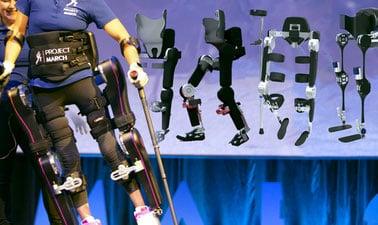
Learn about cutting-edge exoskeleton technology that can help people with spinal cord injuries to walk again. Create your own vision of how to advance this technology in the future, benefiting from the hands-on experience of the Project MARCH student team in building exoskeletons.
Class Deals by MOOC List - Click here and see EdX's Active Discounts, Deals, and Promo Codes.
Over the last 20 years, exoskeletons have gained an increasing amount of attention as an assistive device to help people with spinal cord injury stand up and walk again. While this cutting-edge technology can have many applications - for example, in military or industrial settings - this course focuses on the use of powered exoskeletons in the medical field, specifically for people with spinal cord injury. Each year, between 250,000 and 500,000 people worldwide suffer from spinal cord injury. Amongst many possible symptoms, this may result in a loss of motor control in large parts of the body, including the legs.
The course is open to anyone interested in exoskeletons for the medical or technological field. This includes, but is not limited to, people who:
- are eager to learn about exoskeleton technology;
- are university students interested in medical or technological topics;
- are working in a non-biomechanical field and are simply enthusiastic about exoskeleton technology;
- have some experience of working on a biomechanical project.
The course delivers a complete overview of all aspects of exoskeleton technology. Topics range from the health benefits of exoskeletons and the importance of co-creation with the user, to mechanical structure and developing 'smarter' exoskeletons. You will strengthen your analytical and creative mindset by designing solutions to given problems and by analyzing current challenges in the field of exoskeleton technology. Through discussions with fellow participants, you will form your own vision about the future of exoskeletons.
This course is developed by and uses examples from Project MARCH: the exoskeleton-building team consisting of students from TU Delft. This team consists of around twenty-five students from different disciplines who volunteer to participate in the project over the course of a full year. Drawing from their hands-on experience and the knowledge gained while researching, designing and building different exoskeletons over the years, they are ideally placed to provide you with a complete online course covering the design, use and future challenges of letting people with spinal cord injury walk again.
What you'll learn
- Understand the role of exoskeletons in paraplegia induced by Spinal Cord Injury
- Compare existing exoskeletons and employ them as inspiration for future design
- Understand the interaction between humans and machines
- Apply analytical and creative thinking to design questions
- Perform basic calculations relevant to exoskeleton design and performance
- Understand the importance of balance and methods applied to achieve balance in exoskeletons
Syllabus
Week 1: Introduction to exoskeleton technology and its purpose
Topics of week 1 include:
- Understanding the concept of exoskeletons, explained with reference to relevant examples
- Getting to know Project MARCH
- Understanding the role of exoskeletons concerning Spinal Cord Injury induced paraplegia
- Learning about the advantages and disadvantages of exoskeletons deployed as assistive devices
Week 2: The building bricks of the exoskeleton
Topics that will be covered:
- Basic structural components of the exoskeleton
- Differences between the various MARCH exoskeletons
- Different joints and joint transmission
- The importance of a perfectly fitted exoskeleton
- How to handle the exoskeleton as a carer/companion
- The principles of the engineering design process
Week 3: Creating movement: making the exoskeleton walk
Topics we'll cover this week include:
- The human gait and important anatomical terms
- How gaits are generated for an exoskeleton
- The complexity of human-machine interaction concerning gait
- The basics of control and why it is so important
- Important safety measures needed to limit movement
- Gait generation at Project MARCH
- The future of gait generation
Week 4: Smart-technologies: how to provide input and process feedback
Topics that will be covered:
- Input technology for complex systems
- Definition of an input device and how it is used in exoskeleton technology
- Co-creation with a pilot
- The concept of user-feedback, its relevance and contribution to safety
- Use of sensors to provide additional input
- Data processing related to examples of sensors that could be used in exoskeletons
- Learn how to choose and design input methods
- Assess the advantages and disadvantages of input methods
Week 5: Self-Balancing Exoskeletons
Topics we'll cover in this week:
- Examples of balance in the animal kingdom, and the definition of balance
- Physiology of balance in humans
- Balance in bipedal robots, in exoskeletons and the difference between those two groups
- How Project MARCH tries to achieve balance in its exoskeleton using Capture Point
- Balance needed in surmounting everyday obstacles
- Designing a balance-friendly exoskeleton from scratch / redesigning a self-balancing bipedal robot to fit a human while maintaining balance
Week 6: Exoskeletons – the bigger picture
Topics we'll cover in this week:
-A recap of the previous five weeks
- Designing your own exoskeleton, using the knowledge gained from the previous weeks
- An explanation of Project MARCH's vision
- How to create your own vision for exoskeleton technology and how to implement this vision in your particular context