Particle Dynamics (Coursera)

Particle Dynamics (Coursera)

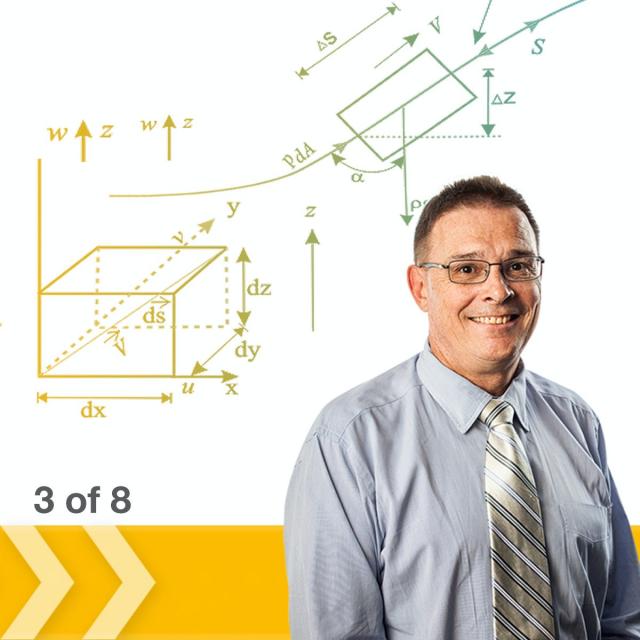
This course teaches dynamics, one of the basic mechanics subjects of Mechanical Engineering. Students would be able to organize their knowledge about force and motion, work-energy, impulse-momentum in view of Newton's 2nd law and its integration over time and displacement. The Engineering Dynamics consists of two parts: particle dynamics and rigid body dynamics.

Class Deals by MOOC List - Click here and see Coursera's Active Discounts, Deals, and Promo Codes.

This is the first part of the dynamics: Particle dynamics class will consist of lecture videos, which are about 15 min length (or a bit longer). These contain a couple of practice problem solving. There will also be standalone homeworks that are not part of video lectures, and a final exam.

Syllabus

WEEK 1
Lecture Note
Before you start the Lecture, please download this lecture note.
Each chapter has two version of lecture note. One is student version that has blanks, the Other is filled version.

WEEK 2
1-1 Week
Kinematics of particle in Cartesian, T-N, Polar coordinate and relative motion

WEEK 3
1-2 Week
Kinematics of particle in Cartesian, T-N, Polar coordinate and relative motion

WEEK 4
2-1 Week
Equations of motion of particle in linear motion

WEEK 5
2-2 Week
Equations of motion of particle in linear motion

WEEK 6
3-1 Week
Work & Energy of particle

WEEK 7
3-2 Week
Work & Energy of particle

WEEK 8
4-1 Week
Impulse momentum of a particle

WEEK 9
4-2 Week
Impulse momentum of a particle

WEEK 10
5-1 Week
Impact of particle

WEEK 11
5-2 Week
Impact of particle

WEEK 12
6-1 Week
Kinetics of motion of the systems of particle

WEEK 13
6-2 Week
Kinetics of motion of the systems of particle

WEEK 14
7-1 Week
Kinetics of steady mass flow and variable mass

WEEK 15
7-2 Week
Kinetics of steady mass flow and variable mass

WEEK 16
FINAL TEST

Go to Class
MOOC List is learner-supported. When you buy through links on our site, we may earn an affiliate commission.

Related Courses

Introduction to Chemistry: Reactions and Ratios (Coursera) Coursera
Duke University

Introduction to Chemistry: Reactions and Ratios (Coursera)

This is an introductory course for students with limited background in chemistry; basic concepts involved in chemical reactions, stoichiometry, the periodic table, periodic trends, nomenclature, and chemical problem solving will be emphasized with the goal of preparing students for further study in chemistry as needed for many science, health, and policy professions.

Sep 7th 2026
5-12 Weeks
Engineering Systems in Motion: Dynamics of Particles and Bodies in 2D Motion (Coursera) Coursera
Georgia Institute of Technology

Engineering Systems in Motion: Dynamics of Particles and Bodies in 2D Motion (Coursera)

This course is an introduction to the study of bodies in motion as applied to engineering systems and structures. We will study the dynamics of particle motion and bodies in rigid planar (2D) motion. This will consist of both the kinematics and kinetics of motion. Kinematics deals with the geometrical aspects of motion describing position, velocity, and acceleration, all as a function of time. Kinetics is the study of forces acting on these bodies and how it affects their motion.

Sep 7th 2026
5-12 Weeks
Advanced Engineering Systems in Motion: Dynamics of Three Dimensional (3D) Motion (Coursera) Coursera
Georgia Institute of Technology

Advanced Engineering Systems in Motion: Dynamics of Three Dimensional (3D) Motion (Coursera)

This course is an advanced study of bodies in motion as applied to engineering systems and structures. We will study the dynamics of rigid bodies in 3D motion. This will consist of both the kinematics and kinetics of motion. Kinematics deals with the geometrical aspects of motion describing position, velocity, and acceleration, all as a function of time. Kinetics is the study of forces acting on these bodies and how it affects their motion.

Sep 7th 2026
5-12 Weeks
Mécanique Lagrangienne (Coursera) Coursera
École Polytechnique Fédérale de Lausanne

Mécanique Lagrangienne (Coursera)

Le formalisme de Lagrange permet une résolution efficace de problèmes complexes de mécanique. Il permet aussi d'apporter un éclairage plus fondamental sur les lois de conservation (théorème de Noether). A titre d'illustration de la méthode de Lagrange, on traitera le problème très important des oscillateurs harmoniques couplés, exprimé comme un problème de valeurs propres et de vecteurs propres. On termine avec un formalisme permettant d'analyser les résonances paramétriques, notion illustrée par l'expérience montrant la stabilité d'un pendule inversé forcé.

Sep 7th 2026
5-12 Weeks
Act on Climate: Steps to Individual, Community, and Political Action (Coursera) Coursera
University of Michigan

Act on Climate: Steps to Individual, Community, and Political Action (Coursera)

Are you concerned about climate change? Would you like to learn how to address and respond to this challenge? If so, this course is for you. Act on Climate: Steps to Individual, Community, and Political Action is intended to help learners understand, address and respond to climate change as individuals and in partnership with their communities and political leaders.

Sep 7th 2026
5-12 Weeks
Wind resources for renewable energies (Coursera) Coursera
École Polytechnique

Wind resources for renewable energies (Coursera)

The main goal of this course is to get the necessary knowledge on atmospheric and fluid dynamics in order to quantify the wind resource of a local or regional area. We’ll learn about basic meteorology, the specific dynamics of turbulent boundary layers and some standard techniques to estimate wind resources regardless of the type of turbine used or the level of efficiency achieved.

Sep 7th 2026
4 Weeks
Politics and Economics of International Energy (Coursera) Coursera
Sciences Po

Politics and Economics of International Energy (Coursera)

Energy issues have always been important in international relations, but in recent years may have become even more important than in the past due to the widespread awareness of existing limits to energy sources and negative climate impacts. The course discusses global trends in energy consumption and production, various available scenarios for potential developments in the coming decades, the availability of oil reserves and the evolution of the oil industry.

Sep 7th 2026
5-12 Weeks
Ressources minérales et transition (Coursera) Coursera
Institut Mines-Telecom

Ressources minérales et transition (Coursera)

Ce MOOC sur les ressources minérales et les transitions invite à se questionner sur la soutenabilité de nos choix technologiques. Les transitions énergétiques et numériques sont en effet confrontées aux enjeux d'approvisionnement des ressources minérales et aux impacts que leur cycle de vie génère sur l’environnement et la société.

Sep 14th 2026
4 Weeks
Municipal Solid Waste Management in Developing Countries (Coursera) Coursera
École Polytechnique Fédérale de Lausanne

Municipal Solid Waste Management in Developing Countries (Coursera)

Have you come across large piles of garbage in neighborhoods and streets, or smelly waste disposal sites polluting the environment of low and middle income countries? Are you also convinced that improvements are necessary and do you want to know what kind of sustainable solutions are appropriate to better manage waste and enhance recycling and recovery? If yes, this course is for you!

Sep 7th 2026
5-12 Weeks
Material Processing (Coursera) Coursera
Georgia Institute of Technology

Material Processing (Coursera)

Have you ever wondered why ceramics are hard and brittle while metals tend to be ductile? Why some materials conduct heat or electricity while others are insulators? Why adding just a small amount of carbon to iron results in an alloy that is so much stronger than the base metal? In this course, you will learn how a material’s properties are determined by the microstructure of the material, which is in turn determined by composition and the processing that the material has undergone.

Sep 14th 2026
2 Weeks