Ocean Science in Action: Addressing Marine Ecosystems and Food Security in the Western Indian Ocean (FutureLearn)

Ocean Science in Action: Addressing Marine Ecosystems and Food Security in the Western Indian Ocean (FutureLearn)

Explore how innovative marine technologies can tackle the challenges of the sustainable management of marine ecosystems. Discover the new technologies that can aid marine resource management. Journey to the Western Indian Ocean alongside experts at the UK’s National Oceanography Centre to learn how we can measure and monitor the oceans in order to better protect them.

Class Deals by MOOC List - Click here and see FutureLearn's Active Discounts, Deals, and Promo Codes.

Explore how ocean science can contribute to achieving the UN Sustainable Development Goals
The United Nations has declared the decade of 2021 to 2030 a Decade of Ocean Science for Sustainable Development, designed to reverse the decline in ocean health. On this course, you’ll learn what the critical challenges of sustainable development are in the framework of the Ocean Science Decade and the wider Sustainable Development Goals.
You’ll examine the latest advances in marine technologies, including marine robotics, remote sensing, and ocean modelling, exploring their use via three real-world case studies from the Western Indian Ocean.

Learn how climate change impacts ocean ecosystems
Learning via engaging digital animations and video lectures, you’ll understand how we can use earth observation satellites to inform sustainable coastal development and marine resource management.
You’ll dive into the principles behind ocean models and explore the modelled world of ocean circulation, marine ecosystems, as well as the impact of climate change on the marine environment.
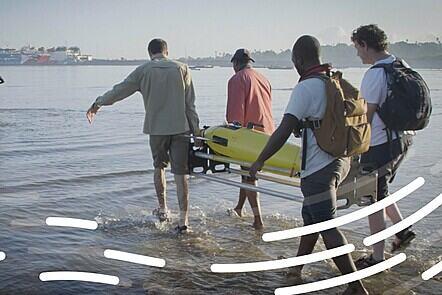
Exploring the advances in marine autonomous robotic systems and their role in observing our 3D oceans, you’ll investigate how these technologies can be deployed to address the global challenges of food security and sustainable use of living marine resources.

What topics will you cover?

  • Introduction to numerical modelling, earth observation satellites and marine robotics and how they are used to address the challenges of sustainable use of living marine resources in a range of case studies in the Western Indian Ocean.
  • The principles behind ocean models and how they can help explain the dynamics of marine ecosystems.
  • How we measure and monitor the oceans using earth observation satellites and how the information they provide can inform sustainable coastal development and marine resource management.
  • Advances in Marine Autonomous Robotic Systems and their role in observing our 3D oceans.
  • The North Kenya Banks fishery and mechanisms behind the upwelling system that makes it so productive.
  • The environmental changes responsible for the collapse of the Chokka squid fishery in South Africa, and how marine technologies can help us to understand the future dynamics of the squid population.
  • Small pelagic fisheries of the Pemba Channel and their importance for food security in Tanzania.
  • The importance of the United Nations Sustainable Development Goals and how evidence-based environmental management can contribute to achieving them.

What will you achieve?
By the end of the course, you‘ll be able to...

  • Explain how we measure and monitor the oceans using numerical models, ocean robots, and earth observation satellites
  • Apply your understanding of how marine technologies are used in order to address the challenges of sustainable use of living marine resources
  • Describe climate change impacts on the marine environment
  • Identify unique features of oceanography, ecosystems and marine economy of the Western Indian Ocean
  • Summarise the foundation pillars of Food Security
  • Reflect on the importance of the United Nations Sustainable Development Goals (SDGs)
  • Discuss how ocean science can contribute to the United Nations Decade of Ocean Science for Sustainable - Development (2021-2030)
  • Explore your interests in ocean science and the marine technologies used to study the ocean

Who is the course for?
This course is designed to be accessible to anyone with an interest in ocean management and conservation, the technology used to study the ocean, and the impact of climate change on the marine environment.
It would particularly appeal to people working within marine-related industries, such as fisheries, in the Western Indian Ocean, and those who study this ocean region.

Go to Class
MOOC List is learner-supported. When you buy through links on our site, we may earn an affiliate commission.

Related Courses

Climate Intelligence: Using Climate Data to Improve Business Decision-Making (FutureLearn) FutureLearn
University of Reading

Climate Intelligence: Using Climate Data to Improve Business Decision-Making (FutureLearn)

Build climate resilience in your business as you learn how climate intelligence helps make decisions that mitigate risks. How exposed is your organisation to climate risk? Climate and weather projections hold the data that businesses need both to evaluate the risk climate change poses and to mitigate that risk. However, interpreting this data can be challenging. On this two-week course, you’ll learn how to identify relevant and reliable climate data for your business and explore how that raw data can be converted into information that connects with the particular operational and financial decisions you face.

Self Paced
2 Weeks
Exploring Our Oceans (FutureLearn) FutureLearn
University of Southampton

Exploring Our Oceans (FutureLearn)

Explore the half of our world covered by deep ocean, and how our lives affect the hidden face of our planet. Discover how you can play a part in the safe keeping of the future of our ocean. What lies in the half of our world covered by water more than two miles deep? How are our everyday lives connected to the ocean depths, and what challenges and opportunities does this previously hidden realm hold for our future?

Nov 21st 2022
4 Weeks
Transforming Your Organisation with the UN SDGs (FutureLearn) FutureLearn
EFQM

Transforming Your Organisation with the UN SDGs (FutureLearn)

Explore the importance of the UN SDGs and learn how to implement them in your organisation to create a brighter future. Discover what the UN SDGs are and why they matter. Sustainability is high on the agenda for many organisations but knowing where to start to make meaningful impacts can be challenging. On this four-week course from the European Foundation for Quality Management (EFQM), you’ll explore the background, importance, and nature of the United Nations Sustainable Development Goals.

May 16th 2022
4 Weeks
Farm to Fork: Sustainable Food Production in a Changing Environment (FutureLearn) FutureLearn
Queen’s University Belfast,EIT Food,EIT,University of Turin

Farm to Fork: Sustainable Food Production in a Changing Environment (FutureLearn)

Understand how food goes from farm to fork: explore food security, supply chains, food production and agriculture. Discover food supply chains from farm to fork. How does food reach our plates? How is the food industry changing? What threats are there to food supply chains? How can we build a sustainable food industry? Get answers to these questions and more with this course that explores food and agriculture in the modern world.

Jan 2nd 2023
4 Weeks
Learning for a Sustainable Future: Live at COP26 (FutureLearn) FutureLearn
University of Edinburgh

Learning for a Sustainable Future: Live at COP26 (FutureLearn)

Explore global issues during COP26 and be part of the call for collective action. What on Earth could be more important? Live at COP26. The 26th UN Climate Change Conference (COP26) is being held in Glasgow, Scotland between 31st October and 12th November 2021. It will bring together heads of state, climate experts and campaigners to agree and accelerate coordinated global action on climate change.

Nov 7th 2022
2 Weeks
Organising for the Sustainable Development Goals (SDGs) (FutureLearn) FutureLearn
Hanken School of Economics

Organising for the Sustainable Development Goals (SDGs) (FutureLearn)

What are the Sustainable Development Goals and how will we achieve them? Learn how you can work towards the United Nations’ SDGs. Learn how to tackle sustainability challenges through the 17 SDGs. The world is facing unprecedented and pressing social and environmental challenges. On this course, you’ll explore the what, why and how of the 17 SDGs and understand what key global challenges remain as we work towards a sustainable and inclusive world.

Jan 20th 2025
5-12 Weeks
Sustainable Cities: Governing Urban Adaptation Under Climate Change (FutureLearn) FutureLearn
University of Groningen,Global Center on Adaptation

Sustainable Cities: Governing Urban Adaptation Under Climate Change (FutureLearn)

Discover expert governance strategies for preparing urban areas to face the challenges posed by climate change. Learn how cities can successfully adapt to environmental change. In this course, you will investigate how governance strategies and policies for making cities more sustainable and resilient in the face of increasing climate risks can be financed and implemented.

Self Paced
3 Weeks
Climate Change and Resilience in Food Systems (FutureLearn) FutureLearn
University of Leeds,Africap

Climate Change and Resilience in Food Systems (FutureLearn)

Learn new research-led strategies designed to mitigate the effects of climate change on agriculture and food systems. Learn about the effects of climate change and how to build resilience in agriculture and food systems. Even small climate changes can have large-scale consequences in agriculture and food systems with devastating effects for the people and their economies. On this course, you will learn strategies designed to mitigate the impact of climate change, develop resilient food systems and create sustainable development in local communities.

Self Paced
2 Weeks
Climate and Energy: An Interdisciplinary Perspective (FutureLearn) FutureLearn
University of Glasgow,CIVIS

Climate and Energy: An Interdisciplinary Perspective (FutureLearn)

Explore climate change issues from an interdisciplinary perspective to find innovative solutions for a better future. Gain interdisciplinary skills for climate change solutions. On this four-week course, you’ll join educators from ten universities on a virtual field trip to a remote Swedish island to gain perspectives on climate and energy from a multitude of disciplines.

Self Paced
4 Weeks
Creating Ethical and Sustainable Cities at the Local Level (FutureLearn) FutureLearn
RMIT University,EIT Community

Creating Ethical and Sustainable Cities at the Local Level (FutureLearn)

See how frameworks for ethical and sustainable cities can be localised, fostering resilient cities for the future. Learn how you can contribute to the sustainable cities of tomorrow. It’s widely accepted that, as we look towards the future, we need to actively create cities that are ethical, sustainable, inclusive, and well-governed. To do this, we need to localise frameworks and principles such as the Sustainable Development Goals (SDGs), the European Green Deal and New European Bauhaus to make tangible differences. Knowing how to start this localisation can be daunting, which is why this course from RMIT is so valuable.

Self Paced
2 Weeks
Understanding Food Supply Chains in a Time of Crisis (FutureLearn) FutureLearn
Queen’s University Belfast,EIT Food,EIT

Understanding Food Supply Chains in a Time of Crisis (FutureLearn)

Learn how agri-food supply chains deal with crises and get practical advice on how you can minimise disruption during COVID-19. Explore contingency plans for ensuring food security during COVID-19 in Europe. Movement restrictions imposed due to the coronavirus are leading to an increase in food stockpiling, and there are concerns the agri-food supply chain won’t keep up with demand.

Jan 2nd 2023
2 Weeks