O Real Paço Mafra: do Magnânimo ao Clemente (UAb)

Offered by Universidade Aberta,
O Real Paço Mafra: do Magnânimo ao Clemente (UAb)

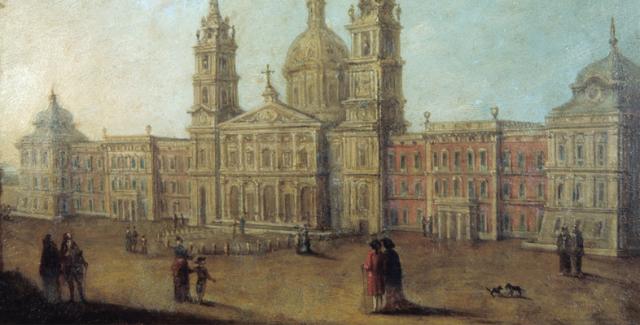
Erguido numa lógica de afirmação do poder real, o Real Paço de Mafra está intimamente ligado à figura de D. João V. Mas a adaptação a novos tempos, a evolução do gosto, o terramoto de 1755 e as campanhas de Napoleão vão determinar a forma como o Paço vai sendo (ou não) habitado ao longo do século XVIII. Outro monarca, D. João VI, deixará também a sua marca neste que era um dos seus Paços favoritos. Conheça neste curso esta e outras dimensões da história do Palácio.

Este curso aberto tem particular relevância para professores e profissionais de turismo, mas despertará certamente o interesse de um público mais alargado, motivado numa atualização ou num aprofundamento de conhecimentos sobre o Paço de Mafra.
A frequência deste curso vai permitir:

  • Conhecer a vida quotidiana num palácio do século XVIII e estabelecer comparações entre situações e modos de vida de diferentes épocas.
  • Reconhecer no monumento de Mafra a permanência de uma estratégia de encenação do poder.
  • Habilitar professores e profissionais de Turismo à condução de uma visita diferente ao Palácio Nacional de Mafra.

Temas:
TEMA 1 | Viver no Paço Real - de D. João V a D. João VI
TEMA 2 | Seguindo a Tradição - um Voto de Sucessão: a Sala dos Camaristas e os Oratórios Sul e Norte
TEMA 3 | Ao Gosto do Tempo - os Temas Mitológicos na Decoração
TEMA 4 | A Exaltação da Nacionalidade e da Família Real
Go to Class
MOOC List is learner-supported. When you buy through links on our site, we may earn an affiliate commission.

Related Courses

Greek and Roman Mythology (Coursera) Coursera
University of Pennsylvania

Greek and Roman Mythology (Coursera)

Myths are traditional stories that have endured over a long time. Some of them have to do with events of great importance, such as the founding of a nation. Others tell the stories of great heroes and heroines and their exploits and courage in the face of adversity. Still others are simple tales about otherwise unremarkable people who get into trouble or do some great deed. What are we to make of all these tales, and why do people seem to like to hear them? This course will focus on the myths of ancient Greece and Rome, as a way of exploring the nature of myth and the function it plays for individuals, societies, and nations. We will also pay some attention to the way the Greeks and Romans themselves understood their own myths.

Oct 19th 2026
5-12 Weeks
Organising an Empire: The Assyrian Way (Coursera) Coursera
Ludwig-Maximilians-Universität München

Organising an Empire: The Assyrian Way (Coursera)

Discover the mighty kingdom of Assyria, which came to be the world’s first great empire three thousand years ago. From the 9th to the 7th centuries BC, during the imperial phase of Assyria’s long history, modern day northern Iraq was the central region of a state reaching from the Mediterranean Sea to the Persian Gulf, and incorporating what is now Iraq, Syria, and Lebanon, as well as half of Israel, and wide parts of south-eastern Turkey, and Western Iran.

Nov 2nd 2026
5-12 Weeks
Applied Public History: Places, People, Stories (Coursera) Coursera
University of London

Applied Public History: Places, People, Stories (Coursera)

This course introduces learners to applied public history: understanding and interpreting the past today, and engaging diverse communities in the practice of making and sharing histories. The course draws on project case studies, expert insights and diverse perspectives to model exciting approaches to researching and sharing the history of places and people. Learners will develop a toolkit to apply in their own practice, by participating in discussion, quizzes, creative activities and mini masterclasses. What kinds of stories can we discover through research into the history of places and people?

Nov 2nd 2026
5-12 Weeks
The Modern and the Postmodern (Part 2) (Coursera) Coursera
Wesleyan University

The Modern and the Postmodern (Part 2) (Coursera)

This course examines how the idea of "the modern" develops at the end of the 18th century in European philosophy and literature, and how being modern (or progressive, or hip) became one of the crucial criteria for understanding and evaluating cultural change. Are we still in modernity, or have we moved beyond the modern to the postmodern?

Nov 2nd 2026
5-12 Weeks
Iniciación a los Jeroglíficos Egipcios (Coursera) Coursera
Universitat Autònoma de Barcelona

Iniciación a los Jeroglíficos Egipcios (Coursera)

¿Te apasiona la historia y la cultura del antiguo Egipto? ¿Sientes fascinación por las lenguas y los sistemas de escritura de las civilizaciones de la Antigüedad? ¿Te atrae la idea de adentrarte en el secreto de los jeroglíficos egipcios y comprender las claves de su lectura e interpretación? ¡Si es así, este es tu curso!

Oct 26th 2026
5-12 Weeks
Reimagining Blackness and Architecture (Coursera) Coursera
The Museum of Modern Art

Reimagining Blackness and Architecture (Coursera)

Architecture structures our daily lives. It shapes our homes, streets, neighborhoods, cities and more. But who gets to create and occupy these spaces? In the United States, a long history of anti-Black racism has created spatial inequalities that are built into the physical environment and erased the stories of Black architects and communities. Reimagining Blackness and Architecture explores the relationship between architecture and Blackness as an identity and a lived experience.

Nov 2nd 2026
5-12 Weeks
Wonders of Ancient Egypt (Coursera) Coursera
University of Pennsylvania

Wonders of Ancient Egypt (Coursera)

Colossal pyramids, imposing temples, golden treasures, enigmatic hieroglyphs, powerful pharaohs, strange gods, and mysterious mummies are features of Ancient Egyptian culture that have fascinated people over the millennia. The Bible refers to its gods, rulers, and pyramids. Neighboring cultures in the ancient Near East and Mediterranean wrote about its god-like kings and its seemingly endless supply of gold. The Greeks and Romans describe aspects of Egypt's culture and history.

Oct 26th 2026
5-12 Weeks
The Ancient Greeks (Coursera) Coursera
Wesleyan University

The Ancient Greeks (Coursera)

This is a survey of ancient Greek history from the Bronze Age to the death of Socrates in 399 BCE. Along with studying the most important events and personalities, we will consider broader issues such as political and cultural values and methods of historical interpretation.

Oct 19th 2026
5-12 Weeks
The Bible's Prehistory, Purpose, and Political Future (Coursera) Coursera
Emory University

The Bible's Prehistory, Purpose, and Political Future (Coursera)

With its walls razed to ground by Babylon’s armies, Jerusalem joined a long line of ancient vanquished cities—from Ur and Nineveh and Persepolis to Babylon itself. While some recovered from the destruction, others did not. But none responded to political catastrophe by fashioning the kind of elaborate and enduring monument to their own downfall that we find in the Bible. Most conquered populations viewed their subjugation as a source of shame. They consigned it to oblivion, opting instead to extol the golden ages of the past. The biblical authors in contrast reacted to loss by composing extensive writings that acknowledge collective failure, reflect deeply upon its causes, and discover thereby a ground for collective hope.

Oct 19th 2026
5-12 Weeks